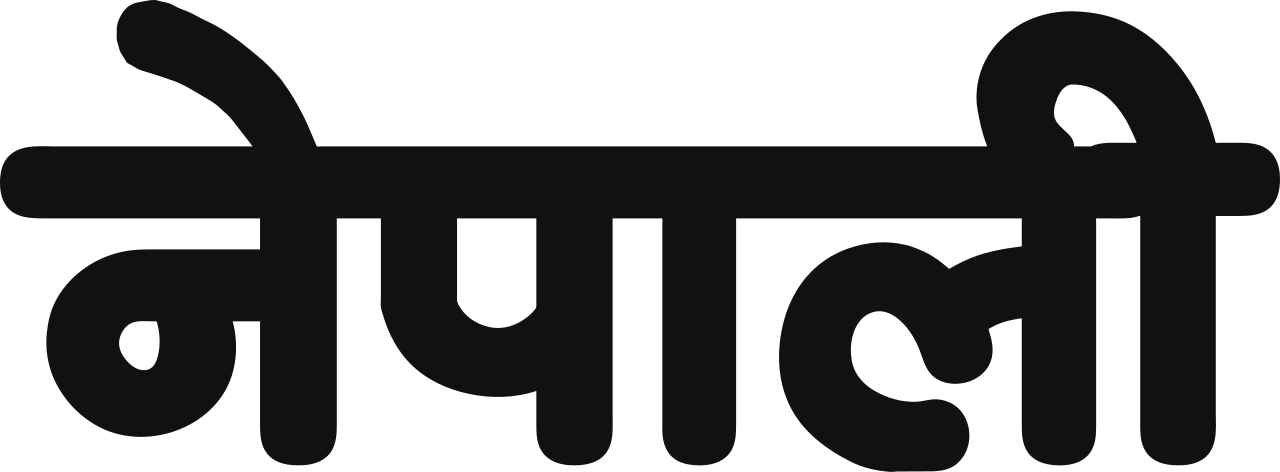

Nepali, known in Bhutan as Lhotsamkha ("language of the southern border"), is an Indo-Aryan language spoken by the Lhotshampa communities of southern Bhutan. It is the only major Indo-European language in a country otherwise dominated by Tibeto-Burman tongues. Bhutanese Nepali is essentially identical to the Nepali spoken in Nepal and the Indian states of Sikkim, West Bengal, and Assam, belonging to the Eastern Pahari branch of the Indo-Aryan language family. Estimates of the number of Nepali speakers in Bhutan vary widely, ranging from 100,000 to over 250,000, depending on the source and the definition of "Lhotshampa" used.[1]
The history of Nepali in Bhutan is inseparable from the broader story of the Lhotshampa — ethnic Nepali settlers who migrated to southern Bhutan from the late nineteenth century onward, clearing forests and establishing communities in the subtropical lowlands. For much of the twentieth century, Nepali was accommodated within Bhutan's education system, with schools in the south operating partly in the Nepali medium. This changed dramatically in the late 1980s, when the government's Driglam Namzha cultural homogenisation policy and the 1985 Citizenship Act targeted Lhotshampa identity, including their language, contributing to the expulsion or flight of approximately 100,000 Lhotshampa as refugees.[2]
The suppression of Nepali in Bhutan represents one of the most politically charged language policy episodes in South Asian history. While the Bhutanese government framed its policies as necessary for national unity and cultural preservation, critics and human rights organisations have characterised the treatment of the Nepali language as part of a broader campaign of ethnic cleansing against the Lhotshampa. Today, Nepali remains spoken in southern Bhutan despite decades of marginalisation, and it is the primary language of the large Bhutanese refugee diaspora resettled in countries including the United States, Canada, Australia, and the United Kingdom.[3]
Classification
Nepali belongs to the Eastern Pahari subgroup of the Indo-Aryan branch of the Indo-European language family. It is closely related to Hindi, Maithili, and other languages of the northern Indian plains, and is mutually intelligible to a significant degree with Hindi-Urdu. Within Bhutan, Nepali stands apart from all other languages of the country, which belong to the Tibeto-Burman family. This linguistic distinctiveness has been both a marker of Lhotshampa identity and a source of political tension, as it underscores the ethnic and cultural differences between the Lhotshampa and the Ngalop-Sharchop majority.[4]
Bhutanese Nepali does not constitute a distinct dialect separate from Nepali as spoken in Nepal. The language was brought to Bhutan by migrants from eastern Nepal and has maintained close contact with Nepali across the border. Some lexical borrowings from Dzongkha and from Bhutanese administrative terminology have entered the speech of long-established Lhotshampa communities, but these represent a thin overlay on an essentially standard Nepali base.[5]
History
Nepali-speaking settlement in southern Bhutan began in earnest in the late nineteenth century, when the Bhutanese government encouraged migration from Nepal and Darjeeling to cultivate the underpopulated subtropical lowlands. These settlers, who came to be known as Lhotshampa, brought their language, Hindu religious practices, and Nepali cultural traditions with them. By the mid-twentieth century, Nepali speakers constituted a substantial minority — and possibly a plurality — of Bhutan's population, concentrated in the southern dzongkhags of Samtse, Chukha, Sarpang, Tsirang, Dagana, and Samdrup Jongkhar.[6]
The third king, Jigme Dorji Wangchuck, pursued a relatively inclusive approach, granting citizenship to long-established Lhotshampa families and including Nepali in the national education system. Schools in the south taught in Nepali, and Nepali-language teachers were recruited from Nepal and India. The fourth king, Jigme Singye Wangchuck, initially continued this approach but shifted toward cultural homogenisation in the late 1980s, driven by concerns about the growing demographic and political weight of the Lhotshampa population.[7]
In 1989, the government removed Nepali as a subject from the school curriculum in southern Bhutan and replaced Nepali-medium instruction with Dzongkha. Nepali-language teachers, many of them ethnic Nepali, were reassigned or dismissed. The simultaneous enforcement of Driglam Namzha — which mandated traditional Ngalop dress and cultural norms — was perceived by the Lhotshampa as an assault on their cultural identity, of which language was a central component. The resulting political tensions, protests, and government crackdowns led to the Bhutanese refugee crisis of the early 1990s, in which approximately one-sixth of Bhutan's population was expelled or fled the country.[8]
Writing System
Nepali is written in the Devanagari script, the same script used for Hindi, Sanskrit, and Marathi. This is the only script in common use in Bhutan that derives from the Brahmic tradition of the Indian subcontinent rather than from the Tibetan script family. In southern Bhutan, Devanagari was widely used in schools, religious contexts, and community life before the language policy changes of 1989. Today, Devanagari literacy persists among older Lhotshampa and in the diaspora, where Nepali-language newspapers, websites, and social media maintain a vibrant written tradition.[9]
Status and Language Policy
The current status of Nepali in Bhutan is ambiguous. The Constitution of Bhutan (2008) recognises Dzongkha as the sole national language and makes no mention of Nepali or any other minority language. Nepali is not taught in Bhutanese schools, is not used in government communications, and receives no support from the Dzongkha Development Commission or any other state institution. Bhutan Broadcasting Service provides some Nepali-language programming, but its scope is limited compared to Dzongkha and English content.[10]
Human rights organisations, including Amnesty International and Human Rights Watch, have documented the suppression of Nepali in Bhutan as part of a broader pattern of discrimination against the Lhotshampa. The removal of Nepali from schools has been characterised as a deliberate effort to erase Lhotshampa cultural identity and to discourage the continued presence of Nepali-speaking populations in the country. The Bhutanese government has countered that national unity requires a common language and that Dzongkha serves this unifying function.[11]
Despite decades of marginalisation, Nepali continues to be spoken in daily life in southern Bhutan. The Lhotshampa who remained in the country — estimated at several hundred thousand — maintain their language within families and communities, even as they function in Dzongkha and English in official and educational settings. The language shows no signs of disappearing from southern Bhutan, though its transmission to younger generations is complicated by the absence of school instruction and written media.[12]
Geographic Distribution
Within Bhutan, Nepali is spoken primarily in the southern dzongkhags: Samtse, Chukha, Dagana, Tsirang, Sarpang, and parts of Samdrup Jongkhar, Pemagatshel, and Zhemgang. The southern belt of Bhutan, which borders the Indian states of West Bengal, Assam, and Arunachal Pradesh, has a subtropical climate and topography more similar to the Nepali Terai than to the alpine valleys of central and western Bhutan, and the Lhotshampa communities there maintain cultural and linguistic ties with Nepali-speaking populations across the border.[13]
Outside Bhutan, the Bhutanese refugee diaspora — numbering approximately 100,000 people resettled since 2008 through the UNHCR Third Country Resettlement Programme — maintains Nepali as a community language. Major resettlement cities in the United States (Columbus, Ohio; Pittsburgh; Atlanta; and others), Canada (Calgary, Edmonton), and Australia (Adelaide, Sydney) host active Nepali-speaking Bhutanese communities with cultural organisations, media outlets, and language transmission programmes.[14]
References
- "Nepali language." Wikipedia.
- "Bhutanese refugees." Wikipedia.
- "Lhotshampa." Wikipedia.
- "Nepali language." Wikipedia.
- "Nepali." Ethnologue.
- "Lhotshampa." Wikipedia.
- "Bhutan — Languages." Country Studies, Library of Congress.
- "Bhutanese refugees." Wikipedia.
- "Nepali language." Wikipedia.
- "Bhutan Broadcasting Service." Wikipedia.
- "Last Hope: The Need for Durable Solutions for Bhutanese Refugees in Nepal and India." Human Rights Watch, 2007.
- "Lhotshampa." Wikipedia.
- "Lhotshampa." Wikipedia.
- "Bhutanese refugees." Wikipedia.
Related articles
Know something about this topic? Edit this article or . Anonymous contributions welcome — no account required.