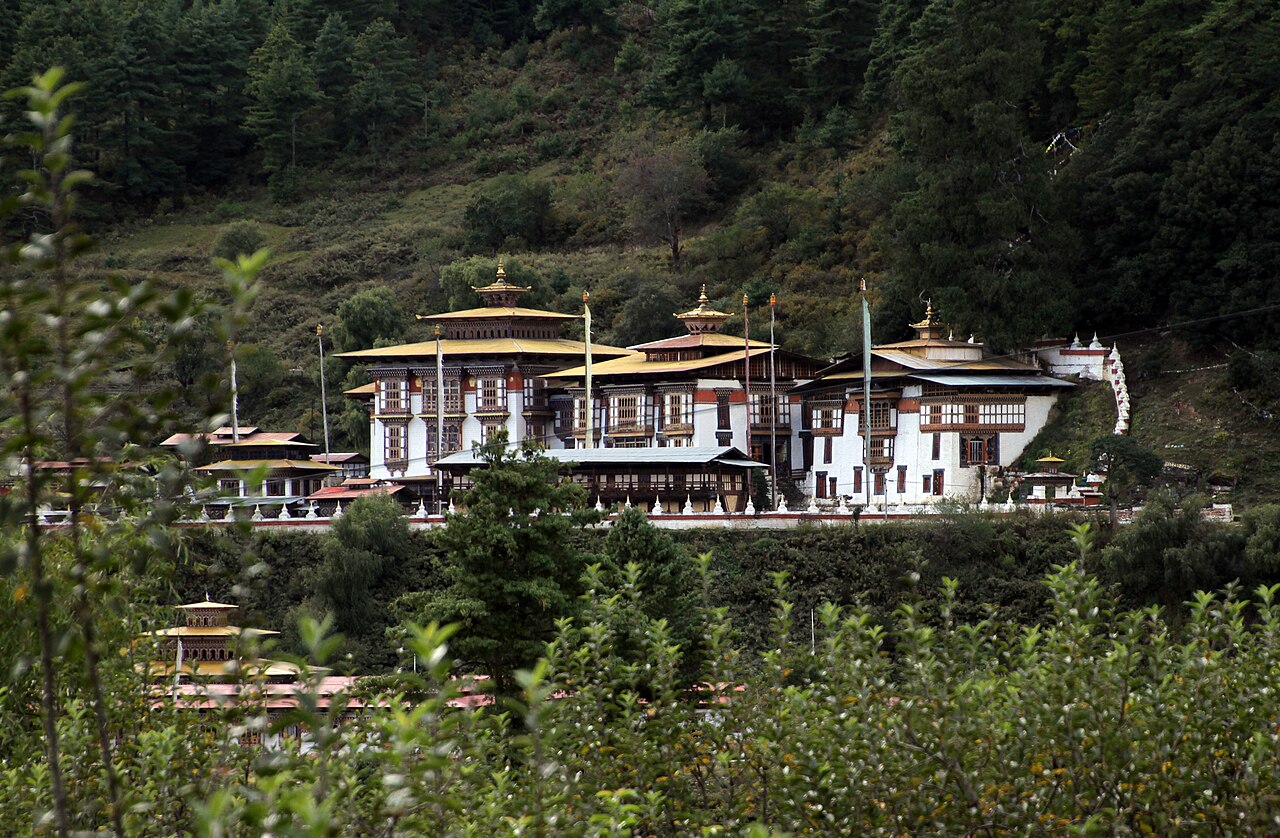

Kurjey Lhakhang (Dzongkha: སྐུ་རྗེས་ལྷ་ཁང་), meaning "Temple of the Body Imprint," is one of the most sacred temple complexes in Bhutan. Located on the bank of the Chamkhar River in the Choekhor Valley of Bumthang District, the complex derives its name from the Tibetan ku (body) and jey (imprint) — a reference to the impression of Guru Rinpoche's body said to be preserved in a rock within the oldest of the three temples that comprise the site.[1]
The temple complex is intimately connected to the foundational narrative of Buddhism in Bhutan. According to tradition, Guru Rinpoche (Padmasambhava) visited the Bumthang Valley in the eighth century at the invitation of the local ruler Sindhu Raja, who had fallen gravely ill. Guru Rinpoche meditated in a cave at the site, subdued a hostile local deity, and left the imprint of his body in the cave rock. The first temple was built around this cave to enshrine the imprint, establishing one of the holiest pilgrimage sites in the country.[2]
Kurjey Lhakhang also holds significance as one of the royal burial grounds of the Wangchuck dynasty. The cremation sites of the first three kings of Bhutan are located within the complex's extensive grounds, surrounded by 108 chortens (stupas) that form a protective boundary around the sacred precinct. The combination of deep historical resonance, royal associations, and the physical presence of Guru Rinpoche's body imprint makes Kurjey one of the most revered sites in Bhutanese Buddhism.[3]
History
The story of Kurjey Lhakhang begins with the arrival of Guru Rinpoche in the Bumthang Valley, traditionally dated to approximately 746 CE. According to Bhutanese chronicles, Sindhu Raja (also known as Sendha Gyab), an Indian king who had established dominion over the Bumthang region, fell deathly ill after his guardian deity, Shelging Kharpo, was offended by a rival deity named Guru Rinpoche was invited to Bumthang to intervene. He meditated in a cave at the site of present-day Kurjey, transformed himself into the wrathful deity Dorji Drolö, and subdued the hostile deity, converting it into a protector of Buddhism. During his meditation, his body pressed into the rock of the cave, leaving the imprint that gives the temple its name.[4]
The first temple (Guru Lhakhang) was built around the meditation cave, though the precise date of its original construction is uncertain. The structure as it exists today dates substantially to a reconstruction by Minjur Tenpa, the third Desi (secular ruler) of Bhutan, in 1652. The cave containing the body imprint is housed within the innermost sanctum of this temple and remains accessible to pilgrims.[5]
The second temple (Sampa Lhundrup Lhakhang) was built in 1900 by Ugyen Wangchuck, who would become the first king of Bhutan in 1907. This temple is the largest of the three and reflects the political consolidation of the Wangchuck family in the Bumthang region during the late nineteenth century. Its construction demonstrated Ugyen Wangchuck's piety and his connection to the sacred landscape of Bumthang, his ancestral homeland.[6]
The third temple was commissioned in 1990 by Ashi Kesang Choden Wangchuck, the queen grandmother of the fourth king. This newest addition houses a large copper statue of Guru Rinpoche, one of the finest modern religious sculptures in Bhutan. The three temples together span more than a millennium of Bhutanese religious and political history.[7]
Architecture
The three temples of Kurjey are arranged side by side, facing south toward the Chamkhar River. Each reflects the architectural style of its period of construction while maintaining the essential elements of Bhutanese temple design: whitewashed stone and rammed-earth walls, elaborately carved and painted wooden elements, and gilded roof ornaments.
The first temple, the oldest, is built directly around the cave containing Guru Rinpoche's body imprint. The cave itself forms the inner sanctum, with the rock bearing the imprint visible behind a protective grille. The chapel contains a statue of Guru Rinpoche in meditation posture and wall paintings depicting the eight manifestations of Guru Rinpoche. The atmosphere within this temple is particularly charged with devotional intensity, as pilgrims press their foreheads against the rock in emulation of the guru's ancient meditation.[8]
The second temple is a large, three-storey structure housing a thousand small images of Guru Rinpoche arranged along the interior walls, surrounding a central altar. The ground floor serves as the main prayer hall, while upper floors contain additional chapels and images. The third temple, the most recent, is notable for its monumental copper statue of Guru Rinpoche, approximately eight metres in height, which dominates the interior space.[9]
The entire compound is encircled by 108 white chortens, forming a protective sacred boundary. A large cypress tree within the grounds is said to have grown from Guru Rinpoche's walking staff, planted when he first arrived at the site. The tree is considered sacred and is draped with prayer flags.[10]
Religious Significance
Kurjey Lhakhang is one of the most sacred sites in Bhutan, rivalled only by Taktsang (Tiger's Nest) and Kyichu Lhakhang in terms of its spiritual importance. The body imprint of Guru Rinpoche is considered a direct physical relic of the master who brought Buddhism to Bhutan, making it an object of intense veneration. Pilgrims visit to prostrate before the imprint, make offerings, and accumulate spiritual merit.[11]
The site's function as a royal burial ground adds a further dimension to its significance. The cremation sites of the first king, Ugyen Wangchuck (d. 1926); the second king, Jigme Wangchuck (d. 1952); and the third king, Jigme Dorji Wangchuck (d. 1972), are located within the compound. The choice of Kurjey as a royal burial ground underscores the deep connection between the Wangchuck dynasty and the sacred geography of Bumthang, and between temporal authority and spiritual lineage in Bhutanese culture.[12]
Festivals
The Kurjey Tshechu is held annually on the tenth day of the fourth Bhutanese month (approximately June). The festival features sacred mask dances performed by monks in the courtyard between the temples. The dances depict episodes from the life of Guru Rinpoche, including his subjugation of local deities and his various manifestations. A highlight is the unfurling of a large thongdrel (religious silk applique banner) at dawn, which is believed to grant liberation through sight (thong = see, drel = liberation) to all who view it.[13]
Visiting
Kurjey Lhakhang is located approximately five kilometres north of Jakar, the administrative centre of Bumthang District, on the opposite bank of the Chamkhar River. The temple is accessible by a short drive and a pedestrian bridge. Visitors may enter the compound and visit the outer areas of the temples, though access to the cave containing the body imprint may be restricted during certain periods. The site is often visited in conjunction with nearby Jambay Lhakhang and Tamshing Lhakhang, forming a triangulation of the Choekhor Valley's most important sacred sites. As with all Bhutanese temples, visitors are expected to dress modestly and remove shoes before entering temple interiors. Bumthang is accessible from Thimphu by road or domestic flight.[14]
References
- "Kurjey Lhakhang." Wikipedia.
- "Kurjey Lhakhang." Wikipedia.
- "Kurjey Lhakhang." Wikipedia.
- "Padmasambhava." Wikipedia.
- "Kurjey Lhakhang." Wikipedia.
- "Kurjey Lhakhang." Wikipedia.
- "Kurjey Lhakhang." Wikipedia.
- "Kurjey Lhakhang." Wikipedia.
- "Kurjey Lhakhang." Wikipedia.
- "Kurjey Lhakhang." Wikipedia.
- "Kurjey Lhakhang." Wikipedia.
- "Kurjey Lhakhang." Wikipedia.
- "Kurjey Tshechu." Wikipedia.
- "Kurjey Lhakhang." Wikipedia.
Related articles
Know something about this topic? Edit this article or . Anonymous contributions welcome — no account required.