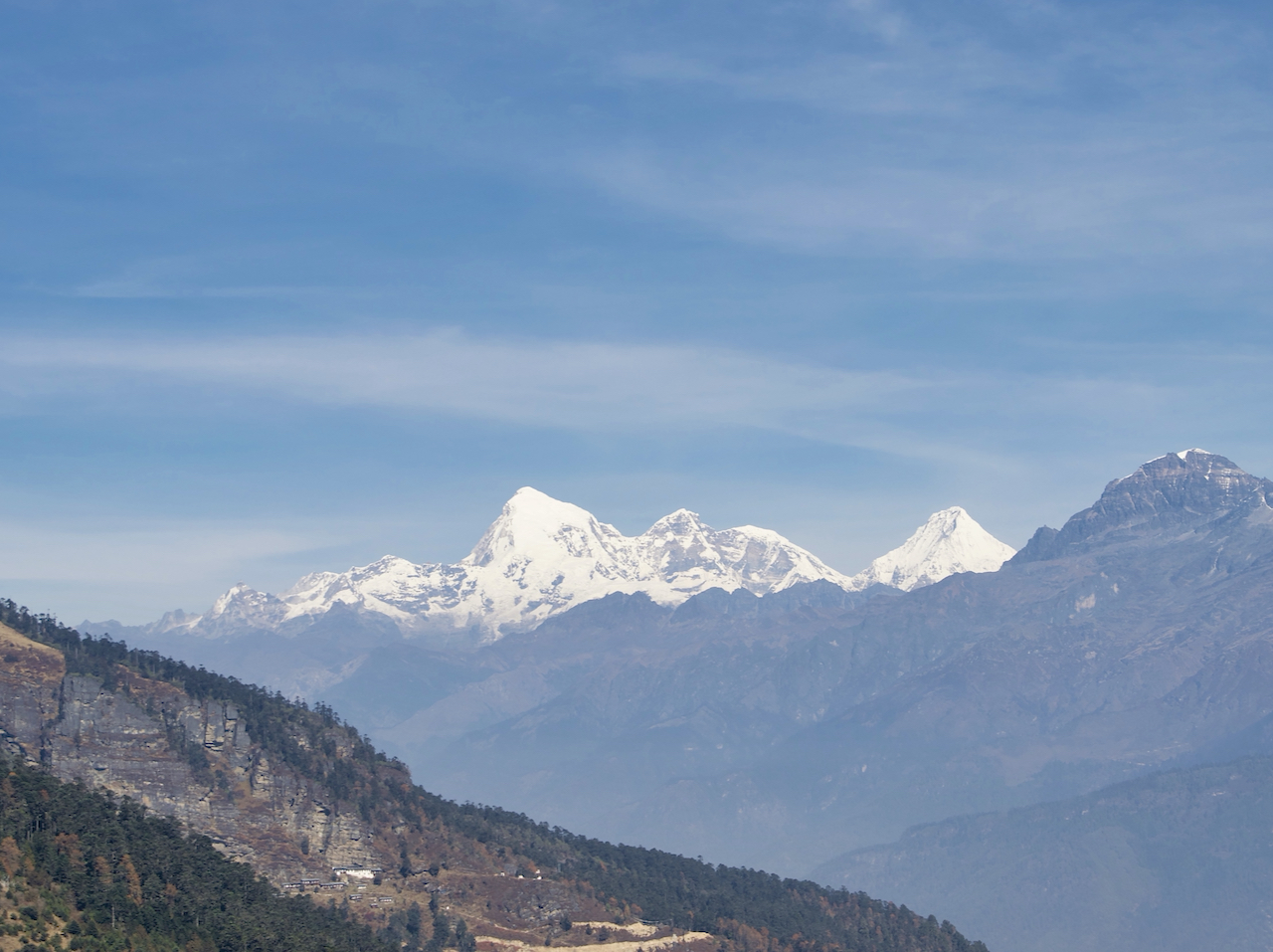

Jomolhari (Dzongkha: ཇོ་མོ་ལྷ་རི, also spelled Chomolhari) is a mountain standing at 7,326 metres (24,035 feet) on the border between Bhutan and China's Tibet Autonomous Region. It is the second-highest peak in Bhutan after Gangkhar Puensum and one of the most visually striking mountains in the Eastern Himalayas, its massive snow-clad pyramid dominating the landscape of northwestern Bhutan. The mountain is located at the head of the Paro Chhu river valley, approximately 50 kilometres north of Paro, and is visible from numerous points across the western Bhutanese highlands on clear days.[1]
Jomolhari holds profound spiritual significance in Bhutanese culture. The mountain is considered the abode of Jomo, a fierce protective goddess who is one of the principal deities in the Bhutanese Buddhist pantheon. The name Jomolhari translates roughly as "Mountain of the Goddess Jomo" or "Bride of the Goddess." This sacred status has shaped both the cultural practices of surrounding communities and the government's approach to managing access to the peak. Like all mountains in Bhutan, Jomolhari is closed to climbing under the country's mountaineering ban, a policy that preserves both its spiritual integrity and its pristine alpine environment.[1]
Despite the climbing prohibition, Jomolhari is intimately connected to Bhutan's trekking tourism. The Jomolhari Trek, a multi-day route through the Jigme Dorji National Park that passes the mountain's base camp at an altitude of approximately 4,080 metres, is widely considered Bhutan's finest and most popular trek. The combination of spectacular mountain scenery, rich wildlife, and encounters with yak-herding communities has made it a signature experience for visitors to the kingdom.[2]
Geography and Geology
Jomolhari is situated in the Great Himalayan range at the point where the borders of Bhutan's Paro and Thimphu districts meet the Tibet Autonomous Region. The mountain rises sharply from the high-altitude valleys of northwestern Bhutan, its south face presenting a dramatic wall of rock, ice, and snow. The peak is flanked by several subsidiary summits, including Jichu Drake (6,989 m), a striking rocky spire that lies to the southeast and is often photographed alongside Jomolhari.[1]
Several glaciers descend from Jomolhari's slopes, feeding the headwaters of the Paro Chhu, one of Bhutan's principal rivers, which flows southward through the Paro Valley and eventually joins the Wang Chhu system. The base camp area, known as Jangothang, is a broad alpine valley at approximately 4,080 metres, ringed by peaks and glacial moraines. The valley contains the ruins of a small dzong (fortress) and offers unobstructed views of Jomolhari's south face and the neighbouring Jichu Drake.[2]
Geologically, Jomolhari is composed of the metamorphic and igneous rocks characteristic of the High Himalayas, formed by the collision of the Indian and Eurasian tectonic plates. The mountain's steep faces and prominent ridgelines reflect the ongoing processes of glacial erosion and tectonic uplift that continue to shape the Himalayan landscape.[1]
Climbing History
Unlike Gangkhar Puensum, Jomolhari has been climbed, though only once from the Bhutanese side. The first ascent was made in 1937 by Spencer Chapman and Pasang Dawa Lama, approaching from the Tibetan side. A Chinese-Tibetan expedition climbed the mountain in 1996 from the north. The only successful ascent from the Bhutanese side occurred in 1970, when a joint Bhutanese-Indian military expedition reached the summit. Since the implementation of Bhutan's mountaineering ban, no further attempts have been permitted from either the Bhutanese or Tibetan side.[1]
Cultural Significance
Jomolhari's cultural importance in Bhutan is immense. The goddess Jomo is regarded as one of the most powerful protector deities of the Bhutanese people, and the mountain is considered her physical manifestation and dwelling place. Offerings and prayers directed toward Jomolhari are a regular feature of religious life in the Paro and Thimphu valleys. The mountain plays a role in Bhutanese origin myths and is referenced in numerous religious texts and oral traditions.[1]
The community of Lingshi, a remote settlement north of the Paro Valley within Jigme Dorji National Park, maintains a particularly close relationship with the mountain. The annual Jomolhari Mountain Festival, established to promote community-based ecotourism in the region, celebrates the cultural traditions of the yak-herding communities who live in Jomolhari's shadow. The festival features traditional music, dance, yak riding, and exhibits on the region's natural heritage, providing an economic alternative for communities whose livelihoods have been affected by changes in traditional pastoral practices.[2]
Trekking
The Jomolhari Trek is a multi-day trekking route that typically takes eight to ten days to complete, traversing the alpine and sub-alpine landscapes of Jigme Dorji National Park. The standard route begins at Drukgyel Dzong in the upper Paro Valley and ascends northward through forests of blue pine, fir, and rhododendron before emerging above the treeline into a landscape of alpine meadows, glacial moraines, and high passes. The trek reaches its climax at Jangothang, the base camp below Jomolhari's south face, where trekkers typically spend one or two nights.[2]
From Jangothang, the route crosses several passes exceeding 4,500 metres, including the Nyile La (4,870 m) and Yeli La (4,950 m), before descending through the Lingshi and Laya valleys. An alternative shorter route, sometimes called the Jomolhari Loop, returns southward from Jangothang via the Bonte La pass and the Soe Valley, completing the trek in five to six days. Along the route, trekkers may encounter blue sheep, takin, marmots, and, on rare occasions, snow leopard tracks. Yak herders' camps provide opportunities for cultural interaction.[1]
The best trekking season runs from late September to November, when clear skies offer the best mountain views, and from April to June, when rhododendrons bloom across the alpine slopes. The trek requires a good level of physical fitness due to the high altitudes involved, and all trekkers must be accompanied by a licensed Bhutanese guide and support crew. Permits are required for entry into Jigme Dorji National Park.[2]
Conservation
Jomolhari lies within Jigme Dorji National Park, Bhutan's second-largest protected area, which covers 4,316 square kilometres of diverse habitats from subtropical forests to permanent snowfields. The park is home to approximately 37 species of mammals, including the snow leopard, blue sheep, Himalayan black bear, red panda, and takin. The mountaineering ban has helped preserve the mountain's immediate environment from the waste and erosion associated with high-altitude climbing expeditions on popular peaks elsewhere in the Himalayas.[1]
Climate change is an increasing concern for the Jomolhari region. The glaciers on the mountain's slopes have shown measurable retreat over recent decades, and glacial lakes in the area are monitored for the risk of outburst floods. The Thorthormi glacial lake, located near Jomolhari, was identified as a significant GLOF risk, and a major project supported by the United Nations Development Programme successfully lowered its water level through controlled drainage between 2008 and 2012. Continued monitoring and adaptation measures remain priorities for the Bhutanese government.[2]
References
Related articles
Know something about this topic? Edit this article or . Anonymous contributions welcome — no account required.