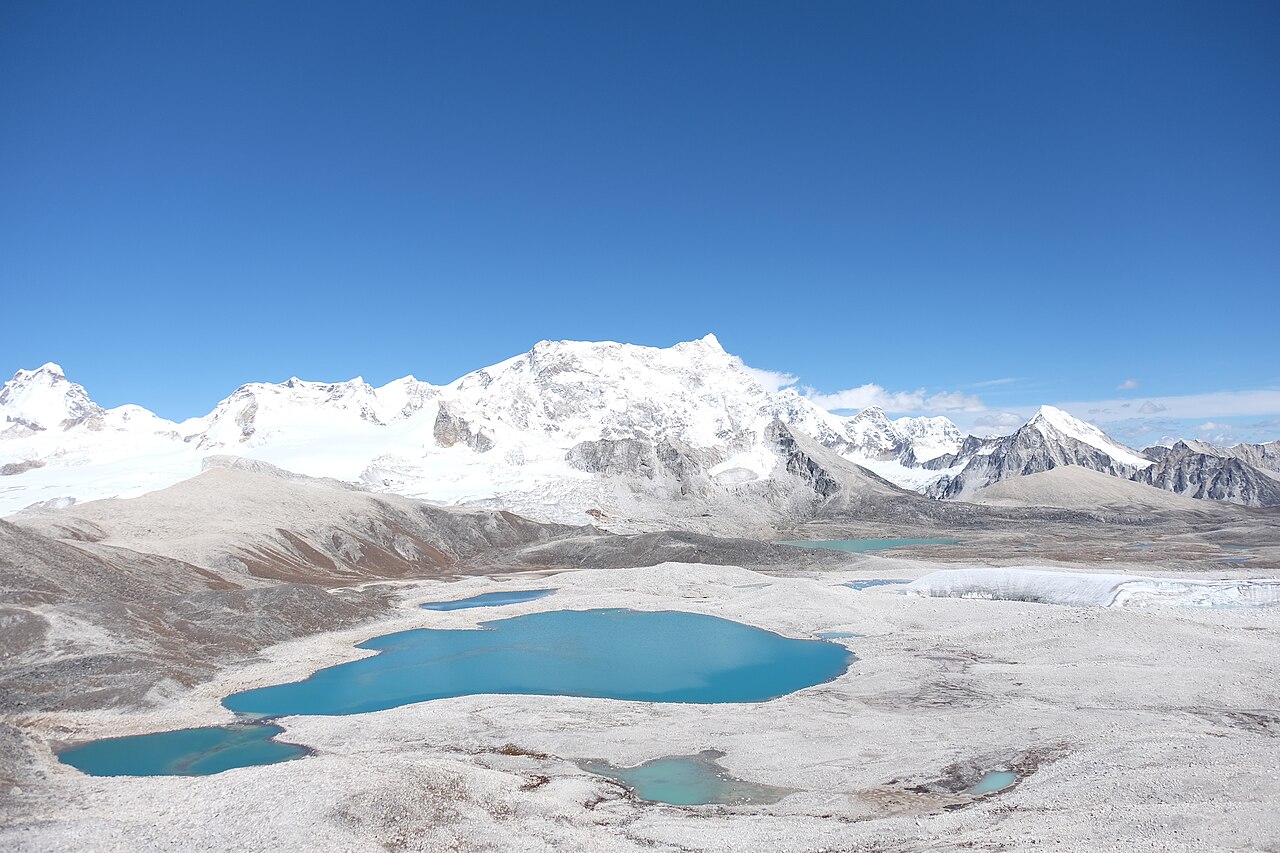

Gangkhar Puensum (Dzongkha: གངས་དཀར་སྤུན་གསུམ, meaning "White Peak of the Three Spiritual Brothers") is the highest mountain in Bhutan and, at 7,570 metres (24,836 feet), the highest unclimbed mountain in the world. The peak is located on the border between Bhutan and China's Tibet Autonomous Region, in the remote northern reaches of the Bumthang and Wangdue Phodrang districts. Despite four known expeditions attempting the summit between 1985 and 1986, all were unsuccessful, and Bhutan's subsequent ban on mountaineering above 6,000 metres has ensured that Gangkhar Puensum remains unconquered.[1]
The mountain's unclimbed status has made it an object of fascination for the international mountaineering community, but it also reflects a deeper truth about Bhutanese culture: the belief that high mountains are the abodes of gods and spirits, and that to climb them is an act of desecration. Bhutan's decision to ban mountaineering was not primarily motivated by safety concerns or logistical challenges, but by a genuine commitment to preserving the spiritual sanctity of its sacred peaks. In this sense, Gangkhar Puensum stands as a symbol of Bhutan's distinctive approach to balancing modernisation with the preservation of cultural and spiritual values.[2]
The exact height and location of Gangkhar Puensum were the subject of considerable confusion for much of the twentieth century, partly because the mountain is located in one of the most remote and least-mapped regions of the Himalayas. Different surveys produced varying measurements, and the mountain was sometimes misidentified on maps. Modern satellite imagery and GPS measurements have established its position and elevation with greater precision, confirming its status as the world's fortieth-highest peak.[1]
Geography and Geology
Gangkhar Puensum is situated in the Great Himalayan range, which forms the spine of northern Bhutan and the natural boundary with Tibet. The mountain rises from a rugged landscape of glaciated valleys, moraines, and high-altitude lakes, surrounded by numerous subsidiary peaks exceeding 6,000 metres. The nearest significant settlement is the town of Lhuntse, which lies several days' trek to the east, while the Bumthang Valley lies to the south. Access to the mountain's base requires a multi-day trek through roadless wilderness.[1]
The mountain's geology is typical of the High Himalayas, composed primarily of metamorphic rocks including gneiss, schist, and marble, products of the ongoing tectonic collision between the Indian and Eurasian plates. Active glaciers cling to the mountain's flanks, feeding rivers that eventually flow into Bhutan's major river systems, including the Mangde Chhu and Chamkhar Chhu. These glaciers represent critical freshwater reserves for downstream communities and ecosystems, making them increasingly significant in the context of climate change and glacial retreat across the Himalayan region.[1]
Climbing History
Bhutan opened a limited number of peaks to mountaineering expeditions in 1983, and Gangkhar Puensum was among the first objectives targeted by international climbing teams. In 1985, a British expedition led by Steven Berry made the first known attempt on the mountain but was turned back by harsh weather and navigational difficulties arising from inaccurate maps. The expedition discovered that the mountain's actual position differed significantly from its marked location on available maps, adding an unexpected challenge to the already formidable undertaking.[1]
A second British expedition in 1986, and an Austrian expedition the same year, also failed to reach the summit, defeated by the mountain's technical difficulty, extreme altitude, and unpredictable weather. A Japanese expedition planned for 1986 was denied permission after local communities objected, citing the mountain's spiritual significance. Following these unsuccessful attempts, the Bhutanese government grew increasingly uneasy about mountaineering activities on its sacred peaks.[2]
In 1994, Bhutan banned all mountaineering above 6,000 metres, a restriction that was formalised and extended in 2003 when the government prohibited climbing on any peak in the country. This ban effectively sealed Gangkhar Puensum's status as the world's highest unclimbed mountain. In 1998 and 1999, a Japanese-Chinese expedition climbed a subsidiary peak, Liankang Kangri (7,535 m), which is connected to Gangkhar Puensum and approached from the Tibetan side, but the main summit of Gangkhar Puensum itself has never been reached.[1]
Cultural Significance
In Bhutanese belief, high mountains are the dwelling places of deities and protective spirits. Gangkhar Puensum, whose name references "three spiritual brothers," is associated with specific deities in the local Buddhist and pre-Buddhist cosmology. The Brokpa and other communities of northern Bhutan regard the mountain with deep reverence, and the idea of humans standing on its summit is considered spiritually inappropriate if not outright sacrilegious.[2]
The mountaineering ban reflects a broader Bhutanese philosophy, articulated through the concept of Gross National Happiness, that economic and recreational activities should not come at the cost of cultural and spiritual values. While neighbouring Nepal generates significant revenue from mountaineering tourism on peaks such as Everest, Bhutan has chosen to forgo this income in favour of preserving the sanctity of its mountains. This decision has been widely praised by cultural and environmental advocates, even as it frustrates mountaineers who dream of standing on the world's highest unclimbed summit.[1]
Conservation
Gangkhar Puensum lies within or adjacent to the Jigme Dorji National Park and the Wangchuck Centennial National Park, two of Bhutan's largest protected areas. The broader region is home to snow leopards, blue sheep, takin (Bhutan's national animal), and a variety of high-altitude bird species. The absence of mountaineering activity has kept the mountain's environment free from the refuse and environmental degradation that afflicts heavily climbed peaks elsewhere in the Himalayas.[1]
Climate change poses a growing threat to the mountain's glaciers and the ecosystems they support. Glacial retreat has accelerated across the Bhutanese Himalayas in recent decades, increasing the risk of glacial lake outburst floods (GLOFs) that can devastate downstream communities and infrastructure. The Bhutanese government, with support from international organisations, has implemented monitoring and early warning systems for glacial lakes in the Gangkhar Puensum region.[2]
References
Related articles
Know something about this topic? Edit this article or . Anonymous contributions welcome — no account required.