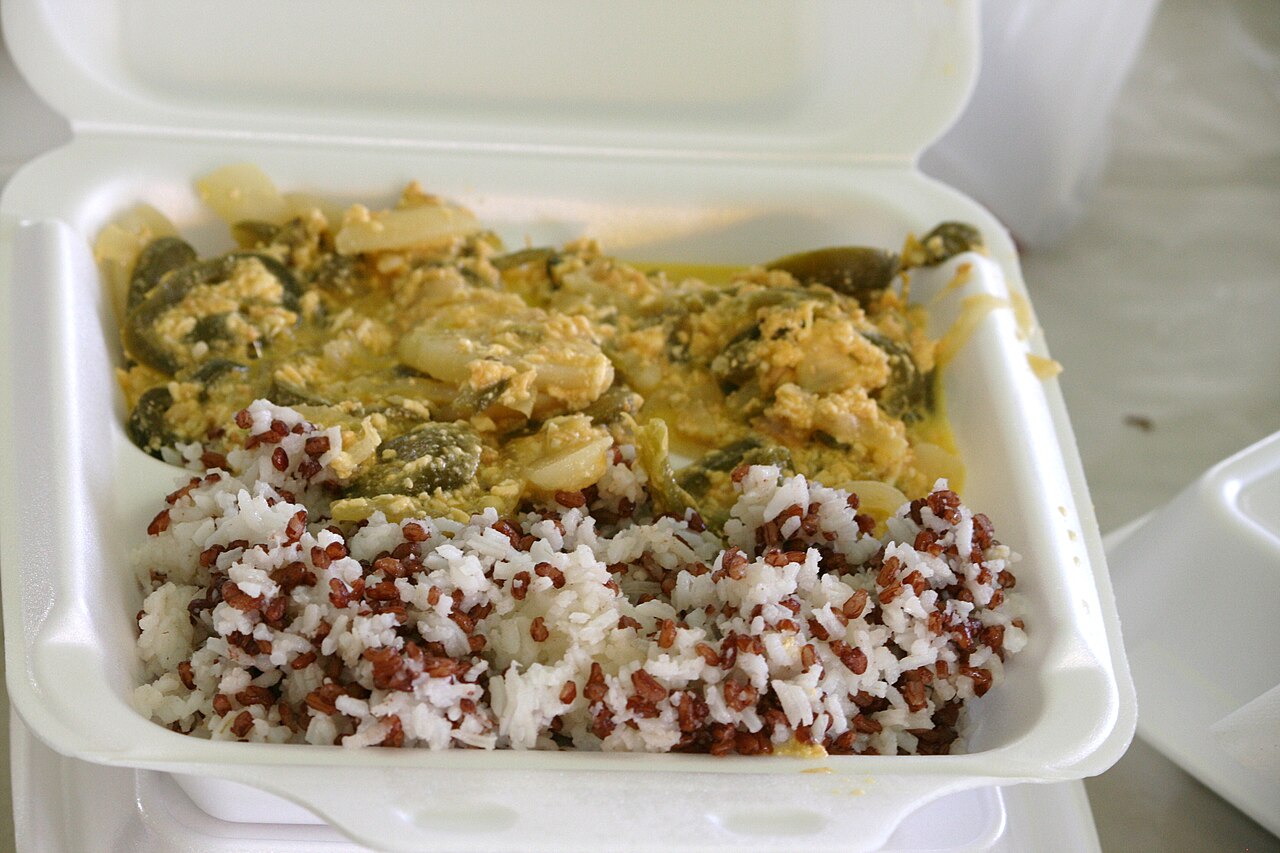

Bhutanese cuisine is the culinary tradition of the Kingdom of Bhutan, a small Himalayan nation whose food culture is shaped by its mountainous terrain, cold climate, Buddhist religious practices, and centuries of relative isolation from neighbouring culinary traditions. Characterized by its heavy reliance on chili peppers, cheese, red rice, and a limited but distinctive palette of locally available ingredients, Bhutanese food is among the spiciest in the world. The national dish, ema datshi — whole chili peppers stewed in a sauce of melted cheese — has become an international symbol of Bhutan's bold and unapologetic approach to flavour.[1]
Unlike many Asian cuisines that use chili as a seasoning or garnish, Bhutanese cooking treats the chili pepper as a primary vegetable. This distinction is fundamental to understanding the cuisine: dishes that appear to be "chili-flavoured" to outsiders are, from the Bhutanese perspective, chili dishes that happen to contain other ingredients. This intensity of spice, combined with a relatively limited ingredient base dictated by geography and climate, gives Bhutanese cuisine a character that is immediately recognizable and unlike any of its regional neighbours.[2]
Bhutanese food is traditionally simple in preparation but deeply satisfying, centered on the interplay between fiery chili heat, the creamy richness of cheese and butter, the earthy nuttiness of red rice, and the aromatic depth of garlic, ginger, and Sichuan pepper. The cuisine reflects a society that has historically been agrarian, Buddhist, and self-sufficient, producing food from what the land provides rather than importing exotic ingredients.
Staple Foods
The foundation of the Bhutanese diet is red rice, a semi-milled, nutty-flavoured grain cultivated in the high-altitude valleys of western and central Bhutan. Rice is served at every meal, typically in generous portions that form the caloric backbone of the diet. In eastern Bhutan, where rice cultivation is less feasible, buckwheat and maize play a similar role, prepared as noodles, pancakes, or porridge.[3]
Chili peppers are the second essential staple. Bhutanese consume an estimated 250 grams or more of fresh chili per person per week, and chilies appear in virtually every dish. Both fresh green and dried red varieties are used extensively, and the condiment ezay — a raw chili relish — accompanies every meal.
Cheese, known as datshi, is the third pillar. Made from yak milk or cow milk, Bhutanese cheese comes in soft fresh forms and hard dried forms (churpi). Cheese is used both as an ingredient in cooked dishes and as a standalone snack, and it provides essential fat and protein in a diet that is relatively low in meat for many households.
Signature Dishes
Bhutanese cuisine features a repertoire of dishes that, while not vast, are deeply satisfying and culturally significant:
- Ema datshi — the national dish, consisting of large chili peppers (either fresh green or dried red) cooked in a rich sauce of cheese, butter, and sometimes tomato. Variants include kewa datshi (potatoes with cheese) and shamu datshi (mushrooms with cheese).
- Phaksha paa — sliced pork cooked with dried red chilies, radish, and sometimes spinach or turnip greens. Pork is the most commonly consumed meat in Bhutan.
- Jasha maru — a spicy chicken stew made with tomatoes, onions, garlic, ginger, and chilies, sometimes called Bhutanese chicken curry.
- Shakam paa — dried beef (or yak meat) cooked with dried chilies, radish, and cheese. The drying of meat is an important preservation technique in a country where refrigeration was historically unavailable.
- Sikam paa — dried pork belly strips, typically stir-fried with dried chilies and sometimes cheese.
- Hoentoe — buckwheat dumplings filled with turnip greens, cheese, and spices, a specialty of the Haa Valley in western Bhutan.
- Momos — steamed or fried dumplings filled with meat or vegetables, adopted from Tibetan cuisine and widely popular across Bhutan.
- Puta — buckwheat noodles, a staple of the Bumthang region in central Bhutan.
Meat and Buddhism
Bhutan's relationship with meat is complex. As a predominantly Buddhist country, Bhutan recognizes the religious ideal of ahimsa (non-violence), and many devout Buddhists refrain from eating meat, particularly on auspicious days and during religious observances. However, Bhutan is not a vegetarian society. Pork, beef, yak meat, and chicken are all consumed, though the slaughter of animals within Bhutan's borders has historically been discouraged and at times restricted.[4]
Much of the meat consumed in Bhutan is imported from India, allowing Bhutanese consumers to eat meat without directly participating in the act of killing. Dried meat — beef, pork, and yak — is a traditional preservation method that predates refrigeration and remains popular for its concentrated flavour and long shelf life. In recent years, a growing vegetarian movement among younger Bhutanese, inspired by Buddhist ethics and global food trends, has led to the emergence of vegetarian restaurants and plant-based versions of traditional dishes.
Dairy
Dairy products are central to Bhutanese cooking. In addition to the soft cheese (datshi) used in ema datshi and related dishes, Bhutanese cuisine features churpi, a hard, dried cheese that can be chewed as a snack or grated into dishes for flavour. Yak butter is used in suja (butter tea) and as a cooking fat, while buttermilk is consumed as a refreshing drink.
The importance of dairy reflects the agro-pastoral nature of Bhutanese society, where cattle and yak herding have historically been as important as crop cultivation. In high-altitude regions where agriculture is limited, dairy products provide essential calories and nutrients.
Beverages
Bhutan's traditional beverages include suja (butter tea), ara (distilled spirit), and chang (fermented grain beer). Suja, made from churned tea, yak butter, and salt, is the national beverage and a cornerstone of Bhutanese hospitality. Ara and chang are the traditional alcoholic drinks, brewed and distilled at home from rice, wheat, millet, or maize.
In modern urban Bhutan, Indian-style sweet milk tea (ngaja) has become increasingly popular, and coffee consumption has grown significantly since the 2010s. Commercially brewed Bhutanese beers — notably Druk 11000 and Red Panda — have captured the urban alcohol market alongside imported brands.
Regional Variations
Bhutanese cuisine varies significantly across the country's diverse geography:
- Western Bhutan (Paro, Thimphu, Haa) — rice-based diet, strong cheese tradition, hoentoe dumplings in Haa, and the most refined versions of ema datshi.
- Central Bhutan (Bumthang, Trongsa) — buckwheat and wheat feature more prominently, with specialties like puta (buckwheat noodles) and bumthang ara (wheat-based spirit).
- Eastern Bhutan (Trashigang, Mongar) — maize and millet are important staples alongside rice, and the cuisine tends to be even spicier than in the west.
- Southern Bhutan — influenced by Nepali and Indian cuisine, with greater use of lentils, pickles, and a wider variety of spices. The Lhotshampa communities of the south have their own distinct culinary traditions.
Meal Structure
A traditional Bhutanese meal is served communally, with all dishes placed in the center of the table or floor mat and shared among diners. The typical meal consists of rice, one or two cooked dishes (vegetable and/or meat), and ezay. Bhutanese eat with their hands in traditional settings, though utensils are used in urban households and restaurants. Meals are generally eaten three times a day, with suja and snacks consumed between meals.[2]
Hospitality demands that guests be offered more food than they can eat, and a good host will insist on multiple servings. Refusing food too quickly is considered impolite, and leaving a small amount on the plate signals that the diner is satisfied.
Modern Developments
Bhutanese cuisine has undergone significant changes since the country began opening to the outside world in the 1960s and 1970s. The introduction of new vegetables (cabbage, cauliflower, carrots), the availability of imported foods, and exposure to Indian, Chinese, and Western cooking through television and tourism have all expanded the Bhutanese culinary repertoire. Urban restaurants in Thimphu now offer Indian, Chinese, Thai, Korean, and Western food alongside traditional Bhutanese dishes.
At the same time, there has been a growing movement to preserve and celebrate traditional Bhutanese food heritage. Food bloggers, cultural organizations, and the tourism industry have all contributed to a renewed appreciation for traditional recipes and ingredients. Bhutanese cuisine has gained international visibility through food media, travel writing, and the global Bhutanese diaspora, introducing ema datshi, red rice, and other Bhutanese specialties to audiences worldwide.
References
Related articles
Know something about this topic? Edit this article or . Anonymous contributions welcome — no account required.