editorial
Taxation, Then Representation
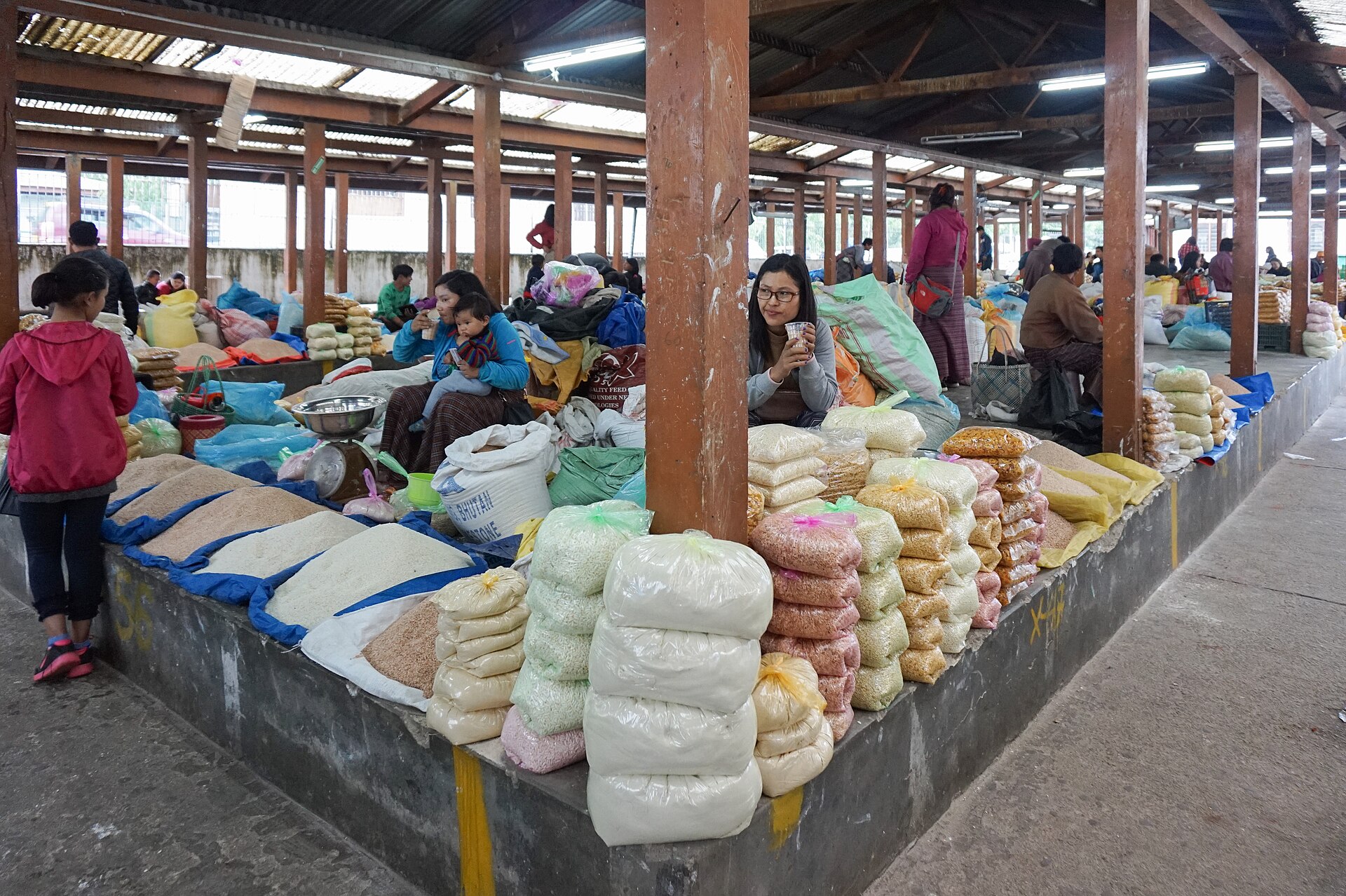
Bhutan's first GST arrived on 1 January 2026 and the anger followed it. An editorial from the BhutanWiki Editorial Team on the double-taxed transition, the exemption U-turn, the quiet shift from taxing income to taxing consumption, the remittance lifeline the budget barely mentions — and why a state that finally needs its people's money owes them a ledger, and answers.

On the first morning of January, milk powder got more expensive in every shop in Bhutan.
It had never been taxed before. Under the old sales tax it was zero-rated — one of the small mercies of a chaotic system. From 1 January 2026, the new Goods and Services Tax reached it: five percent, at the till, on the tin of powder a mother in Mongar stirs into her child's morning tea. And because the shopkeeper had already paid the old sales tax on the stock sitting on his shelf, for months the country paid two taxes on one tin. The Department of Revenue and Customs did not deny this. Its own Sales Tax Commissioner said consumers "will have to bear double taxation for a few months until pre-GST stocks are cleared" — said it the way one reports weather, as though the money in a villager's hand were rain that falls or doesn't.
The anger that has filled Bhutanese Facebook and Reddit since January comes down to arithmetic, and the arithmetic checks out.
We are the BhutanWiki Editorial Team. The encyclopedia we write is neutral by design — every fact double-cited, every claim sourced. This is not that. This is where we put the encyclopedia down and say what we believe. We are Bhutanese. Some of us live in Thimphu and Phuentsholing. Some of us live in Rochester, Sydney, Kathmandu — some of us were driven out, and still keep the old land-tax receipts to prove what we once were. Remember those receipts. They are where this editorial is going.
Be fair first
Give the government its due before anything else, because the case for this tax is real.
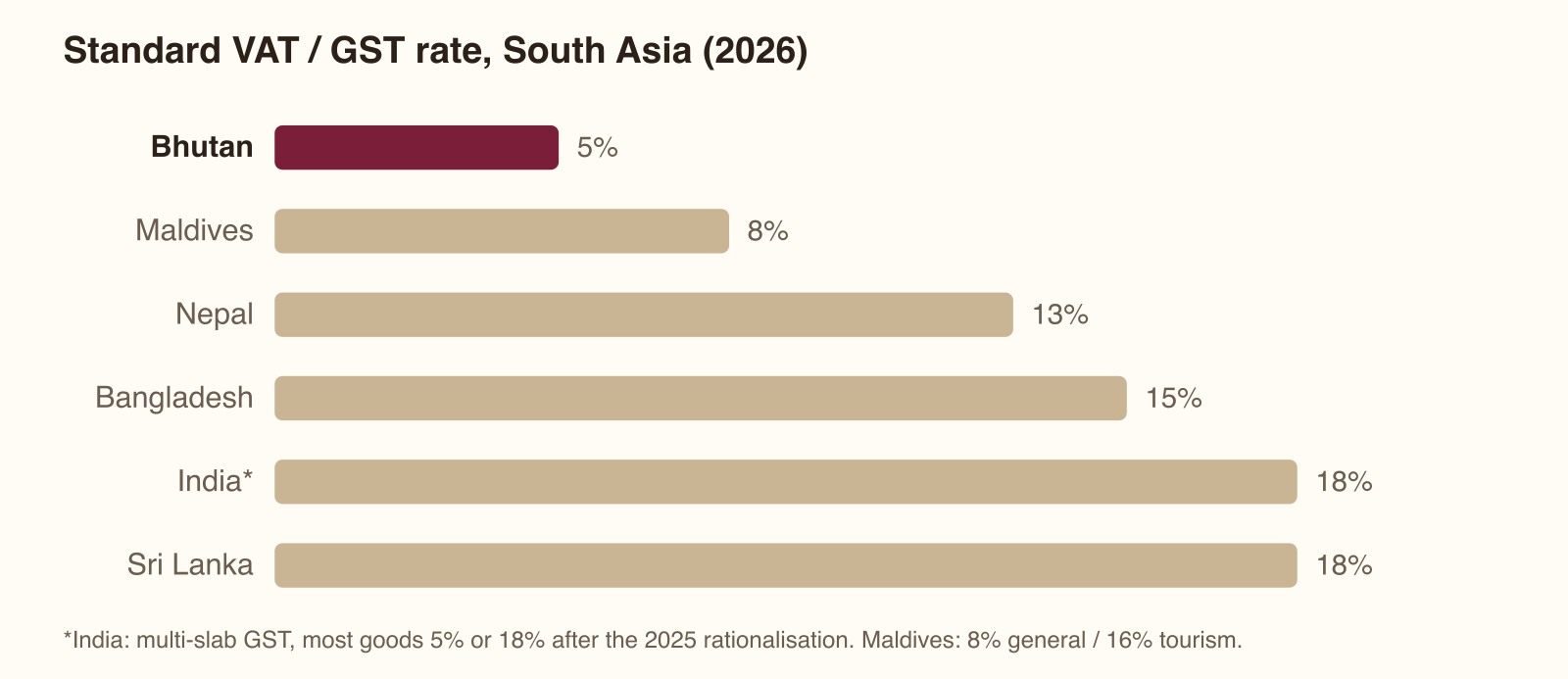
Five percent is the lowest consumption-tax rate in South Asia. Nepal charges 13. Bangladesh charges 15. Sri Lanka charges 18. The Maldives charges tourists 16. The tax Bhutan replaced was worse than the tax it built: the old Bhutan Sales Tax ran anywhere from zero to one hundred percent depending on the item, a bramble of rates that punished at random. Mineral water carried 20 percent; it now carries 5. Furniture carried 20; now 5. Hotels, 10; now 5. Some sixteen hundred items should, on paper, get cheaper.
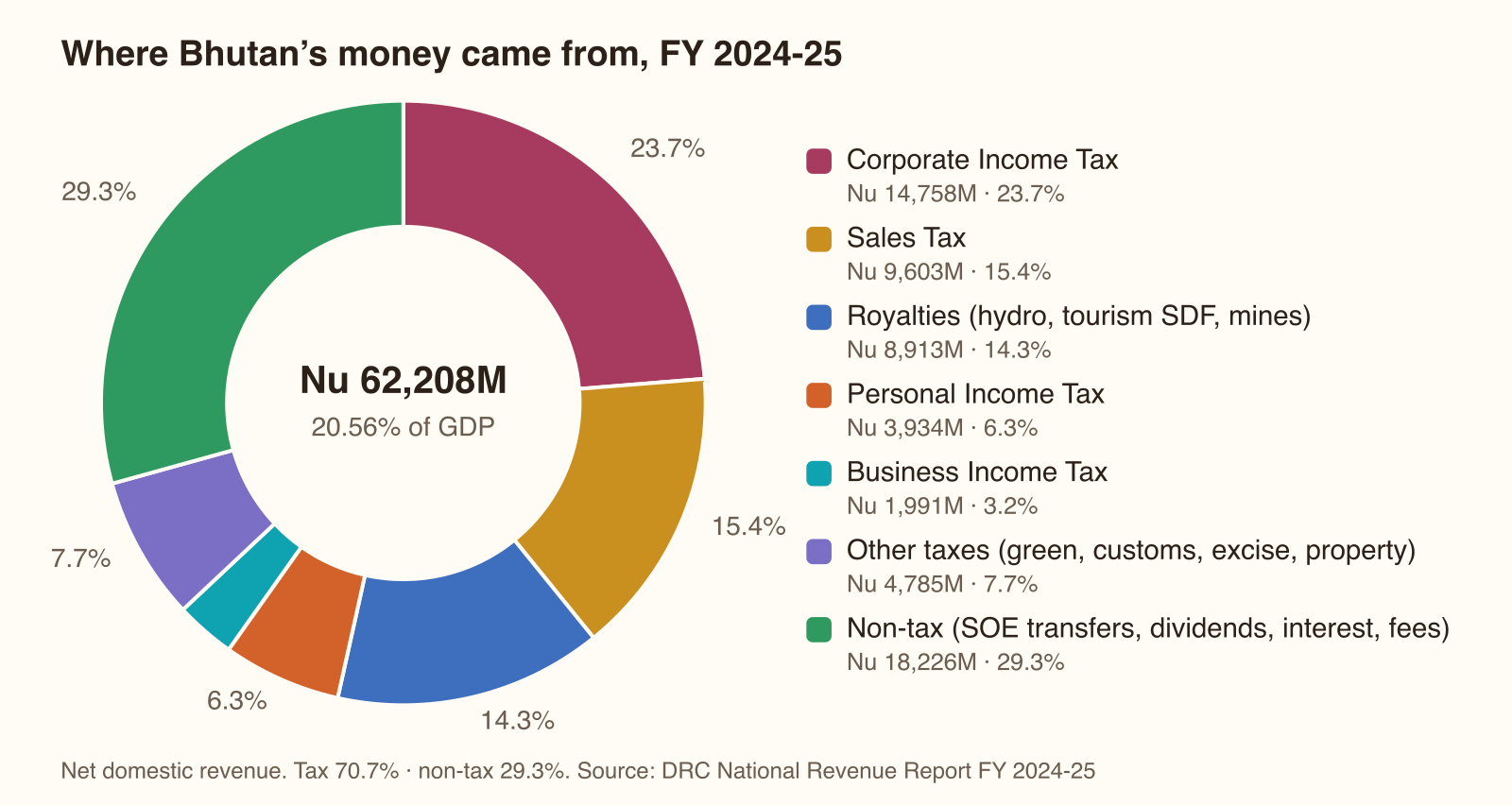
And the deeper truth is harder still: Bhutan has to do this. Look at what actually funds the kingdom. A third of all tax is corporate income tax, and most of that comes from a handful of state-owned giants — one hydropower company alone pays nearly as much as every wage-earner in the country combined. The single largest sales-tax line in the nation is beer: Nu 2,252 million (~USD 26 million), more than all customs duty and excise put together. Customs itself is almost nothing, because four-fifths of our imports come duty-free from India. Personal income tax — the tax that citizens of normal countries grumble about — is barely six percent of revenue. The rest is hydro royalties, dividends from state holding companies, and grants: Nu 30.7 billion (~USD 350 million) of other people's money next year, of which India alone has pledged Rs 22.88 billion. Spending is Nu 135.5 billion (~USD 1.55 billion) against all of it, and the hole left over is six and a half percent of GDP.
And one lifeline the budget documents barely mention has grown fastest of all: the children who left. In 2025, Bhutanese abroad sent home USD 342.9 million (about Nu 30 billion) — more than double the year before, three-quarters of it from Australia. That is roughly a tenth of GDP, about equal to all the foreign grants the government will receive next year, and more than twice what the GST is projected to raise. None of it is taxed; the central bank courts it through Remit Bhutan. The money holding up thousands of households, and a good part of the country's currency reserves, is now earned in Perth and Brisbane — by the exodus the state cannot explain.
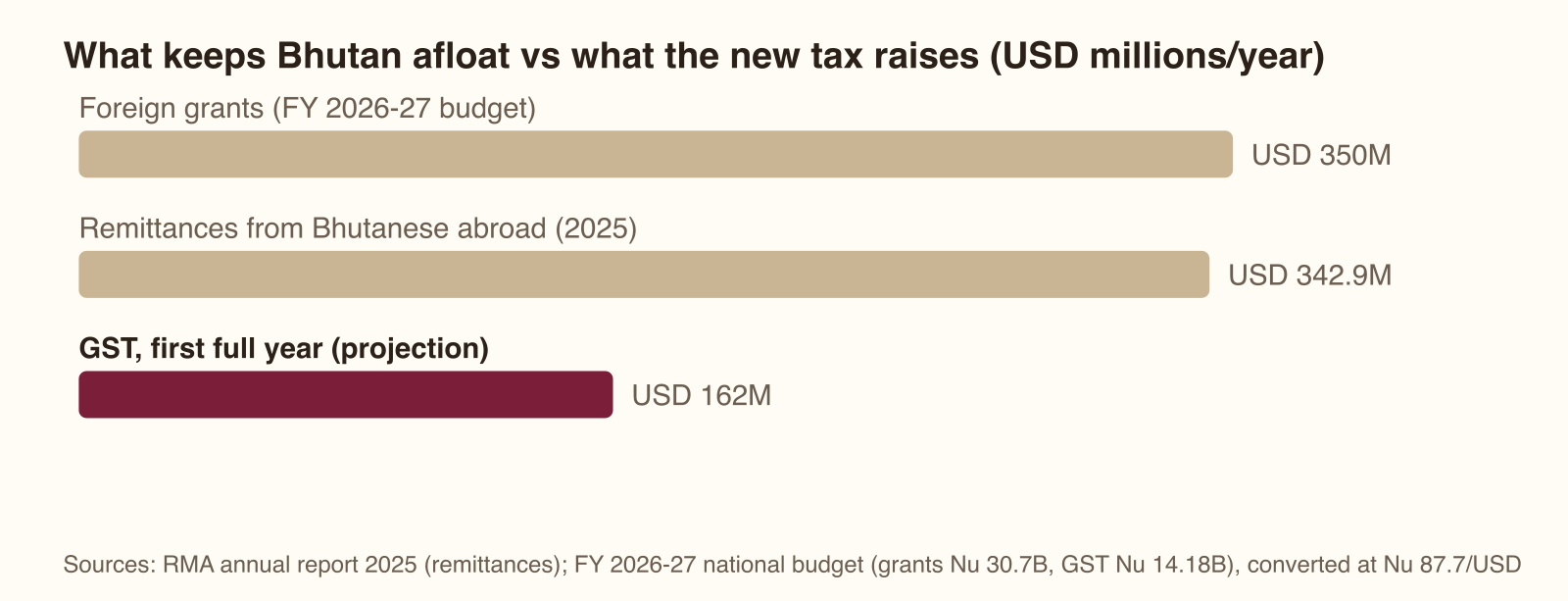
No country can run itself indefinitely on rivers, beer, a neighbour's goodwill and its children's wages. The GST — projected to raise Nu 14.18 billion (~USD 162 million) in its first full year, nearly half again what the old sales tax managed — is the first serious attempt in our history to fund Bhutan with Bhutanese money. On principle we are for it, and we suspect most of the people cursing it on Facebook would be too, if the launch had gone differently.
The bungle
Parliament designed the tax like theologians and launched it like amateurs.
In the summer of 2025, presented with a list of 234 essential items to exempt, lawmakers struck out 225 of them. Nine survived. The theory was elegant — a "clean" tax, no distortions, no loopholes — and the theory got to be elegant because the people who voted for it do not feel five percent on cooking oil. Then January came, and with it everything the elegance had not planned for: the double taxation the DRC shrugged about; hardware shops refused any relief on years of old stock; butter, cheese and eggs climbing because even animal feed now carries the tax — the cow, it turns out, was not consulted about the clean design either.
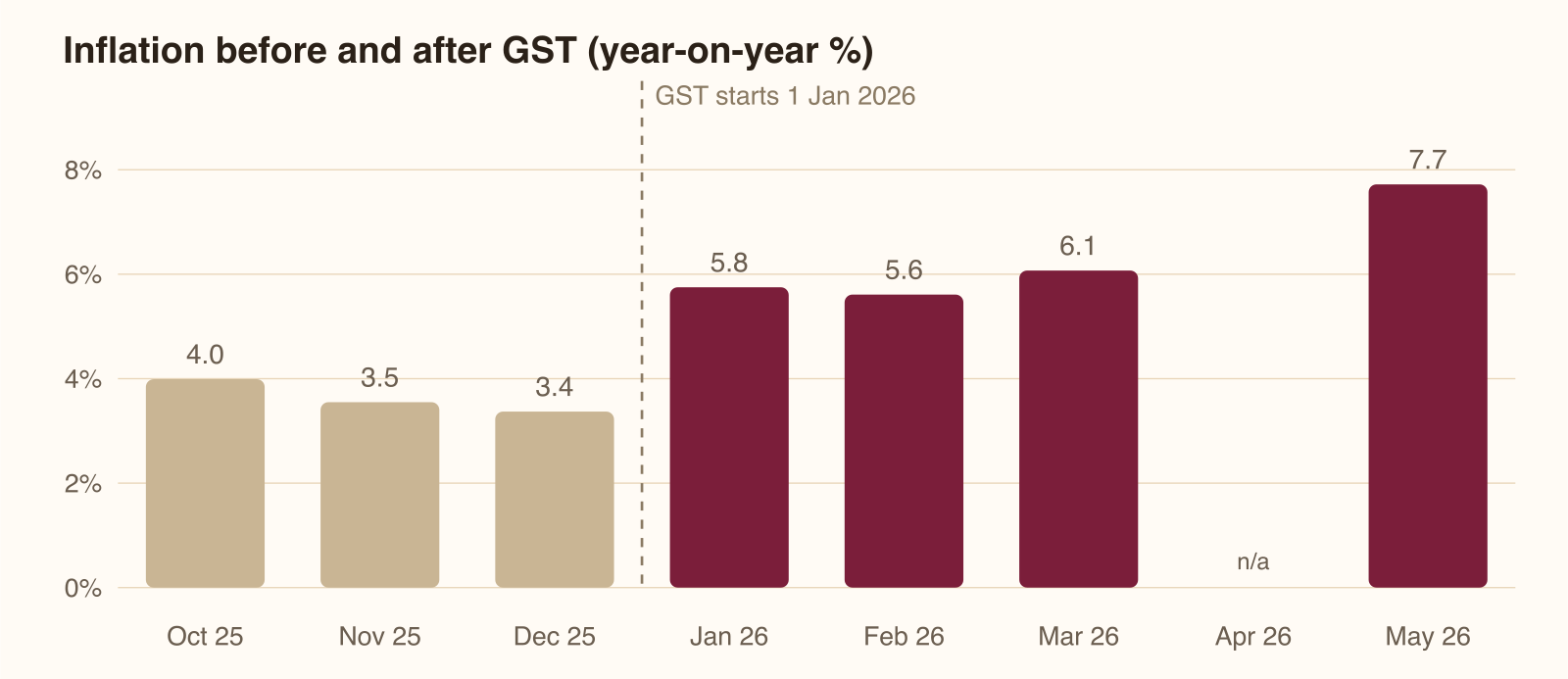
Then the state watched the prices move. Inflation was 3.37 percent in December. By January it was 5.75. By May it was 7.72 — food at 7.8, transport near fifteen. Not all of that is GST; India exports its inflation to us along with everything else. But when a new tax lands on the exact month the graph bends, the villager who cannot eat "multiple economic factors" for dinner is entitled to her conclusion.
And in June, five months into the experiment, the government folded. The GST (Amendment) Bill restored what Parliament had struck out — exemptions tripled from nine items to more than thirty: cooking oils, rice, butter, sanitary napkins, wheelchairs. Royal Assent followed, retroactive to the day the bill was tabled. The tax office now warns, correctly, that every exemption re-opens the door to evasion that the clean design had closed. Both things are true. The purists were right about distortions and wrong about people; the country spent five months and one inflation spike finding out.
The quiet swap
Now put two facts side by side, because almost no one in Thimphu has said them in the same sentence.
In the same reform that taxed milk powder, the corporate income tax was cut from as much as 30 percent to a flat 22 — aligned, we are told, with India. The tax on dividends passing between companies was abolished outright. These are defensible policies, the kind that sound sober in a budget speech. But stand where an ordinary Bhutanese stands and describe what happened: the companies' tax went down, the salaried man's thresholds moved kindly, and the tax that rose — the only one that rose — was the one collected at the till, where a farmer in Zhemgang pays exactly the same rate as a contractor in Thimphu. A consumption tax takes its largest bite from those who consume everything they earn, and in Bhutan that is most of us. Kuensel's own editorial page conceded it: the burden falls disproportionately on low-income households.
This is the third time in four years the state has reached into ordinary pockets and been startled by the reaction. In 2023 it revalued property for the first time in three decades, and a plot in central Thimphu went from Nu 2,100 (~USD 24) a year to over Nu 26,500 (~USD 300) — while a farmer's acre of dry land in Samtse jumped sixty-fold. In 2024 it reopened vehicle imports with taxes so heavy the public called it punishment, then cut them in 2026 and managed to disappoint the buyers and blindside the dealers simultaneously. Now this. Each time it has gone the same way: a quiet decision, an abrupt landing, public fury, then a halfway amendment. A state can be forgiven for asking its people for money. It is harder to forgive that it keeps being surprised by them.
The part nobody says out loud
Here is what we actually think about the anger — and it is not what the Ministry of Finance thinks.
The complaints on Facebook are the sound of something new being born. For as long as anyone can remember, the Bhutanese state has not needed the Bhutanese. The rivers paid, and where the rivers fell short, Delhi and the tourists made up the difference. A government funded that way listens to its funders — which is why every five-year plan is written with one eye on Delhi and one on the donor conference, and neither on the shopkeeper in Trashigang. The citizen was decoration. Beloved decoration, photographed at festivals — but nothing in the state rested on them.
Five percent at every till changes the architecture. When the treasury runs on your money, you stop being decoration and become the foundation. And foundations get to make demands. The reach extends past the border, too: the wages a daughter earns in Perth become groceries in Mongar, and the state clips its five percent at the counter — the exodus it cannot stop has quietly become a tax base it needs.
If you doubt that, look at what just happened. Five months of public fury — on Facebook, on Reddit, in the papers, in the market — took a Money Bill that Parliament had passed in its purest form and forced it into reverse. Nine exemptions became thirty-one, retroactively, with Royal Assent, by June. Nothing in recent Bhutanese history has moved fiscal law that fast, and the people who moved it were the people paying it. The government needed the five percent to keep flowing, and so, for once, it needed the people to stop being angry. The tax that reached into every household handed every household a lever, and in its first five months the country learned how to pull it.
We know how hollow that lever can be when the state chooses not to honour it, and we know it more intimately than anyone in the Ministry. In the early 1990s, one-sixth of this country's people were stripped of citizenship and pushed across the border. Those families had paid the land tax — season after season, in queues at the dzong, stamped and receipted. In resettlement homes in three countries, some of us keep those receipts still: proof that we funded the state that erased us. Bhutan has already run the experiment of taxation without representation, on us, at full scale. We can report the result: the money was kept, and the people were not.
So when we say the GST could be the beginning of something, understand that we do not say it naively. A tax is only the bill for a social contract; whether the goods are ever delivered is a separate question — and that is the question the complaint wave is really asking, even when it comes phrased as the price of eggs.
What we want
We want the transition made honest. The state conceded double taxation and then enforced penalties on the very shopkeepers navigating the chaos it created. Publish the price monitoring. Grant the relief. A government that admits an error owes more than a shrug.
We want the ledger opened. If the treasury is to run on the people's five percent, the people are owed a citizen-readable budget — where every ngultrum of the Nu 14 billion goes, published plainly, not buried in a PDF built for donors. Delhi gets an accounting for its grant. The woman buying milk powder is now a bigger donor than Delhi will ever be. Account to her.
We want the balance defended. A reform that cuts the corporate rate to 22 percent while taxing animal feed has made a choice about who carries the state. Make the subsistence basket's exemption permanent and constitutional in spirit — not a concession extracted by five months of fury, revocable when the fury fades.
And we want the lesson learned, on both sides. To the government: stop treating the anger as a communications problem. You wanted a nation of taxpayers; you have one now, and taxpayers talk back — that comes with the money. To our own people: keep talking back. You just moved a Money Bill. Do not go back to being decoration.
We are the BhutanWiki Editorial Team. We write the encyclopedia. The encyclopedia is neutral. This is not. This is what we believe.
A state that lives on your five percent owes you its ledger. A people who fund the state are owed a state that answers.
References
- National Revenue Report FY 2024-25 — Department of Revenue and Customs, Ministry of Finance
- Bhutanese consumers foot the bill as double taxation bites during GST transition — Kuensel via Asia News Network, 12 January 2026
- Bhutan’s GST debate intensifies as inflation rises — Kuensel via Asia News Network, 21 May 2026
- GST exemptions on additional essentials now in effect — BBS, June 2026
- Inflation hits 7.72% as food and transport costs climb — BBS, July 2026
- Domestic revenue expected to rise nearly 10% next fiscal year — BBS, June 2026
- People feeling heat of new property tax — BBS, 2023
- Money sent home by Bhutanese overseas more than doubles in 2025 — Kuensel via Asia News Network, 13 March 2026
- Bridging the Gap: Revenue Mobilization in South Asia — World Bank, South Asia Development Update, April 2025
See also
View online: https://bhutanwiki.org/articles/taxation-then-representation · Content licensed CC BY-SA 4.0