An opinion piece from the BhutanWiki Editorial Team. Separate from the neutral encyclopedia articles on this site. Browse all editorials at /articles?category=editorial.
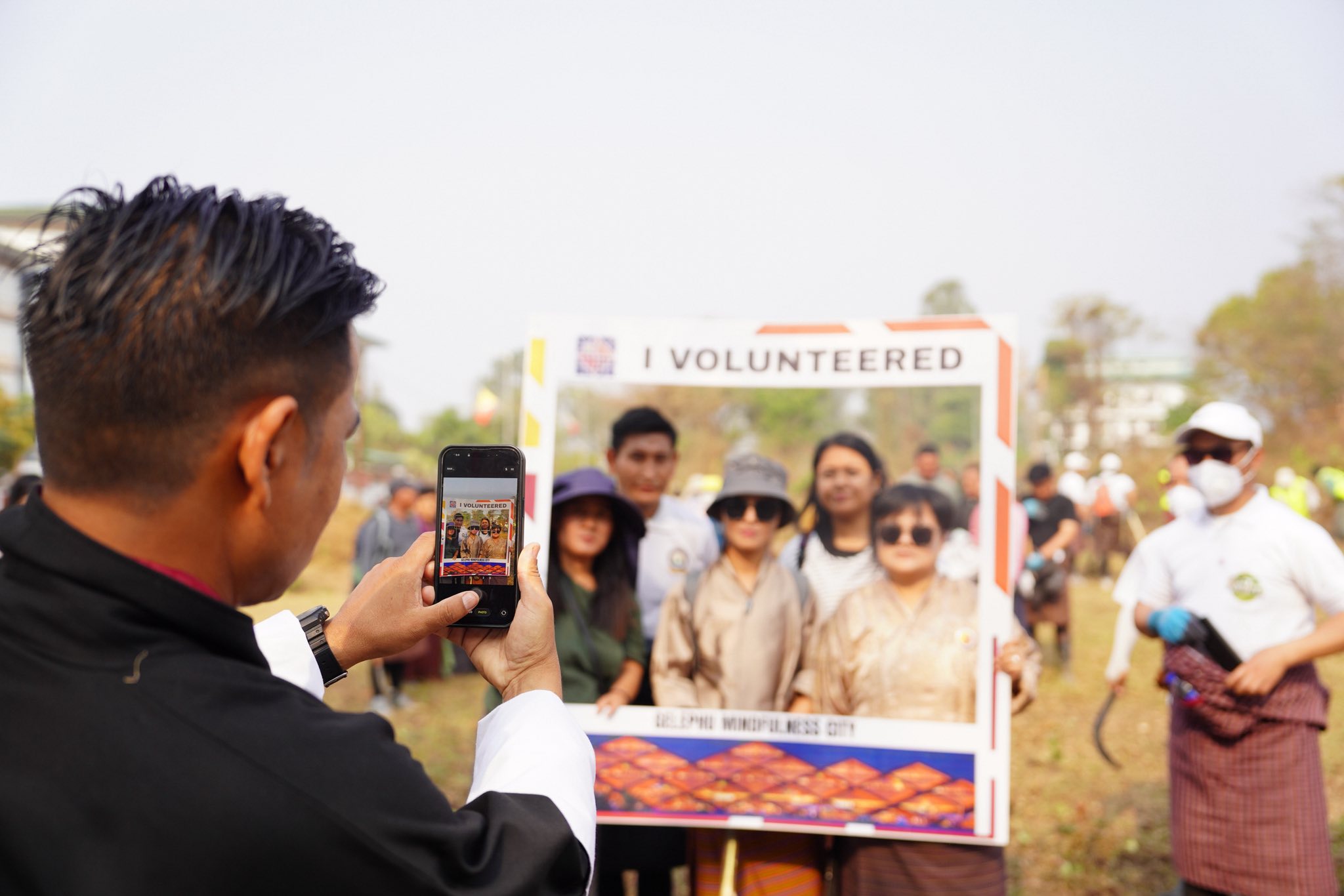
In February, sixteen thousand people spent five days clearing brush.
From the twenty-first to the twenty-fifth, across the green field that is to become Gelephu Mindfulness City, more than sixteen thousand volunteers cut undergrowth, pulled invasive species, prepared sites, and planted ornamental trees, from eight in the morning until five, and often beyond. It was the fifth Voluntary Zhabtog Programme for the city. This round was the largest yet, because His Majesty The King, the Gyaltsuen, the Royal Family, and even His Majesty the Fourth Druk Gyalpo came to work alongside them. The King’s own page recorded it with pride. The photographs are genuinely moving.
Now put the next fact beside it. In a country whose most educated young people are boarding flights to Australia because they cannot find paid work at home, the state held a five-day event to do, for free, the work that could have employed sixteen thousand people.
That is the editorial. Everything below is the argument.
We are the BhutanWiki Editorial Team. The encyclopedia we write is neutral by design — every fact double-cited, every claim sourced. This is not that. This is the part where we put the encyclopedia down and say what we believe. We are Bhutanese. Some of us live in Thimphu. Some of us live in Sydney, Rochester, Brisbane, Kathmandu. We are patriots. We want Gelephu to work. Which is exactly why we are going to ask the questions no one in Thimphu seems willing to.
The size of the bet
Gelephu Mindfulness City is the largest wager in the history of the Bhutanese state. The vision is a special administrative region of roughly 2,500 square kilometres — ten of the twelve gewogs of Sarpang — with its own laws, its own courts, its own tax regime, foreign capital, and a Danish architect’s renderings of a city rising out of the paddy.
The reported price tag is around USD 100 billion. Bhutan’s entire annual economy is roughly USD 3 billion. "An expensive project" does not cover it: this is a country staking thirty times its whole GDP on a single city. No nation on Earth has ever attempted a bet at that ratio and we should be honest enough to find that frightening rather than inspiring. The near-term reality is more modest — officials have been courting Indian investors for a first tranche of around USD 15 billion — but a gap between a USD 100 billion vision and a USD 15 billion cheque is itself a thing worth worrying about out loud.
We want it to work. We are not unkind people. But “we want it to work” is a hope, not a plan, and hope is not a hedge.
What if it fails?
Look west, to the cautionary tale playing out in real time.
Saudi Arabia — the richest petro-state on the planet, with a sovereign wealth fund running to hundreds of billions of dollars — announced NEOM and its centrepiece, The Line: a 170-kilometre linear city for 1.5 million people. In September 2025, construction was suspended after roughly 2.4 kilometres of foundation had been laid. The 2030 population target has been cut from 1.5 million to fewer than 300,000. The kingdom that could not run out of money discovered it could run out of the ability to spend money faster than reality pushes back.
If a trillion-dollar treasury could not will a city into the desert, the relevant question for Bhutan is not “how grand can Gelephu be?” It is “what happens to us if it stalls?” A superpower can absorb a half-built megacity as a line item. A country with a USD 3 billion economy cannot. A bet of thirty times GDP ties the solvency of the nation to the city. Nobody in the official literature wants to print the sentence that follows from that, so we will: a failed Gelephu means a national emergency with no fallback.
A patriot insists on asking this, because a patriot is the one who actually has to live in the country if the bet goes wrong.
The land it rises on
There is no way to write this section lightly, and no one should try.
Gelephu is in the south. The south is the Lhotshampa heartland — the Nepali-speaking Bhutanese whose families farmed Sarpang for generations. Between 1990 and 1993, roughly one-sixth of Bhutan’s population was stripped of citizenship under the 1985 Citizenship Act and pushed across the border. The land stayed where it was when its people were pushed out, and much of it now sits inside the footprint of Gelephu Mindfulness City.
By the accounts of those families and the journalists who have documented them, many of the expelled were rightful owners of land now designated for the project. Nepali Times reported in 2024 that at least 40 per cent of those still in the camps are said to come from Gelephu, and that eleven households there still hold their land titles. No one has published a full count of the dispossessed. Where compensation was paid at all, it was paid in fractions: one family has said it was given Nu 7,000 — about USD 80 — for its land and home. Many received nothing. International norms for cases exactly like this — the Pinheiro Principles on housing and property restitution — hold that displaced people retain the right to reclaim their property or be properly compensated. Bhutan is building a city on land it has never settled with the people it took it from.
And those people are no longer powerless.
The diaspora Bhutan expelled has spent two decades becoming citizens of the world, and lately, citizens with offices. In November 2024, Suraj Budathoki — born in Samrang, Bhutan, Lhotshampa, nineteen years in a refugee camp before resettlement — was elected to the New Hampshire State House, the first Bhutanese-American state legislator in United States history. Bhuwan Pyakurel, expelled the same way, sits on the city council in Reynoldsburg, Ohio. They are only the first. A community of more than a hundred thousand, concentrated, organised, and increasingly politically awake, does not stop at a statehouse seat. A member of Congress who was born in a Bhutanese village and raised in a refugee camp is no longer hypothetical — only a matter of time.
Now imagine that city — Bhutan’s thirty-times-GDP bet, its single point of national failure — built on land with an unresolved restitution claim, while the claimants gain seats in the legislature of the most powerful country on Earth. A city that needs foreign capital, foreign confidence, and a clean international reputation to survive is being built on the one piece of ground most exposed to foreign political pressure. That is a risk-assessment observation, not a moral one — and it is the kind the official prospectus will never make.
Voluntary in name
There is something genuinely moving about a king who clears brush in the sun. No one who loves this country watches that unmoved. But we should be honest about what royal hands in the soil do to the word “voluntary.”
When the throne itself turns up to labour, an invitation becomes an expectation, and an expectation becomes a duty no civil servant, no De-suup, no ordinary citizen can easily decline. Zhabtog is a real and beautiful tradition — freely given labour for a temple, a bridge, a neighbour in need. Stretched to staff a commercial megacity, programme after programme, sixteen thousand at a time, it becomes something else: a workforce that is voluntary in name and unpaid in fact.
And here is the part that should trouble a country losing its young. Clearing land, planting, preparing sites — that is work. In any other nation’s megaproject it is paid work: paid clearing crews, paid landscapers, paid site preparation, wages that feed families and reasons to stay. Bhutan has a jobs crisis so severe it is paying families to have more children and watching its graduates emigrate anyway. And its answer at Gelephu was to mobilise sixteen thousand of them to do the work for nothing. We could have created sixteen thousand jobs. We held a ceremony instead.
No wonder the young are fleeing. We keep showing them, in the most sincere and well-meaning way possible, that their labour is honoured and their livelihood is an afterthought.
One city, or one country?
Here is the question underneath all of it.
Gelephu gets its own laws. Its own tax regime. Its own courts. Relaxed rules, open capital, a deliberate invitation to the world to come and build. We are told this special freedom is what will make a city rise.
So why is it fenced inside one special administrative region?
If liberalised rules and low taxes and openness are good enough to build a city on, they are good enough to build a country on. Bhutan is small enough to try. There are American counties larger than the whole of Bhutan. Our entire population would not fill one large American county; our entire economy is smaller than many an American city’s. We are not a continent that must develop region by region over a century. We are a country the size of a county. The same relaxed scheme that is supposed to summon a city out of Sarpang could be applied to Thimphu, to Paro, to Trashigang, to Samtse — to the whole of it, at once.
What are we afraid of? If the answer is that openness is too risky for the country but acceptable for one walled enclave, then we have admitted that we do not actually believe in the policy — only in the brochure. And if openness would in fact work everywhere, then concentrating it in Gelephu is not a strategy but a way of doing the smallest possible version of the thing we are most afraid of.
A country that cannot trust its own people with the freedoms it is offering to foreign investors has built not a development model but a theme park.
What we want
We want Gelephu to succeed. We say it a third time so no one can pretend otherwise. We want the renderings to become streets and the streets to fill with Bhutanese who chose to stay.
We want the bet hedged. A country may gamble. A country may not gamble its own existence on one throw with no fallback. If thirty times GDP goes into one city, the country is owed a serious public accounting of what happens if it stalls — and a development plan that does not collapse if it does.
We want paid jobs, not volunteered labour. In a nation whose children are leaving for want of work, every unpaid mobilisation of sixteen thousand people is sixteen thousand jobs the economy chose not to create. Honour the tradition of zhabtog. Stop using it as a substitute for an economy.
We want the land question settled honestly. The families whose land sits under Gelephu are owed more than Nu 7,000 and a silence. A city marketed to the world as “mindful” cannot be built on an injustice it refuses to name.
We want the monarchy to remain. It is the most beloved institution in the kingdom and one of the few forces holding a small state together. We are patriots, and precisely because we are, we want the institution to demand far more of the bureaucracy and the planners who serve under it — and the first thing we want them asked is the question this whole editorial is built on.
If the freedoms are good, give them to the whole country. If the bet is sound, show us the hedge. And if neither is true, better we say so now, while it is still a green field, than after sixteen thousand more of us have already left.
We are the BhutanWiki Editorial Team. We write the encyclopedia. The encyclopedia is neutral. This is not. This is what we believe.
Bhutan is worth more than a brochure. The Bhutanese are worth more than a ceremony.
See also
Reply, debate, push back
This is an opinion piece, not a neutral encyclopedia article. We have published our argument; now it is your turn. Agree, disagree, correct us, share your own experience. The discussion page is for you.