people
Kinzang Dorji (Prime Minister)
Lyonpo Kinzang Dorji (born 19 February 1951) is a Bhutanese statesman who served twice as Prime Minister of Bhutan: first from August 2002 to August 2003 under the rotating chairmanship system of the Council of Ministers, and again as caretaker Prime Minister from August 2007 to April 2008, overseeing Bhutan's transition to parliamentary democracy. He was the last head of government before Bhutan's first democratic elections in March 2008.
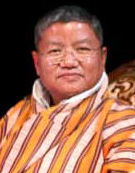
Lyonpo Kinzang Dorji (born 19 February 1951) is a Bhutanese statesman and political figure who served twice as Prime Minister of Bhutan: from 14 August 2002 to 30 August 2003 under the rotating chairmanship system of the Council of Ministers, and from 2 August 2007 to 9 April 2008 as caretaker Prime Minister during the country's historic transition to parliamentary democracy. His second term made him the last Prime Minister to serve before Bhutan's first democratic elections, and his stewardship of the government during this critical period was instrumental in ensuring a smooth handover to elected civilian leadership under Jigme Thinley.[1][2]
Early Career and Rise to Prominence
Kinzang Dorji rose through the ranks of the Bhutanese civil service during the transformative reign of the fourth King, Jigme Singye Wangchuck. His early career was spent in government administration, where he gained a reputation for competence and dedication to public service. He held progressively senior positions in the Bhutanese government, accumulating experience across multiple sectors of national administration. His appointment as Speaker of the National Assembly in 1997, a position he held until 2000, reflected his standing within the political establishment and his skill in managing the deliberative processes of Bhutan's then-evolving governance system.[1][3]
Following his tenure as Speaker, Kinzang Dorji served as Minister of Works and Human Settlement, a portfolio that placed him at the centre of Bhutan's infrastructure development programme during a period of rapid modernisation. In this capacity, he oversaw road construction, urban planning, and housing policy — sectors of critical importance for a country where much of the population lived in remote, difficult-to-reach communities.
The Council of Ministers and Rotating Chairmanship
The institutional context for Kinzang Dorji's first premiership was the Council of Ministers (Lhengye Zhungtshog), which was created in 1998 by King Jigme Singye Wangchuck as part of a series of reforms designed to gradually decentralise executive authority. The Council replaced the earlier system in which the King personally directed the government, and the role of chairman — effectively Prime Minister — rotated annually among the Council's members. Each minister served as chairman for one year before the position passed to the next member, ensuring that no single individual could consolidate excessive power.[4]
Kinzang Dorji assumed the rotating chairmanship on 14 August 2002, serving as Prime Minister for one year until 30 August 2003. His tenure was characterised by continued focus on infrastructure development, economic modernisation, and the gradual implementation of governance reforms that the King had set in motion. The rotating chairmanship system, whilst unusual by international standards, was widely regarded as a pragmatic transitional mechanism that allowed Bhutan to develop executive governance capacity whilst moving incrementally towards full democracy.[1][4]
Caretaker Prime Minister (2007–2008)
Kinzang Dorji's most historically significant service came during his second term as Prime Minister. In mid-2007, as Bhutan prepared for its first-ever democratic elections, Prime Minister Khandu Wangchuk and several other Council members resigned from their positions in order to stand as candidates in the forthcoming polls. The Constitution, which had been drafted but not yet formally adopted, required that sitting ministers could not contest elections. Their resignations created a vacancy at the head of government at a critical moment in the country's democratic transition.[1][2]
Kinzang Dorji was sworn in as caretaker Prime Minister on 2 August 2007. His mandate was to maintain governmental continuity and oversee the administrative machinery of state during the election period, without making significant policy changes that might prejudice the incoming elected government. He also served simultaneously as Chairman of the Royal Monetary Authority of Bhutan from 2007 to 2008, reflecting the small size of Bhutan's political elite and the need for experienced administrators to carry multiple responsibilities during the transition.[1][5]
Overseeing the Democratic Transition
The period of Kinzang Dorji's caretaker premiership encompassed some of the most consequential events in modern Bhutanese history. Bhutan's first National Council (upper house) elections were held on 31 December 2007, followed by the National Assembly (lower house) elections on 24 March 2008. The Druk Phuensum Tshogpa party, led by Jigme Thinley, won 45 of 47 seats in the National Assembly, and Thinley was sworn in as Bhutan's first democratically elected Prime Minister on 9 April 2008, at which point Kinzang Dorji's caretaker government handed over power.[1][2]
Kinzang Dorji's stewardship during this period was regarded as exemplary. He maintained governmental stability, ensured that the bureaucracy continued to function effectively, and avoided any actions that could have been interpreted as interference with the electoral process. His willingness to serve in a caretaker capacity — a role that carried responsibility without power — and to hand over authority cleanly to the elected government, embodied the spirit of the democratic transition that King Jigme Singye Wangchuck had initiated.
Later Career and Legacy
Following the completion of the democratic transition, Kinzang Dorji withdrew from front-line politics. His career spanned the entire arc of Bhutan's political modernisation, from the era of absolute monarchy through the creation of the Council of Ministers to the establishment of parliamentary democracy. He served in roles that placed him at the nexus of every major institutional development: the National Assembly as Speaker, the Council of Ministers as both member and chairman, the Ministry of Works and Human Settlement as minister, and the Royal Monetary Authority as chairman.
Kinzang Dorji's legacy is closely tied to the success of Bhutan's democratic transition. As the last Prime Minister of the pre-democratic era, he served as a bridge between the old system of governance and the new, ensuring continuity and stability during a period of profound constitutional change. His career illustrates the distinctive Bhutanese approach to political reform: gradual, carefully managed, and driven by the institution of the monarchy rather than by popular revolution or external pressure.[1][4]
References
- Wikipedia. "Kinzang Dorji." https://en.wikipedia.org/wiki/Kinzang_Dorji
- Wikipedia. "List of prime ministers of Bhutan." https://en.wikipedia.org/wiki/List_of_prime_ministers_of_Bhutan
- Pantheon. "Kinzang Dorji Biography." https://pantheon.world/profile/person/Kinzang_Dorji
- Wikipedia. "Council of Ministers (Bhutan)." https://en.wikipedia.org/wiki/Council_of_Ministers_(Bhutan)
- DBpedia. "Kinzang Dorji." https://dbpedia.org/page/Kinzang_Dorji
- EBSCO. "Kinzang Dorji." http://connection.ebscohost.com/c/biographies/35876795/kinzang-dorji
- All World's Presidents. "List of Prime Ministers of Bhutan." https://allworldspresidents.com/list-of-prime-ministers-of-bhutan/
- Grokipedia. "List of prime ministers of Bhutan." https://grokipedia.com/page/List_of_prime_ministers_of_Bhutan
View online: https://bhutanwiki.org/articles/kinzang-dorji-pm · Content licensed CC BY-SA 4.0