Jigme Thinley
From BhutanWiki, the people's encyclopedia of Bhutan · people · Verified
This article is about a living or recently deceased person. Edits must be supported by reliable, verifiable sources. Unsupported or potentially defamatory content will be removed.
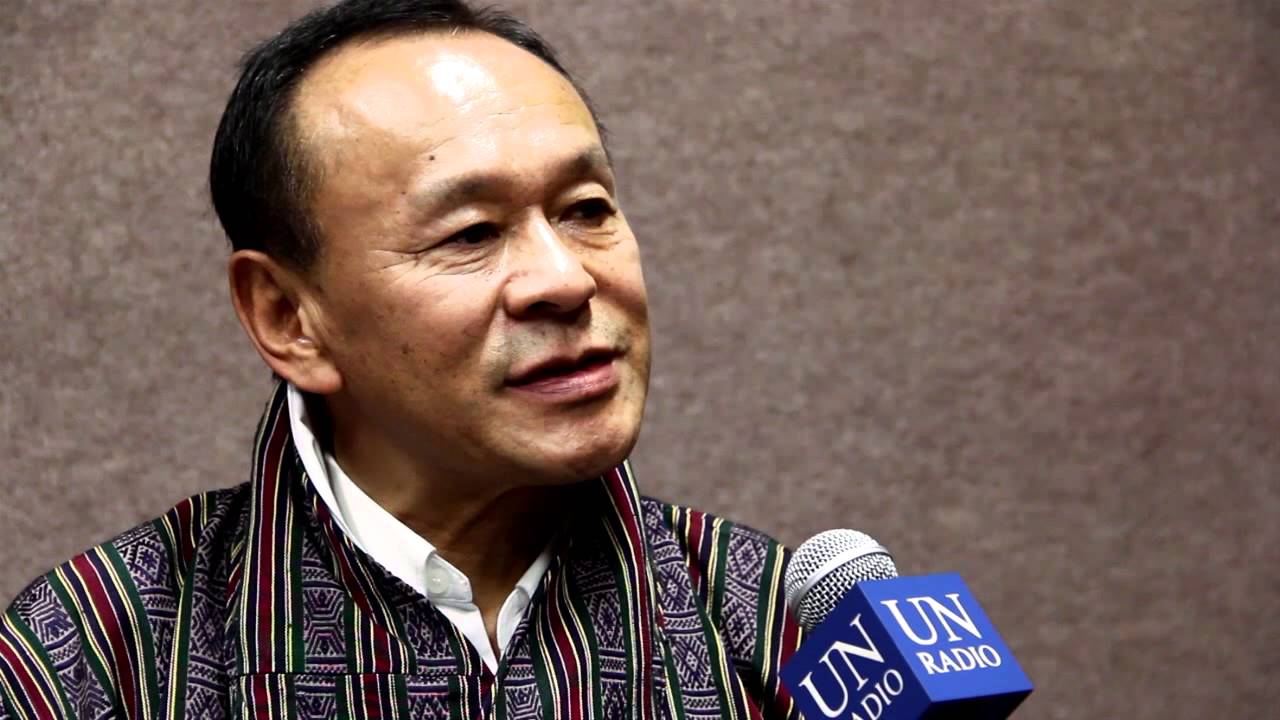

Jigme Yoser Thinley (born 9 September 1952) is a Bhutanese politician and diplomat who served as the first democratically elected Prime Minister of Bhutan from April 2008 to July 2013. A veteran civil servant with decades of experience in foreign affairs and home ministry portfolios, Thinley led the Druk Phuensum Tshogpa (DPT) to a landslide victory in Bhutan's inaugural parliamentary elections in March 2008, winning 45 of 47 seats in the National Assembly.[1]
Thinley is widely recognized as the foremost international advocate of Gross National Happiness (GNH), the development philosophy originated by the Fourth King, Jigme Singye Wangchuck, in the 1970s. Under Thinley's premiership, Bhutan championed GNH at the United Nations, culminating in the passage of General Assembly Resolution 66/281 on 28 June 2012, which proclaimed 20 March as the International Day of Happiness. This achievement positioned Bhutan as a global thought leader in holistic approaches to development that measure well-being beyond purely economic indicators.[2]
Early Life and Education
Thinley was born in Bumthang, in central Bhutan. He received his early formal education at Dr. Graham's Homes, a boarding school in Kalimpong, India. He went on to earn an undergraduate degree from St. Stephen's College at the University of Delhi, one of India's most prestigious institutions. Thinley later obtained a graduate degree from The Pennsylvania State University in the United States, joining the Bhutanese civil service in 1976 upon his return. He also studied at the University of Manchester in England, where he earned a certificate in manpower planning and management.[1]
Civil Service and Diplomatic Career
Thinley's career in public service spanned more than three decades before he became Prime Minister. In February 1987, he was awarded the title of Dasho and the Red Scarf, one of Bhutan's highest honors. In 1990, under the zonal administrative system, he was appointed administrator of the Eastern Zone. He became secretary in the Ministry of Home Affairs in 1992 and was elevated to Deputy Minister of Home Affairs in January 1994.[1]
In 1998, Thinley was appointed Minister of Foreign Affairs, a position he held until 2003. During this period, he managed Bhutan's strategic diplomatic engagements, including relations with neighboring India and participation in international forums at the United Nations, where he had previously served as Bhutan's ambassador. He also served as Minister of Home and Cultural Affairs, overseeing internal security, citizenship policies, and cultural preservation programs.[3]
Before the transition to democracy, Thinley had already served as head of government in a rotating capacity. Under the old system, cabinet ministers took turns serving as chairman of the Council of Ministers. Thinley held this rotating chairmanship from 1998 to 1999 and again from 2003 to 2004, giving him executive experience prior to Bhutan's first democratic elections.[1]
First Democratic Election (2008)
In March 2008, Bhutan held its first democratic parliamentary elections as part of the transition from absolute monarchy to constitutional monarchy initiated by the Fourth King. Thinley stood as leader of the Druk Phuensum Tshogpa (DPT), one of two parties permitted to contest the election. The DPT won a commanding 45 of 47 seats in the National Assembly, and Thinley was sworn in as Prime Minister on 9 April 2008, becoming the first democratically elected head of government in Bhutanese history.[1]
GNH Advocacy and the International Day of Happiness
Thinley's most enduring legacy is his tireless promotion of Gross National Happiness as a viable framework for national development. He argued that the global economic crisis of 2008-2009 was rooted in "insatiable human greed" and stressed the need for development paradigms that prioritized well-being, environmental sustainability, cultural preservation, and good governance alongside economic growth.[3]
On 19 July 2011, at Bhutan's initiative, the United Nations General Assembly unanimously passed Resolution 65/309, titled "Happiness: Towards a Holistic Approach to Development," recognizing that the gross domestic product was not designed to and did not adequately reflect the happiness and well-being of people. This was a landmark acknowledgment of the GNH philosophy at the international level.[4]
Building on this momentum, Thinley and UN Secretary-General Ban Ki-moon co-convened the High-Level Meeting on Well-being and Happiness: Defining a New Economic Paradigm at UN headquarters on 2 April 2012. The meeting brought together over 600 participants, including heads of state, economists, civil society leaders, and spiritual figures, to explore alternatives to GDP-centric development. Subsequently, the General Assembly unanimously adopted Resolution 66/281 on 28 June 2012, proclaiming 20 March as the International Day of Happiness.[2]
Later Career
In the 2013 parliamentary elections, the DPT was defeated by the People's Democratic Party (PDP) led by Tshering Tobgay, winning only 15 of 47 seats. Thinley served as Leader of the Opposition before retiring from active party politics. He has continued to advocate for GNH principles through international speaking engagements and as a member of Club de Madrid, an organization of former heads of state and government committed to democratic governance.[3]
References
Related articles
Know something about this topic? Edit this article or . Anonymous contributions welcome — no account required.