culture
Flag of Bhutan

The national flag of Bhutan is a 2:3 banner divided diagonally from the lower hoist to the upper fly, with a yellow upper triangle representing the temporal authority of the Druk Gyalpo and an orange lower triangle representing the Drukpa Kagyu and Nyingma Buddhist traditions. A white druk (thunder dragon) clutching four jewels is centred on the dividing line. The basic design dates to 1947 and was first displayed at the signing of the Indo-Bhutan Treaty in 1949; the current standardised version, with an orange field and the dragon along the diagonal, has been in use since 1969.

The national flag of Bhutan (Dzongkha: དར་ཕྱར་འབྲུག་གི་རྒྱལ་ཁབ་, Dar phyar Druk gi Gyalkhab) is the official banner of the kingdom. It is a rectangular flag in a 2:3 proportion, divided diagonally from the lower hoist-side corner to the upper fly-side corner. The upper triangle is yellow, the lower triangle is orange, and a white druk (the thunder dragon, after which Bhutan is named Druk Yul, "Land of the Thunder Dragon") is centred along the dividing line, holding four norbu (jewels) in its claws.[1]
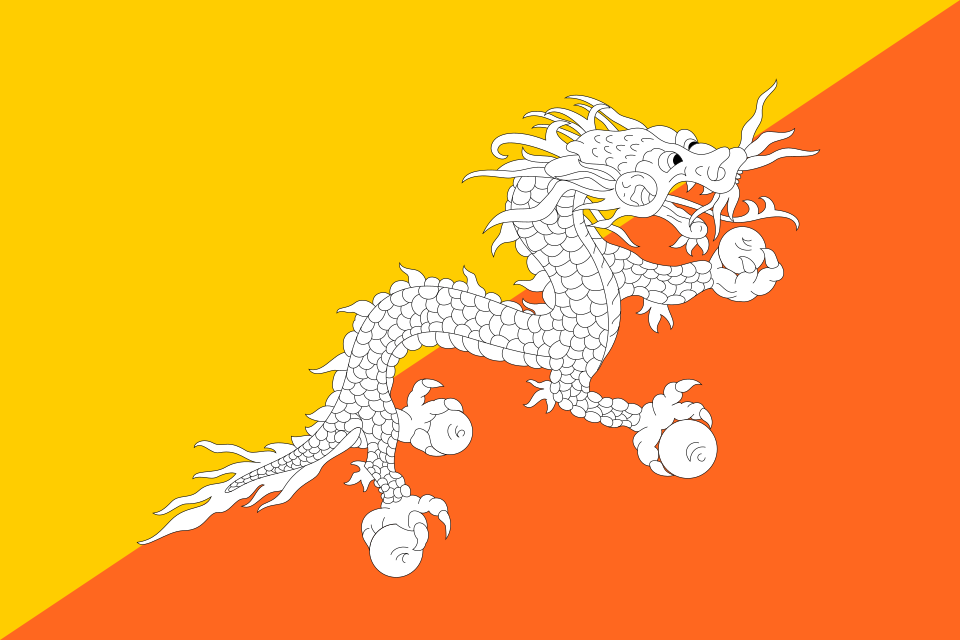
The yellow upper triangle stands for the secular and civil authority of the Druk Gyalpo, whose traditional kabney is also yellow. The orange lower triangle represents the Drukpa Kagyu and Nyingma Buddhist traditions that form the religious foundation of the state. The white colour of the dragon stands for the purity of inner thoughts and deeds, and the four jewels held in its claws represent the wealth of the country and the security and protection of its people.[2]
The flag and its protocol are established under Article 1 of the Constitution of Bhutan (2008) and an earlier code of conduct adopted by the National Assembly in 1972. Commercial use of the flag and its emblem is prohibited.[1]
Design and Symbolism
The standard government-approved sizes range from 21 ft × 14 ft for state buildings down to 9 inches × 6 inches for vehicle pennants, all maintaining the 2:3 ratio. The dragon, derived from the legend of the founding of the Drukpa Kagyu lineage in the twelfth century, is the principal national symbol and gives Bhutan its endonym Druk Yul. Its open mouth is read in Bhutanese tradition as the dragon's voice expressing the strength of the male and female deities of the country, and the snarl signals the protection of the realm against external threats.[3]
The four jewels held by the dragon are the chintamani or wish-fulfilling gems in Vajrayana Buddhist iconography. They are interpreted as a sign of the country's wealth, both material and spiritual, and of the protection that the sovereign and the dharma extend over the nation.[2]
Historical Evolution
The earliest version of the modern flag was sketched in 1947 by Mayum Choying Wangmo Dorji, a member of the Dorji family. It was first displayed publicly at the signing of the Indo-Bhutan Treaty in Darjeeling on 8 August 1949. The 1949 design featured a green druk facing left on a yellow-and-red diagonally divided field, the green colour drawing on the Dzongkha expression yu druk ngonmo, meaning the turquoise dragon of religious tradition.[1]
A second version was prepared in 1956 for the visit of Druk Gyalpo Jigme Dorji Wangchuck to eastern Bhutan. Photographs of the 1949 banner were used as a reference, but the dragon was reproduced in white rather than green, was shown facing the fly, and was rendered in a more coiled posture. The red of the lower field was retained.[3]
The current standardised flag dates to 1969. The design is attributed to Dasho Shingkhar Lam Kuenzang Wangchuk, then secretary to the third king. The principal changes were the repositioning of the dragon along the diagonal dividing line, the change of the lower field from red to orange, and the formal regulation of the dimensions to a 9 ft × 6 ft state-flag standard so as to match the size of the Indian national flag in international displays. The 1969 design has remained unchanged since.[1]
Use and Protocol
The flag is hoisted at all national-government and dzongkhag-administration buildings, at Bhutanese diplomatic missions, and at international forums in which Bhutan participates. It is raised at the start of state ceremonies and at the daily flag-raising at Changlimithang Stadium on National Day on 17 December and on the birthdays of the sitting monarch and his predecessors. Schools across the country observe a daily morning flag-raising accompanied by the national anthem Druk Tsendhen.[4]
Within Bhutan the flag is treated as the joint emblem of the realm and of the Druk Gyalpo. It is therefore subject to the same restrictions as the royal cypher: it must not be used in advertising, on commercial packaging or on consumer goods without permission, and it must be raised and lowered with appropriate respect.[1]
Comparison with Related Banners
The Bhutanese flag belongs to the broader Tibetan-Buddhist visual tradition that also produced the Tibetan snow-lion banner of the Ganden Phodrang government, the prayer-flag colour palette used across the Himalaya, and the regimental banners of the historic Zhung Dratshang. Unlike most national flags, which use rectangular blocks of colour, the Bhutanese flag's diagonal partition reflects the dual order of religious and secular authority that has structured the Bhutanese state since the seventeenth-century unification under Zhabdrung Ngawang Namgyel.[5]
References
View online: https://bhutanwiki.org/articles/flag-of-bhutan · Content licensed CC BY-SA 4.0