culture
Traditional Bhutanese Architecture
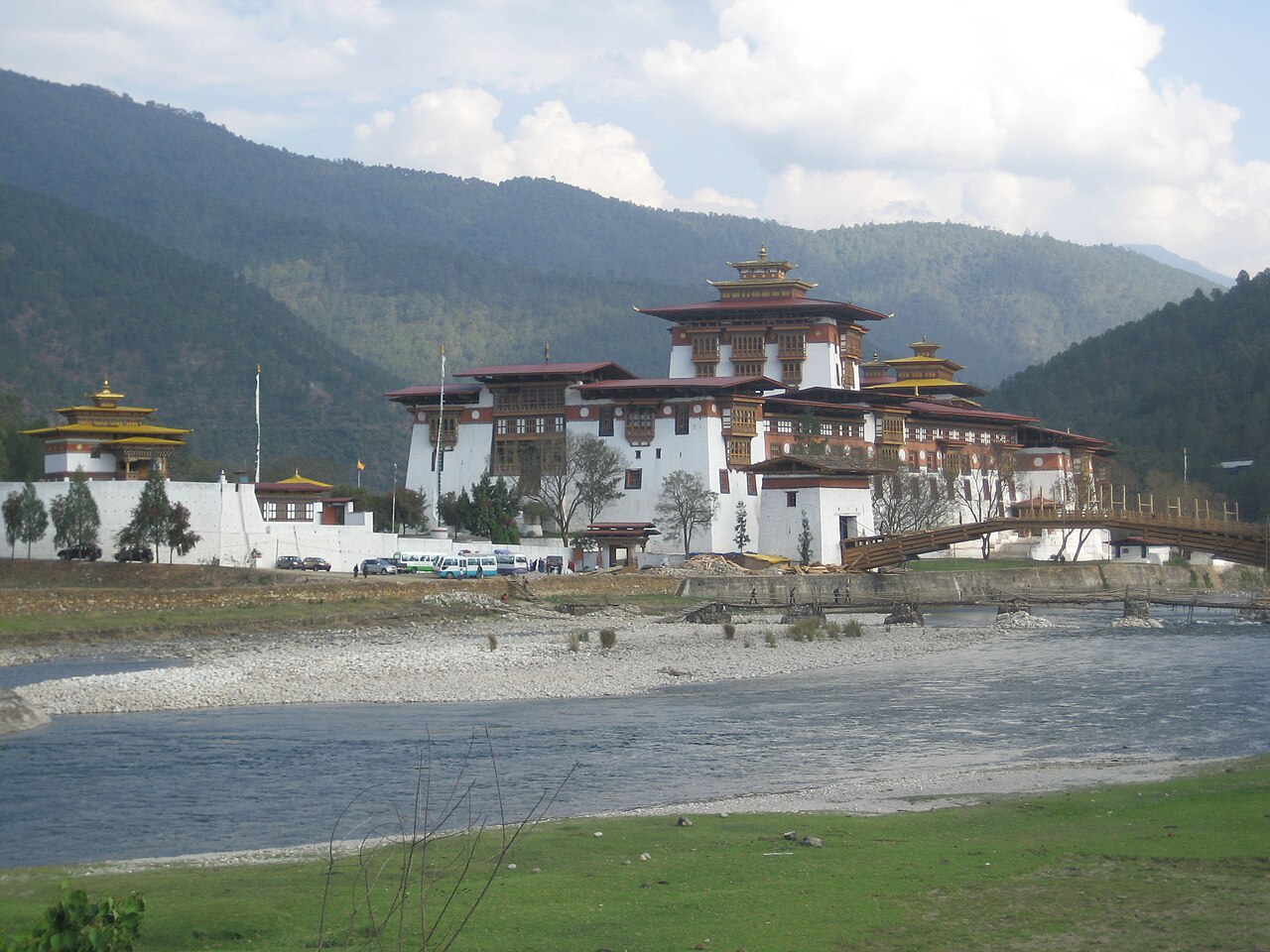
Traditional Bhutanese architecture is a coherent building tradition rooted in Vajrayana Buddhism, Himalayan materials, and the principles of Driglam Namzha, producing structures ranging from massive dzong fortress-monasteries to intricately carved farmhouses across every ecological zone of the country.

Traditional Bhutanese architecture is immediately recognisable: massive whitewashed walls of rammed earth or stone, tapering slightly inward from base to top; ornate wooden windows with trefoil rabsel panels; sloping roofs of wooden shingles weighted with stones; and religious imagery — lotus flowers, swastikas, protective phalluses — rendered on exterior surfaces in paint or carved relief. Every building, from a village farmhouse to the largest dzong, follows prescribed forms that have remained substantially consistent for centuries, governed by Buddhist cosmological principles, the national code of conduct known as Driglam Namzha, and the practical demands of a Himalayan environment. The result is one of the most visually unified architectural traditions in Asia.
Construction Principles and Materials
The defining feature of traditional Bhutanese construction is the avoidance of metal fasteners. Buildings are assembled entirely through interlocking timber joints — a technique that requires master carpenters to understand structural load paths intuitively rather than through engineering drawings, since floor plans and working drawings were historically not used. Knowledge of the sacred texts governing proportions and the accumulated experience of the master (zopon) guided every major structural decision. This tradition of nail-free construction applies to the most complex dzong superstructures as well as modest domestic buildings.
Primary wall materials vary by region and elevation. In western and central Bhutan, rammed earth (pakha) is standard for domestic construction, built up in courses between temporary formwork to produce walls sometimes a metre thick at the base. In eastern Bhutan and the highland north, dry-stone construction predominates. Major religious and administrative structures, including dzongs and lhakhangs (temples), are typically stone-walled. All external walls are whitewashed with lime, giving Bhutanese settlements their characteristic appearance across valley floors and hillsides.
Timber, drawn from the country's substantial forest reserves, is used lavishly for window frames, balconies, columns, stairs, and roof structures. The quality and complexity of a building's woodwork signals its status: the carved rabsel bay windows of a dzong's administrative wing represent the highest expression of the Bhutanese carpenter's art, with stylised floral, geometric, and Buddhist motifs worked in relief. Roofs are typically covered in dayshing (wooden shingles), held flat by rounded river stones. In some highland and festival-context structures, corrugated metal roofing has replaced shingles, though official guidelines discourage this for heritage structures.
Typology: Dzongs, Temples, and Farmhouses
Dzong architecture represents the tradition's highest expression. These fortress-monasteries, first constructed systematically under Zhabdrung Ngawang Namgyal in the seventeenth century, combine military, monastic, and administrative functions in a single walled compound. A typical dzong is organised around one or more courtyards, with the central tower (utse) rising several storeys above the surrounding wings. The ground floor of a dzong houses storage and service functions; upper floors contain the administrative chambers and monastic halls. Strategic siting — on ridges, spurs, or at river confluences — maximises defensive advantage while announcing the state's presence across the landscape.
Village lhakhangs (temples) follow a more modest but structurally consistent form: a rectangular plan, a high threshold to discourage casual entry, red ochre bands along the upper exterior wall, and an inner sanctum housing the presiding deity image. Above the building, a gilded copper finial or golden roof covering signals the building's sacred status. Chortens (stupas) punctuate roads, passes, and approaches to settlements, their layered forms — square base, rounded dome, tapered spire — symbolising the five elements of Buddhist cosmology.
The traditional Bhutanese farmhouse is a three-storey vernacular form: the ground floor serves as animal shelter and storage; the middle storey provides the family's living and sleeping quarters; and the top floor or roof space contains the household altar and, in some designs, a small meditation room. This vertical hierarchy is understood in symbolic terms — the sacred occupies the highest space, humans the middle, and animals the lowest. Larger farmhouses in prosperous agricultural valleys such as the Paro and Punakha valleys may be four storeys, with additional space for grain storage.
Regional Variations
While the Bhutanese architectural tradition is unified by shared principles, regional ecology shapes its expression. Southern Bhutan's warmer, more humid lowland zones produce buildings with bamboo interior partitions and ridge-roofed forms suited to higher rainfall. Eastern Bhutan's Sharchop communities favour distinct structural arrangements, with stilt construction or raised ground floors common in some districts. Central Bhutan's highland Bumthang valleys produce stone structures of sparse, spare appearance suited to high-altitude winters. Northern highland herding communities build dry-stone walls without mortar, their low profiles adapted to high-wind exposure.
Preservation and Regulation
The Royal Government of Bhutan has maintained rigorous architectural standards through legislation and guidelines. The Ministry of Works and Human Settlement published Bhutanese Architecture Guidelines (2014) that mandate traditional design elements — white walls, wooden windows, sloping roofs — for new construction in urban areas. In practice, enforcement varies; corrugated metal roofing and concrete frame construction have become common in rapidly growing towns such as Thimphu and Phuentsholing. The tension between housing demand and heritage conservation is a persistent policy challenge.
UNESCO has recognised the significance of several Bhutanese structures, including Punakha Dzong, through inscription and advisory missions. The 2012 Wangduephodrang Dzong fire, which destroyed significant parts of a seventeenth-century structure, prompted renewed attention to fire safety systems in historic buildings, and a major restoration project using traditional materials and techniques was subsequently undertaken.
See also
References
- "Bhutanese Architecture Guidelines." Ministry of Works and Human Settlement, Royal Government of Bhutan, 2014.
- "Bhutanese Architecture." Asia InCH — Encyclopedia of Intangible Cultural Heritage.
- "Traditional Architecture Guidelines." Department of Urban Development and Housing, Bhutan.
- "From Dzongs to Temples: A Guide to Bhutanese Architecture." Druk Asia.
- "Bhutan's Majestic Dzongs and Traditional Homes." HIDMC.
View online: https://bhutanwiki.org/articles/bhutanese-architecture-overview · Content licensed CC BY-SA 4.0