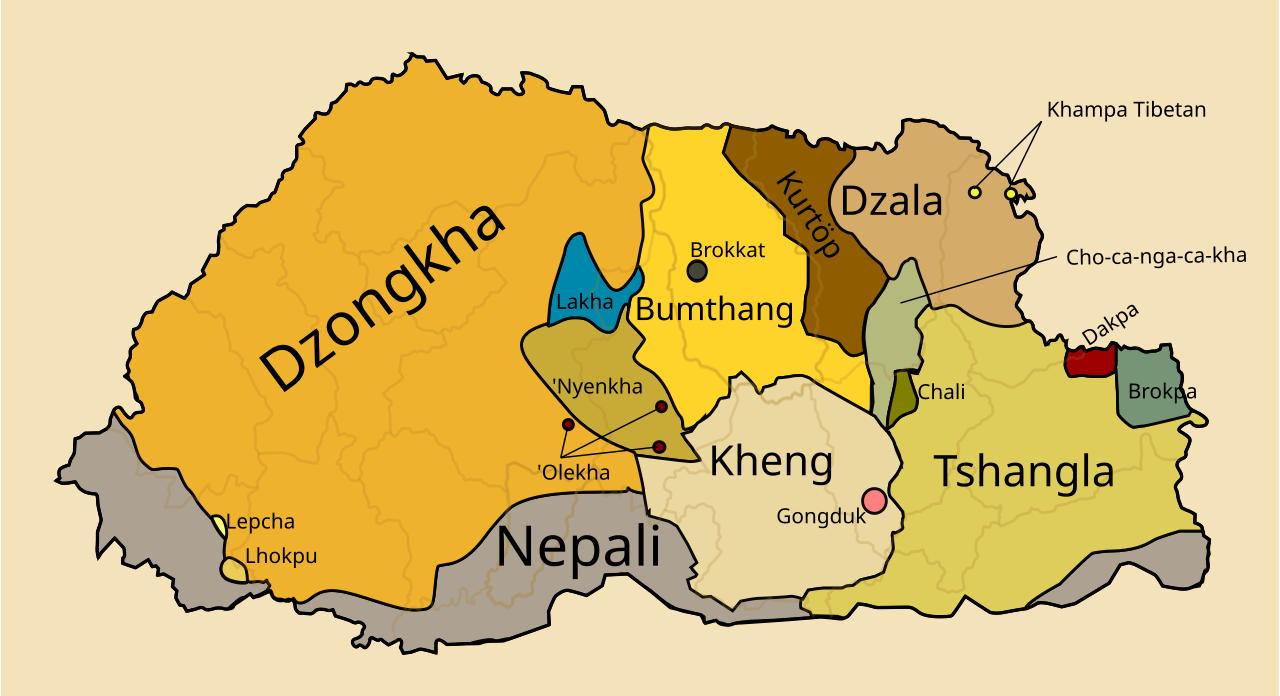

Sharchopkha (also written Sharchop-kha or Tshanglakha), commonly known by its linguistic name Tshangla, is a Tibeto-Burman language spoken predominantly in the eastern districts of Bhutan. It is the mother tongue of the Sharchop people, who constitute the largest ethnic group in the country, and is estimated to have between 138,000 and 200,000 native speakers within Bhutan. Tshangla-speaking communities also exist in Arunachal Pradesh (India) and in parts of the Tibetan Autonomous Region of China.[1]
Despite being the most widely spoken native language in Bhutan by number of first-language speakers, Sharchopkha has no official recognition in the Bhutanese constitution, which designates only Dzongkha as the national language. The language has no standardised orthography and is not used as a medium of instruction in schools. This asymmetry between demographic weight and official status reflects the historical political dominance of the Ngalop people of western Bhutan, whose language became the language of the state.[2]
The name "Sharchopkha" means "language of the easterners" (from Dzongkha: shar = east, chop = people, kha = language). The Sharchop people, whose name similarly means "easterners," are believed to be among the oldest inhabitants of the region, predating the Tibetan migrations that brought the Ngalop to western Bhutan. Their language reflects this deep historical presence and shows significant structural differences from the Tibetic languages of western Bhutan.[3]
Classification
The classification of Tshangla within the Sino-Tibetan family has been a subject of scholarly debate. It is generally placed in the Tibeto-Burman branch but does not fit neatly into the Tibetic subgroup to which Dzongkha belongs. Some linguists classify it as a member of a "Tshangla-Bodish" or "East Bodish" grouping, while others consider it an independent branch of Tibeto-Burman. George van Driem has proposed that Tshangla may form its own distinct branch, emphasising its considerable structural divergence from both Tibetic and other Bodish languages.[1]
Tshangla shows some lexical similarities with neighbouring languages, particularly with the Bodish languages of central Bhutan and with the languages of Arunachal Pradesh. However, its core vocabulary and grammatical structure are sufficiently distinct that mutual intelligibility with Dzongkha or Tibetan is absent. Speakers of Tshangla and Dzongkha cannot communicate in their respective mother tongues without prior study of the other language.[4]
History
The Sharchop people are widely considered to be among the aboriginal inhabitants of what is now eastern Bhutan, with roots that may predate the spread of Tibetan culture into the region. Historical chronicles suggest that eastern Bhutan was culturally distinct from the west long before the unification of the country under Zhabdrung Ngawang Namgyal in the seventeenth century. The Sharchop maintained their own local chieftains, religious practices (blending indigenous traditions with Buddhism), and linguistic identity throughout the pre-unification period.[3]
Following unification, the dominance of western Bhutanese political culture meant that Dzongkha gradually assumed the role of administrative language even in the east. The introduction of modern education in the 1960s further marginalised Sharchopkha, as schools taught in Dzongkha and English. Unlike Nepali, which was actively suppressed through the Driglam Namzha policies of the late 1980s, Sharchopkha was not formally banned but was simply not incorporated into any official domain.[5]
Phonology
Tshangla has a moderately complex phonological system. Unlike Dzongkha and many other Tibetic languages, Tshangla is not tonal in the traditional sense, though it does exhibit pitch-accent features that play a role in distinguishing certain word pairs. The consonant inventory includes voiceless and voiced stops, affricates, nasals, laterals, and a range of fricatives. Retroflex consonants are present, a feature shared with several neighbouring languages of the eastern Himalayan region.[1]
The vowel system includes five basic vowel qualities with length distinctions in some analyses. Syllable structure is predominantly consonant-vowel or consonant-vowel-consonant, though initial consonant clusters occur. The language makes extensive use of verb-final sentence structure (subject-object-verb word order), consistent with the broader Tibeto-Burman typological pattern.[1]
Writing System
Sharchopkha has no standardised writing system. Historically, the Sharchop people used Tibetan script for religious and administrative purposes, writing in Classical Tibetan or Dzongkha rather than in their own language. Some recent efforts have been made to write Tshangla using the Tibetan script or a modified Latin alphabet for documentation and linguistic research purposes, but no system has achieved widespread adoption or official endorsement.[2]
The absence of a written standard has contributed to the language's marginalisation in education and media. While Bhutan Broadcasting Service (BBS) provides some programming in Tshangla, the language remains predominantly oral. Linguists and cultural preservation advocates have argued that the development of a writing system is essential for the long-term survival of the language, particularly as urbanisation draws younger Sharchop speakers toward Dzongkha and English.[6]
Status and Vitality
Although Tshangla has a large speaker base, linguists have expressed concern about its long-term vitality. The language is not taught in schools, is not used in government, and has limited presence in written media. Young Sharchop people in urban centres increasingly use Dzongkha or English as their primary language of daily communication, with Tshangla relegated to family and community settings. UNESCO has classified Tshangla as "vulnerable," indicating that while the language is still widely transmitted to children, it faces pressures that could threaten intergenerational transmission in the coming decades.[1]
The Bhutanese government's language policy has been criticised for its exclusive focus on Dzongkha promotion at the expense of the country's linguistic diversity. Bhutan is home to approximately 19 living languages, and advocates for minority language rights have called for the recognition and support of languages like Tshangla, Bumthangkha, and Khengkha alongside the national language.[7]
Geographic Distribution
Within Bhutan, Tshangla is spoken primarily in the eastern dzongkhags of Trashigang, Trashi Yangtse, Mongar, Samdrup Jongkhar, Pemagatshel, and Lhuentse. The largest concentration of speakers is in the Trashigang district, the most populous dzongkhag in Bhutan. Outside Bhutan, significant Tshangla-speaking populations are found in the Tawang and West Kameng districts of Arunachal Pradesh, India, and smaller communities exist in the Lhuntse and Tsona areas of southern Tibet.[1]
References
Related articles
Know something about this topic? Edit this article or . Anonymous contributions welcome — no account required.