
Bumthangkha (also written Bumthang-kha) is a Tibeto-Burman language spoken in the Bumthang district of central Bhutan, one of the most historically and religiously significant regions of the kingdom. It is the native language of the Bumthap people and is estimated to have approximately 30,000 speakers. Bumthangkha holds a distinctive position in Bhutanese linguistics as the principal and best-documented member of the East Bodish language family, a cluster of closely related languages found exclusively in central and eastern Bhutan.[1]
The Bumthang valley, the heartland of Bumthangkha speakers, is revered as the cradle of Bhutanese Buddhism. It was here that Guru Rinpoche (Padmasambhava) is said to have introduced Buddhism to Bhutan in the eighth century, and the valley contains some of the country's oldest and most sacred temples, including Jambay Lhakhang and Kurjey Lhakhang. The language thus bears a deep cultural association with the origins of Bhutanese religious identity, even though it has no official status in the modern state.[2]
Like other minority languages of Bhutan, Bumthangkha exists in a diglossic relationship with Dzongkha, the national language. Bumthangkha is used in family, community, and local cultural contexts, while Dzongkha and English dominate education, government, and media. The language is not written in any standardised form and is not taught in schools, raising concerns about its long-term vitality as urbanisation and national integration proceed.[3]
Classification
Bumthangkha is classified as a member of the East Bodish branch of the Tibeto-Burman language family. The East Bodish languages are a group found exclusively in Bhutan, forming a distinct cluster separate from both the Tibetic languages (such as Dzongkha) and the Tshangla group of eastern Bhutan. Other East Bodish languages include Khengkha, Kurtopkha, Nupbikha, Chalikha, and several smaller languages spoken in the central valleys.[4]
The East Bodish languages are of particular interest to historical linguists because they appear to represent an early stratum of Tibeto-Burman settlement in the Himalayan region, predating the expansion of Tibetic languages from the north. George van Driem, who conducted extensive fieldwork on Bumthangkha in the 1990s, has argued that the East Bodish languages preserve archaic features that shed light on the early diversification of the Tibeto-Burman family. The relationship among the East Bodish languages themselves, while clear at a broad level, remains the subject of ongoing research regarding exact subgrouping.[5]
History
The historical record of Bumthangkha as a distinct language is intertwined with the history of the Bumthang region itself. Tibetan chronicles mention Bumthang as a distinct territory from at least the eighth century, when Guru Rinpoche's visit is recorded in Buddhist hagiographic literature. The region maintained a degree of political autonomy under local rulers (penlops) before being integrated into the unified Bhutanese state by Zhabdrung Ngawang Namgyal in the seventeenth century.[6]
With unification, Dzongkha-speaking administrators from western Bhutan were installed in the Bumthang dzong (Jakar Dzong), introducing a layer of Dzongkha-medium governance over the local population. Over the centuries, this has created a bilingual environment in which many Bumthap are fluent in both Bumthangkha and Dzongkha. The introduction of modern schooling in the twentieth century added English as a third language for educated Bumthap, further complicating the sociolinguistic landscape.[7]
Phonology
Bumthangkha has a phonological system that differs markedly from Dzongkha. The language is tonal, with a register tone system that distinguishes high and low pitch on syllables. The consonant inventory is moderately large, including voiceless aspirated and unaspirated stops, voiced stops, affricates, nasals, liquids, and fricatives. A distinctive feature is the presence of a series of palatalised consonants that are absent from neighbouring Tibetic languages.[8]
The vowel system includes front, central, and back vowels, with some analyses positing vowel length contrasts. Bumthangkha syllable structure permits initial consonant clusters, though the range of permissible clusters is more restricted than in Classical Tibetan. Verb morphology is considerably more complex than in Dzongkha, with an elaborate system of evidential and epistemic markers that encode the speaker's source of knowledge and degree of certainty about the information being conveyed.[9]
Writing System
Bumthangkha has no indigenous writing system and has never been standardised for written use. Historically, literate Bumthap wrote in Classical Tibetan for religious purposes and in Dzongkha for administrative communication. Linguistic documentation of Bumthangkha has employed both the Tibetan script and the International Phonetic Alphabet (IPA), depending on the researcher's conventions. George van Driem's grammar of the language, published in 2015, remains the most comprehensive scholarly treatment and uses a detailed phonetic transcription system.[10]
The lack of a written standard means that Bumthangkha has no written literature, no newspapers, and no presence in digital media. Some efforts have been made by the Royal University of Bhutan and by international linguists to document oral literature, including folktales, songs, and ritual texts, but these remain scholarly projects rather than community-driven literacy initiatives.[11]
Status and Vitality
Bumthangkha is classified as "vulnerable" by UNESCO's Atlas of the World's Languages in Danger. While the language is still transmitted to children in rural areas of Bumthang district, the situation is less secure in the district capital of Jakar and among Bumthap who have migrated to Thimphu and other urban centres. Intermarriage with speakers of other Bhutanese languages, the prestige of Dzongkha and English, and the absence of Bumthangkha from the education system all contribute to gradual language shift among younger generations.[12]
Cultural festivals in Bumthang, particularly the Jambay Lhakhang Drup and the Bumthang Tshechu, continue to be conducted partly in Bumthangkha, helping to maintain the language's association with local religious and cultural identity. However, without institutional support in the form of school instruction, media programming, or official recognition, the language's future remains uncertain.[13]
Geographic Distribution
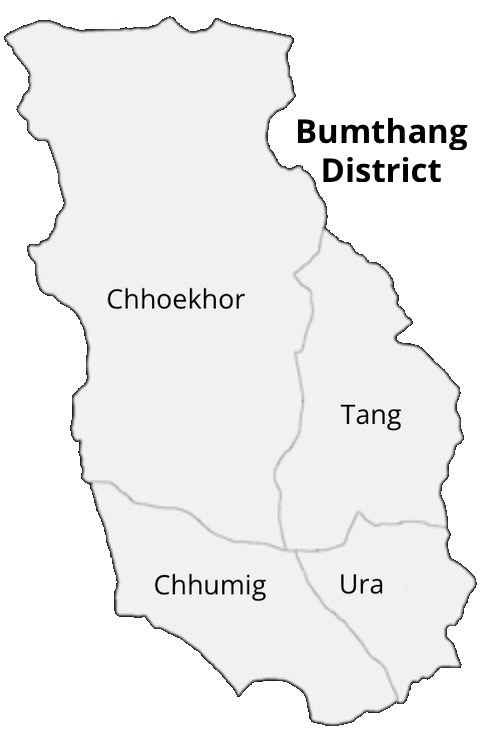
Bumthangkha is spoken primarily in the four valleys (Tang, Ura, Chhume, and Choekhor) that constitute the Bumthang district of central Bhutan. Each valley has its own dialectal variety, with the Choekhor valley dialect serving as the most commonly referenced form. Smaller communities of Bumthangkha speakers are found in adjacent parts of Trongsa and Zhemgang districts, and among migrants in Thimphu. The language has no significant speaker community outside Bhutan.[14]
References
- "Bumthang language." Wikipedia.
- "Bumthang District." Wikipedia.
- "Bumthangkha." Ethnologue.
- "East Bodish languages." Wikipedia.
- "East Bodish languages." Wikipedia.
- "Bumthang District." Wikipedia.
- "Bhutan — Languages." Country Studies, Library of Congress.
- "Bumthang language." Wikipedia.
- "Bumthang language." Wikipedia.
- "Bumthang language." Wikipedia.
- "Bumthangkha." Ethnologue.
- "Bumthang language." Wikipedia.
- "Bumthang District." Wikipedia.
- "Bumthang language." Wikipedia.
Related articles
Know something about this topic? Edit this article or . Anonymous contributions welcome — no account required.