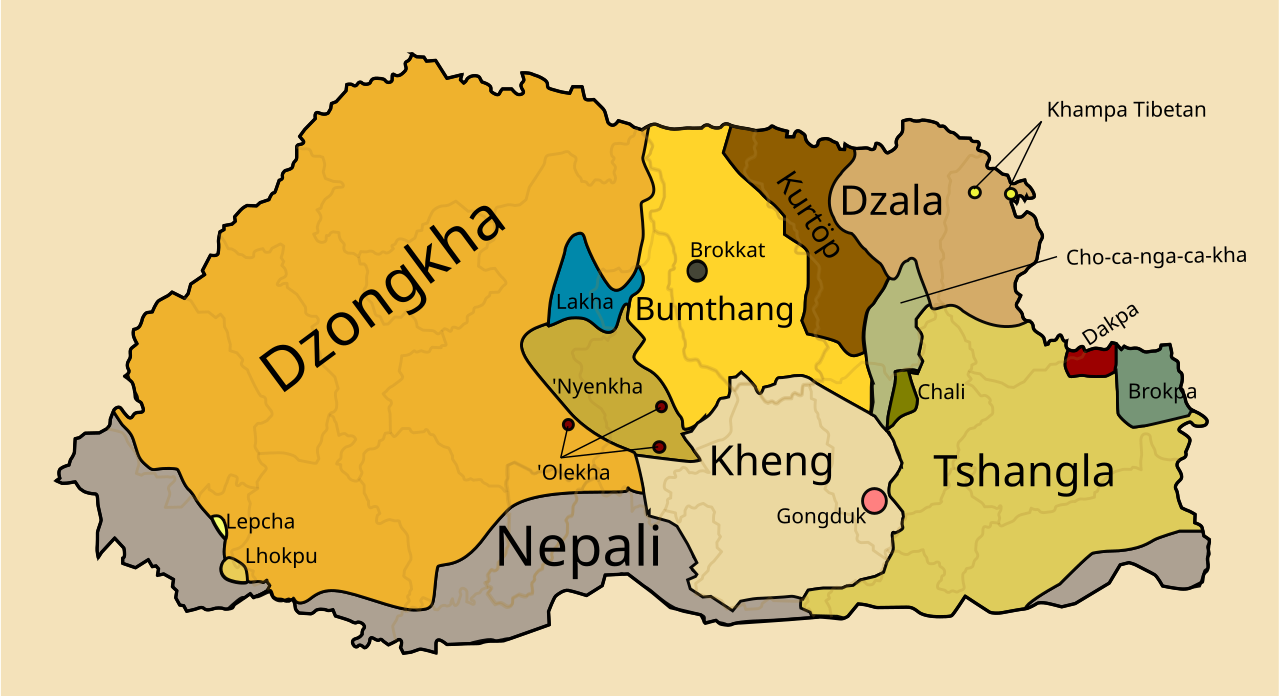

Khengkha (also written Kheng-kha or Khenkha) is a Tibeto-Burman language spoken by the Kheng people in the south-central districts of Zhemgang and Trongsa in Bhutan. With an estimated 40,000 speakers, it ranks among the more widely spoken minority languages of the country. Khengkha is a member of the East Bodish language family, the same linguistic grouping that includes Bumthangkha and Kurtopkha, and it shares with these languages a deep historical presence in the central valleys of Bhutan that predates the arrival of Tibetic-speaking populations.[1]
The Kheng people inhabit one of the most geographically rugged and historically isolated regions of Bhutan. The deep gorges and subtropical forests of Zhemgang district have limited external contact and helped preserve a distinctive linguistic and cultural identity. Khengkha remains a vital language of daily communication in rural Kheng communities, but like other minority languages of Bhutan, it faces pressure from the national language Dzongkha and from English, the medium of instruction in schools.[2]
Despite its relatively large number of speakers, Khengkha has received limited scholarly attention compared to Dzongkha or even Bumthangkha. There is no comprehensive grammar or dictionary of the language, and documentation efforts have been confined to word lists, brief phonological sketches, and comparative linguistic studies of the East Bodish family. This documentation gap, combined with the absence of any official support, places Khengkha among the vulnerable languages of the eastern Himalayan region.[3]
Classification
Khengkha belongs to the East Bodish branch of the Tibeto-Burman language family. Within East Bodish, it is generally considered to be most closely related to Bumthangkha, with which it shares a substantial portion of core vocabulary and several grammatical features. However, mutual intelligibility between Khengkha and Bumthangkha is limited, and speakers of the two languages typically communicate through Dzongkha when they meet. The East Bodish languages as a group are distinguished from the Tibetic languages of western Bhutan and from the Tshangla group of the east, representing an intermediate and archaic stratum of Tibeto-Burman in the central Bhutanese highlands.[4]
Within Khengkha itself, there is notable dialectal variation between the speech of different valleys and gewogs (administrative blocks) in the Zhemgang and Trongsa districts. The rugged terrain has historically limited contact between communities and fostered the development of distinct local varieties. Some scholars have suggested that what is labelled "Khengkha" may in fact encompass a small dialect chain rather than a single homogeneous language, though research on this question remains preliminary.[5]
History
The Kheng people are considered to be among the indigenous inhabitants of south-central Bhutan. Bhutanese historical traditions distinguish the Kheng from both the Ngalop of the west and the Sharchop of the east, recognising them as a distinct ethnic and linguistic community with deep roots in the central highlands. The name "Kheng" appears in historical records as a regional designation from at least the medieval period, when the area was governed by local chieftains before being incorporated into the unified state by Zhabdrung Ngawang Namgyal in the seventeenth century.[6]
The integration of the Kheng region into the centralised Bhutanese state brought Dzongkha-speaking administrators and the influence of the dzong system to the area. The construction of Zhemgang Dzong served as the seat of regional authority and a conduit for the Dzongkha language and western Bhutanese cultural norms. However, the area's remoteness and difficult terrain meant that assimilation proceeded more slowly than in other regions, allowing Khengkha and local cultural practices to persist with greater vitality than in some other minority language areas.[7]
Phonology
Khengkha exhibits a phonological system broadly characteristic of the East Bodish languages. It features a tonal contrast, with high and low register tones distinguishing otherwise similar syllables. The consonant system includes voiceless aspirated and unaspirated stops, voiced stops, affricates, nasals, laterals, and fricatives. Like Bumthangkha, Khengkha possesses palatalised consonants that differentiate it from neighbouring Tibetic languages.[8]
The vowel inventory includes both front and back vowels with possible length distinctions, though the exact vowel system requires further study. Verb morphology is notably complex, with a system of evidential markers that encode the speaker's source of information — a typological feature shared with other East Bodish languages and of interest to linguists studying epistemic marking in Himalayan languages. Word order follows the subject-object-verb pattern typical of Tibeto-Burman languages.[9]
Writing System
Khengkha has no indigenous or standardised writing system. Literate Kheng people have historically used the Tibetan script for religious texts and Dzongkha for official purposes. No systematic effort has been made to develop a Khengkha orthography, whether in Tibetan script or in a Roman-based system. This means the language exists almost entirely in the oral domain, with no written literature, periodicals, or digital presence.[10]
The absence of a writing system severely limits the possibilities for language maintenance through education or media. While Bhutan Broadcasting Service occasionally includes content in minority languages, Khengkha does not receive regular programming. Documentation by international linguists has used IPA-based transcription for academic purposes but has not been translated into community-facing literacy materials.[11]
Status and Vitality
Khengkha is classified as "vulnerable" in assessments of language endangerment. The language continues to be transmitted to children in rural parts of Zhemgang and Trongsa, but several factors threaten its long-term vitality. The construction of roads linking the Kheng region to Thimphu and other major centres in recent decades has dramatically increased mobility and exposure to Dzongkha. Young Kheng people who attend school in district centres or in the capital frequently shift to Dzongkha and English as their primary languages.[12]
Migration from rural areas to urban centres is perhaps the most significant factor driving language shift. As Kheng families relocate to Thimphu for economic opportunities, children grow up in a multilingual environment where Khengkha is rarely the dominant language. Without institutional support — in the form of school instruction, media content, or official recognition — the language's survival depends largely on the strength of community identity and intergenerational transmission within the home.[13]
Geographic Distribution
Khengkha speakers are concentrated in the Zhemgang district, particularly in the gewogs of Trong, Nangkor, Phangkhar, Bardo, and Shingkhar, and in the southern parts of the Trongsa district. The Zhemgang district as a whole is one of the least populated and most heavily forested in Bhutan, with communities scattered across steep hillsides and river valleys at altitudes ranging from 500 to 3,000 metres. Small Kheng communities also exist in Thimphu and other urban areas as a result of recent internal migration. There is no significant Khengkha-speaking population outside Bhutan.[14]
References
- "Khengkha language." Wikipedia.
- "Khengkha." Ethnologue.
- "Khengkha language." Wikipedia.
- "East Bodish languages." Wikipedia.
- "Khengkha language." Wikipedia.
- "Zhemgang District." Wikipedia.
- "Zhemgang District." Wikipedia.
- "Khengkha language." Wikipedia.
- "Khengkha language." Wikipedia.
- "Khengkha." Ethnologue.
- "Khengkha language." Wikipedia.
- "Khengkha." Ethnologue.
- "Khengkha language." Wikipedia.
- "Zhemgang District." Wikipedia.
Related articles
Know something about this topic? Edit this article or . Anonymous contributions welcome — no account required.