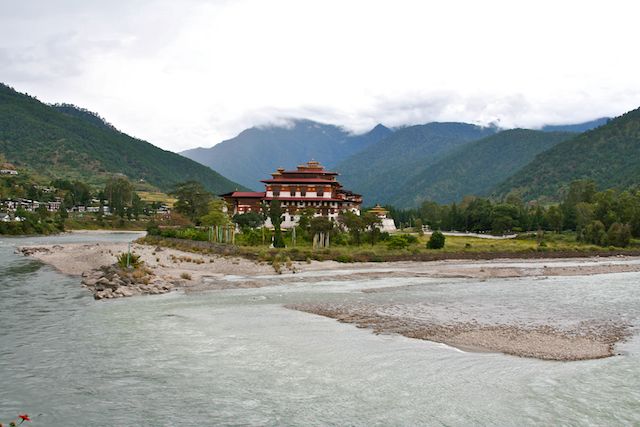

The Punatsang Chhu (Dzongkha: པུ་ན་གཙང་ཆུ; also spelled Punatshang Chhu or Punakha Chhu) is a major river in west-central Bhutan formed by the confluence of the Mo Chhu ("Female River") and the Pho Chhu ("Male River") at the iconic Punakha Dzong. After the two rivers merge at this historically and architecturally significant point, the combined waterway flows southward through Wangdue Phodrang district before crossing into India, where it is known as the Sunkosh River (or Raidak River in its lower reaches). The Punatsang Chhu system drains the Punakha-Wangdue valley, one of Bhutan's most fertile and historically important lowland regions.[1]
The confluence of the Mo Chhu and Pho Chhu at Punakha Dzong is one of the most celebrated geographic features in Bhutan. The dzong, built in 1637-38 by Zhabdrung Ngawang Namgyal, was strategically positioned on the narrow spit of land where the two rivers meet, creating a natural moat on three sides. Punakha served as the capital of Bhutan and the seat of government until 1955, when the capital was moved to Thimphu. The dzong continues to serve as the winter residence of the Central Monastic Body, and the Punatsang Chhu valley remains one of the warmest and most productive agricultural areas in the country.[2]
As a hydrological system, the Punatsang Chhu is significant both for its cultural associations and its practical importance. The river basin supports extensive rice cultivation, and its waters are central to the livelihoods of communities in the Punakha and Wangdue Phodrang districts. On the Indian side, the Sunkosh/Raidak River system is an important waterway in the Duars region of West Bengal and Assam, contributing to the Brahmaputra's massive drainage network.[3]
Tributaries: Mo Chhu and Pho Chhu
The Punatsang Chhu is formed by two principal tributaries, each of which is a substantial river in its own right. The Mo Chhu ("Mother" or "Female River") flows from the northwest, originating in the high mountains along the Tibetan border. It drains the Gasa district, one of the most remote and sparsely populated areas of Bhutan, and passes through the Jigme Dorji National Park. The Mo Chhu is known for its relatively gentle flow and turquoise waters, characteristics that may have contributed to its feminine designation in Bhutanese tradition.[4]
The Pho Chhu ("Father" or "Male River") originates to the northeast, with its headwaters in the glacial lakes of Lunana, one of the most remote inhabited regions on Earth. The Pho Chhu is characterised by faster, more turbulent flow — hence its masculine name. It was the Pho Chhu that caused the catastrophic glacial lake outburst flood (GLOF) of 1994, when the glacial lake Lugge Tsho burst, sending a wall of water downstream that caused extensive damage and killed 21 people at Punakha. This event brought international attention to the GLOF hazard in Bhutan and prompted extensive monitoring and mitigation programmes.[5]
The gendered naming of these two tributaries reflects a common Bhutanese and Tibetan tradition of ascribing masculine and feminine qualities to natural features. The meeting of the "male" and "female" rivers at Punakha Dzong is symbolically significant and is referenced in Bhutanese art, literature, and religious commentary.
Geography and Course
Below the confluence at Punakha, the Punatsang Chhu flows south through the broad Punakha-Wangdue valley, which sits at an elevation of approximately 1,200 to 1,300 metres. This is one of the lowest and warmest major valleys in Bhutan, with a subtropical climate that allows the cultivation of crops not viable in the country's higher-altitude areas. The valley floor is extensively terraced for rice paddies, and citrus orchards line the lower slopes.
The river passes near Wangdue Phodrang, the administrative centre of the eponymous district, where the ruins of Wangdue Phodrang Dzong (destroyed by fire in 2012 and currently under reconstruction) overlook the valley. Below Wangdue, the Punatsang Chhu enters increasingly steep and forested gorges as it descends towards the Indian border, dropping from 1,200 metres to approximately 200 metres over a distance of roughly 100 kilometres.[6]
Upon crossing into India, the river is known as the Sunkosh or Raidak. It flows across the Duars plains in the Alipurduar and Cooch Behar districts of West Bengal before eventually joining the Brahmaputra in Assam. The total length of the river system from its most distant headwaters to its confluence with the Brahmaputra is approximately 320 kilometres.[7]
Historical Significance
The Punatsang Chhu valley has been central to Bhutanese history for centuries. Punakha Dzong, at the confluence, served as the administrative capital of Bhutan from its construction in the seventeenth century until 1955. Virtually every major event in Bhutanese political history during this period took place within or near the dzong: the coronation of Ugyen Wangchuck as the first King of Bhutan in 1907 was held at Punakha, and the dzong continues to host the most sacred religious relics of the Bhutanese state, including the Ranjung Karsapani, a self-created image of Avalokiteshvara.[8]
The valley also witnessed several of the battles that defined Bhutanese sovereignty. Tibetan invasions in the seventeenth and eighteenth centuries targeted Punakha, and the dzong's riverside position provided both a defensive advantage and a vulnerability to flooding. The 1994 GLOF event caused significant damage to the dzong itself, leading to extensive restoration work that incorporated modern flood-protection measures.
Agriculture and Economy
The Punakha-Wangdue valley is one of Bhutan's most productive agricultural regions. The warm climate and abundant water from the Punatsang Chhu and its tributaries support two rice harvests per year in some areas, a rarity in mountainous Bhutan where most regions can manage only a single crop. The valley produces red rice, vegetables, citrus fruits, and increasingly, high-value crops such as cardamom and ginger for export.[9]
Tourism is another growing contributor to the valley's economy. Punakha Dzong is among the most visited cultural sites in Bhutan, and the Mo Chhu has become a popular destination for whitewater rafting, offering Class III and IV rapids set against a backdrop of pristine Himalayan scenery. The annual Punakha Drubchen and Tshechu festivals, held at the dzong, draw both domestic pilgrims and international visitors.
Hydropower and Water Management
The Punatsang Chhu system has been identified as a potential site for hydropower development. The 1,200 MW Punatsangchhu-I Hydroelectric Project and the 1,020 MW Punatsangchhu-II Hydroelectric Project are two major facilities under development on the river, representing some of the largest hydropower investments in Bhutanese history. Both projects are bilateral ventures between Bhutan and India. Punatsangchhu-I, originally expected to be completed by 2016, has faced significant delays due to geological challenges, including unstable rock formations at the dam site, pushing the expected completion date into the late 2020s.[10]
The GLOF risk from glacial lakes in the Pho Chhu headwaters remains a major concern for water management in the basin. Following the 1994 disaster, the Bhutanese government, with support from UNDP and other international organisations, has implemented a comprehensive monitoring system for glacial lakes in the Lunana region. Artificial lowering of lake levels has been undertaken at several sites to reduce the risk of catastrophic outburst floods, though the retreating glaciers continue to form new potentially dangerous lakes as the climate warms.[11]
References
- "Punatsang Chhu." Wikipedia.
- "Punakha Dzong." Wikipedia.
- "Raidak River." Wikipedia.
- "Mo Chhu." Wikipedia.
- "Pho Chhu." Wikipedia.
- "Wangdue Phodrang District." Wikipedia.
- "Raidak River." Wikipedia.
- "Punakha Dzong." Wikipedia.
- "Bhutan — Water Resources." Food and Agriculture Organization of the United Nations.
- "Punatsangchhu-I Hydroelectric Project." Wikipedia.
- "Addressing the Risks of Climate-induced Disasters through Enhanced National and Local Capacity for Effective Actions in Bhutan." UNDP Adaptation.
Related articles
Know something about this topic? Edit this article or . Anonymous contributions welcome — no account required.