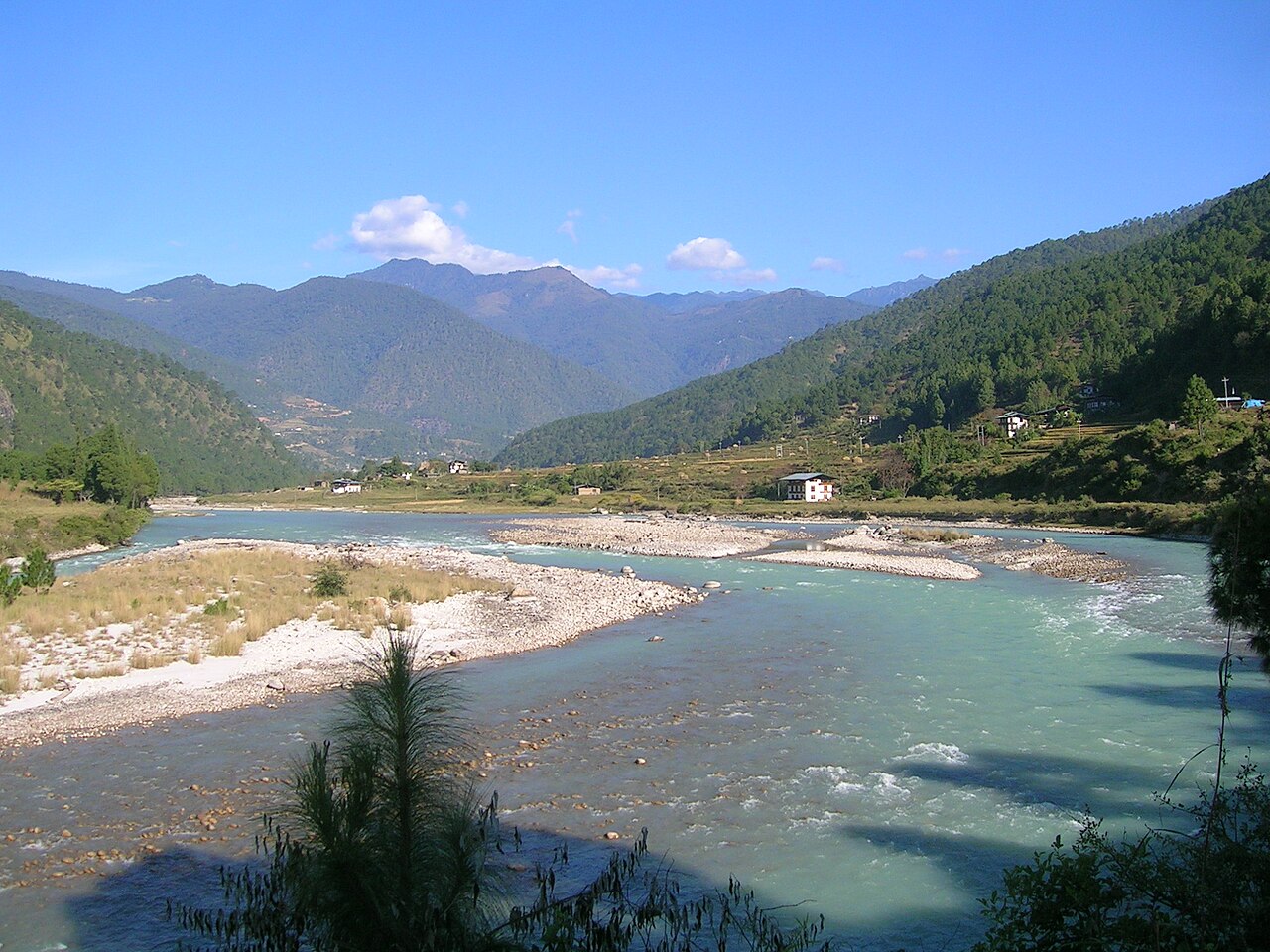

The Pho Chhu (Dzongkha: ཕོ་ཆུ, meaning "Father River" or "Male River") is one of the two principal rivers that define the landscape of Punakha District in western Bhutan. Originating from the glaciers of the remote Lunana region in Gasa District, the river descends through deep gorges and forested valleys before reaching the Punakha Valley, where it joins the Mo Chhu ("Mother River") at the site of Punakha Dzong. The confluence of the two rivers — the masculine and feminine — at the foot of Bhutan's most important historical fortress is among the most iconic geographical features of the kingdom.[1]
The Pho Chhu earns its "male" designation from its more turbulent and powerful flow compared to the gentler Mo Chhu. The river is noticeably faster, carrying a heavier sediment load from the steep terrain of its upper catchment. After merging with the Mo Chhu, the combined waters form the Puna Tsang Chhu (known as the Sankosh River once it crosses into India), which eventually drains into the Brahmaputra in Assam.[2]
Like all of Bhutan's major rivers, the Pho Chhu flows roughly from north to south, descending from the high Himalayan crest to the subtropical plains of the Indo-Gangetic lowlands. This dramatic elevation gradient — from over 5,000 metres at its glacial sources to approximately 1,200 metres at the Punakha confluence — gives the river considerable hydroelectric potential, which the Bhutanese and Indian governments have sought to harness through major dam projects.[1]
Geography and Course
The Pho Chhu's headwaters lie in the Lunana Gewog of Gasa District, one of the most remote inhabited areas in Bhutan. The river is fed by meltwater from several glacial lakes, including the Thorthormi and Raphstreng lakes, which sit at elevations between 4,000 and 5,000 metres. From Lunana, the river flows southward through the narrow Pho Chhu valley, passing through areas of old-growth conifer and broadleaf forests with minimal human settlement.[3]
As it enters the Punakha Valley, the river broadens and its gradient lessens, allowing the formation of terraced agricultural land on its banks. The lower Pho Chhu valley is one of the warmest and most fertile areas in Bhutan, producing rice, citrus, and a variety of vegetables. The river's annual flooding cycle has historically deposited nutrient-rich alluvium across the valley floor, sustaining the agricultural productivity that made Punakha an attractive site for the national capital.
The total length of the Pho Chhu from its glacial sources to the confluence with the Mo Chhu is approximately 120 kilometres. The combined Puna Tsang Chhu continues for roughly 250 kilometres before crossing the Indian border near Daifam in Assam.
Glacial Lake Outburst Floods
The Pho Chhu is particularly vulnerable to glacial lake outburst floods (GLOFs), a hazard that has intensified with climate change. The river's source lakes in Lunana are dammed by unstable glacial moraines, and rising temperatures have caused these lakes to expand as glaciers retreat. The most significant recent GLOF event on the Pho Chhu occurred on 7 October 1994, when Luggye Tsho burst through its moraine dam, releasing an estimated 18 million cubic metres of water. The resulting flood wave travelled down the Pho Chhu at speeds of up to 4 metres per second, killing 21 people, destroying homes and farmland, and damaging Punakha Dzong itself.[4]
Following the 1994 disaster, the Royal Government of Bhutan, with support from UNDP and the governments of Austria, India, and Japan, initiated a long-term GLOF risk reduction programme. This included the manual lowering of water levels in Thorthormi Tsho by constructing drainage channels at approximately 4,500 metres elevation — a remarkable feat of high-altitude engineering. An early warning system with sensors and sirens was also installed along the Pho Chhu valley, allowing downstream communities time to evacuate in the event of a future outburst.[5]
Cultural Significance
The Pho Chhu's confluence with the Mo Chhu at Punakha Dzong carries profound symbolic meaning in Bhutanese culture. The meeting of the "Father" and "Mother" rivers is interpreted as a union of masculine and feminine principles, echoing tantric Buddhist symbolism that pervades Bhutanese religious thought. Zhabdrung Ngawang Namgyal is said to have chosen the confluence site for his dzong precisely because of this auspicious geography, which he interpreted as a sign of divine favour.[6]
The river also features in Bhutanese oral tradition and folk religion. Local communities along the Pho Chhu venerate river deities (lu or naga) believed to inhabit the deeper pools and rapids. Ritual offerings are made to these water spirits to ensure good harvests, prevent floods, and maintain the wellbeing of the community. These practices blend pre-Buddhist animist traditions with Vajrayana Buddhist ritual, reflecting the syncretic character of Bhutanese spirituality.
Hydropower Development
The Pho Chhu basin is central to Bhutan's hydropower development strategy. The Punatsangchhu-I Hydroelectric Project (1,200 MW), located on the Puna Tsang Chhu downstream of the Mo Chhu–Pho Chhu confluence, is one of the largest bilateral projects between Bhutan and India. Construction began in 2008, but the project has encountered severe geological difficulties, including the discovery of unstable rock formations at the dam site that necessitated significant design modifications and caused years of delay.[7]
The Punatsangchhu-II project (1,020 MW), located further downstream, has faced similar challenges. These projects underscore both the immense hydroelectric potential of the Pho Chhu system and the engineering complexities of building large-scale infrastructure in the seismically active, geologically young Himalayas. When completed, the two projects are expected to more than double Bhutan's installed hydroelectric capacity, with the bulk of the generated electricity destined for export to India.[8]
Tourism
While the Mo Chhu is the more established rafting river, the Pho Chhu also attracts adventure tourists seeking a more challenging experience. Its faster currents and Class III–IV rapids appeal to experienced rafters and kayakers. The river is typically navigable for rafting from October to March, outside the monsoon season when water levels become dangerously high.
The scenic walk along the Pho Chhu from Punakha Dzong to the Khamsum Yulley Namgyal Chorten, a temple built by the Queen Mother Ashi Tshering Yangdon Wangchuck, is among the most popular short hikes in the Punakha Valley. The trail follows the river's western bank through rice paddies and small villages, offering views of the river valley and surrounding mountains.[9]
References
- "Pho Chhu." Wikipedia.
- "Sankosh River." Wikipedia.
- "Lunana Gewog." Wikipedia.
- "Addressing Risks of Climate-Induced GLOF." UNDP Bhutan.
- "Reducing Climate Change-Induced Risks and Vulnerabilities from Glacial Lake Outburst Floods in the Punakha-Wangdi and Chamkhar Valleys." UNDP Adaptation.
- "Punakha Dzong." UNESCO World Heritage Tentative List.
- "Punatsangchhu-I Hydroelectric Project Authority." Royal Government of Bhutan.
- "Punatsangchhu-II Hydroelectric Project Authority." Royal Government of Bhutan.
- "Punakha." Wikipedia.
Related articles
Know something about this topic? Edit this article or . Anonymous contributions welcome — no account required.