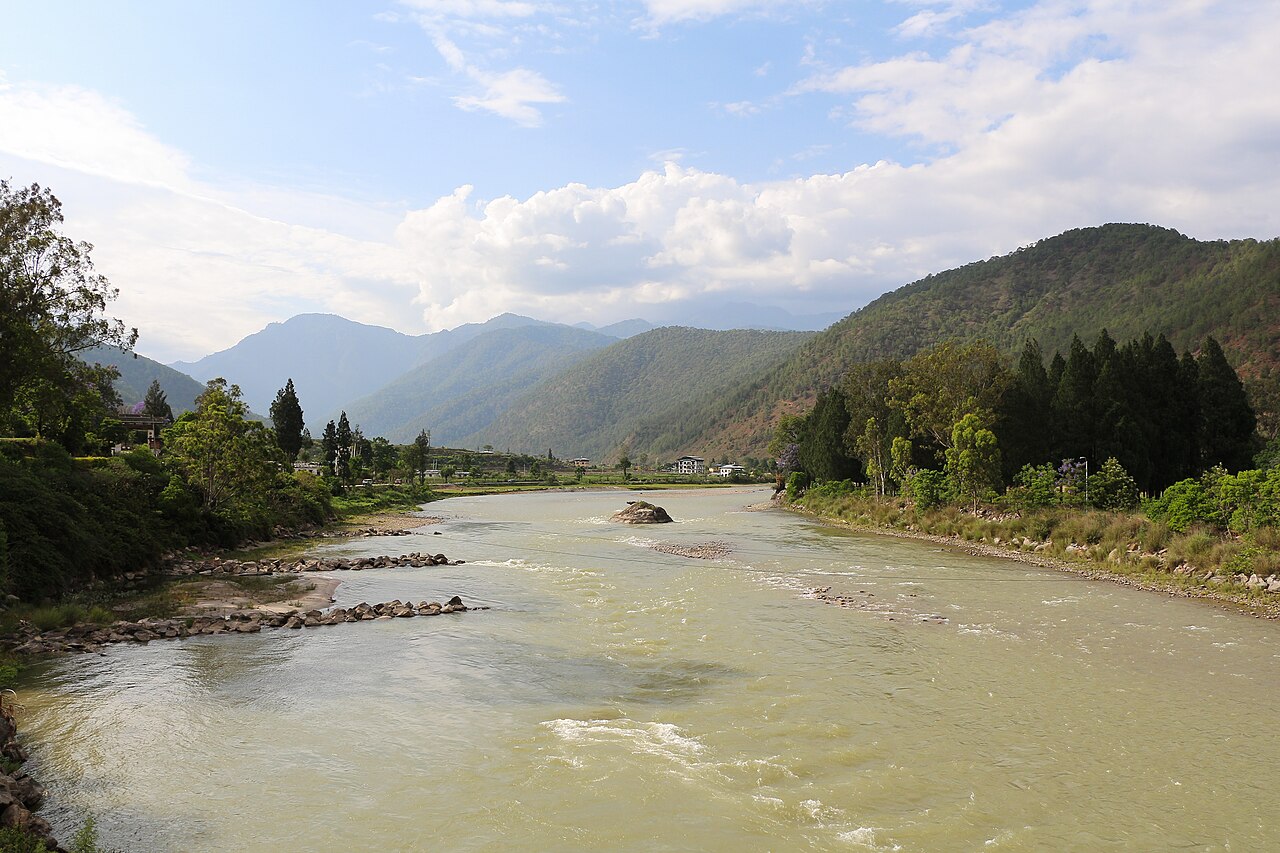

The Mo Chhu (Dzongkha: མོ་ཆུ, meaning "Mother River" or "Female River") is one of the principal rivers of western Bhutan, flowing southward through the Punakha Valley in Punakha District. The river originates in the northern reaches of the Lingzhi and Laya regions near the Tibetan border, fed by glacial melt from peaks exceeding 7,000 metres in the Bhutanese Himalayas. It converges with the Pho Chhu ("Father River") at the historically and spiritually significant site of Punakha Dzong, where the two rivers embrace the fortress on its narrow promontory — an image that has become one of the most recognisable in Bhutanese iconography.[1]
The name "Mo Chhu" follows the Bhutanese tradition of gendering rivers: "mo" denotes the feminine, and the river's gentler current relative to the turbulent Pho Chhu is said to account for its designation. Together, the Mother and Father Rivers form the Puna Tsang Chhu (also known as the Sankosh River), which flows southward through Wangdue Phodrang District and eventually into the Indian state of Assam, where it joins the Brahmaputra river system.[2]
The Mo Chhu holds deep cultural significance for the Bhutanese people. Its waters are considered sacred, and the confluence with the Pho Chhu at Punakha Dzong is regarded as an auspicious site. The river valley has served as a seat of political and religious authority since the seventeenth century, when Zhabdrung Ngawang Namgyal chose the confluence as the site for one of his greatest fortresses.[3]
Geography and Hydrology
The Mo Chhu originates in the high-altitude glacial lakes and snowfields of the Lunana region in northern Gasa District, at elevations above 5,000 metres. The river descends rapidly through steep gorges and dense temperate forests before reaching the broader Punakha Valley at approximately 1,200 metres elevation. Its total length from source to confluence with the Pho Chhu is approximately 130 kilometres, though the combined river continues as the Puna Tsang Chhu for another 250 kilometres before crossing into India.[1]
The river's flow is strongly seasonal, swelling during the monsoon months of June through September when heavy rainfall combines with accelerated glacial melt. During the dry winter months, the Mo Chhu narrows considerably, revealing extensive gravel bars and sandy banks. The river carries a substantial sediment load, particularly during the monsoon, which contributes to the fertile alluvial soils of the Punakha Valley — one of the most productive agricultural areas in Bhutan.[4]
A significant hydrological concern is the risk of glacial lake outburst floods (GLOFs) from Lunana's unstable moraine-dammed lakes, particularly Raphstreng Tsho and Thorthormi Tsho. A devastating GLOF in 1994 from Luggye Tsho sent a wall of water down the Pho Chhu, killing 21 people and destroying infrastructure in the Punakha Valley; the floodwaters reached the Mo Chhu only at the Punakha confluence. The Bhutanese government, with international assistance, has since undertaken extensive monitoring and mitigation efforts, including the lowering of lake water levels.[5]
Cultural and Historical Significance
The Mo Chhu's most celebrated cultural association is with Punakha Dzong, the "Palace of Great Happiness," built at the confluence of the Mo Chhu and Pho Chhu in 1637-1638 by Zhabdrung Ngawang Namgyal. The dzong served as the capital of Bhutan until 1955 and remains the winter residence of the Central Monk Body. The strategic placement of the fortress between two rivers provided natural defensive moats while the sacred geography of the converging waters conferred spiritual legitimacy on the seat of power.[6]
The river valley is also the site of the Punakha Tshechu, one of the most important annual religious festivals in Bhutan. During this festival, the sacred Rangjung Kasarpani, a self-created image of Avalokiteshvara (Chenrezig), is displayed to the public — an event that draws thousands of devotees. The coronation ceremonies of Bhutanese monarchs have traditionally taken place at Punakha Dzong, reinforcing the spiritual connection between the river landscape and national identity.[7]
Tourism and Whitewater Rafting
The Mo Chhu has become one of Bhutan's most popular adventure tourism destinations, particularly for whitewater rafting. The river offers Class II to Class IV rapids depending on the season, making it accessible to both beginners and experienced rafters. The standard rafting run covers approximately 10 kilometres through the Punakha Valley, passing through subtropical forest, terraced rice paddies, and traditional farmsteads, with Punakha Dzong providing a dramatic backdrop at the journey's end.[8]
Rafting on the Mo Chhu was introduced in the early 2000s as part of Bhutan's effort to diversify its tourism offerings beyond cultural sightseeing. The activity is typically available from October through March, when water levels are manageable and the weather is clear. Several licensed tour operators offer half-day and full-day rafting trips, often combined with visits to Punakha Dzong and the Chimi Lhakhang fertility temple nearby. The river is also increasingly popular for kayaking among more experienced paddlers.[8]
Hydropower
The Mo Chhu and its continuation as the Puna Tsang Chhu are integral to Bhutan's hydropower sector, which constitutes the country's largest source of export revenue. The proposed Punatsangchhu-I (1,200 MW) and Punatsangchhu-II (1,020 MW) hydroelectric projects, located downstream of the Mo Chhu–Pho Chhu confluence, are among the largest infrastructure projects in Bhutan's history. These joint ventures with India have faced significant geological challenges and delays, but when completed, they are expected to substantially increase Bhutan's hydroelectric capacity and revenue from electricity exports to India.[9]
Environmental Concerns
The Mo Chhu basin faces several environmental pressures. Climate change threatens the glaciers that feed the river, potentially altering flow patterns in the coming decades — with initial increases in discharge as glaciers retreat, followed by long-term reductions. Agricultural runoff and waste disposal from the growing population in the Punakha Valley pose water quality challenges. The Bhutanese government has designated portions of the river's upper catchment within Jigme Dorji National Park, the country's largest protected area, helping to safeguard the watershed.[4]
References
- "Mo Chhu." Wikipedia.
- "Sankosh River." Wikipedia.
- "Punakha." Wikipedia.
- "Bhutan State of Environment Report." National Environment Commission, Royal Government of Bhutan.
- "Addressing Risks of Climate-Induced GLOF in Punakha-Wangdue and Chamkhar Valleys." UNDP Bhutan.
- "Punakha Dzong." UNESCO World Heritage Tentative List.
- "Punakha Tshechu & Dromchoe." Wikipedia.
- "Rafting." Wikipedia.
- "Punatsangchhu Hydroelectric Project Authority." Royal Government of Bhutan.
Related articles
Know something about this topic? Edit this article or . Anonymous contributions welcome — no account required.