Karma Phuntsho: The History of Bhutan
From BhutanWiki, the people's encyclopedia of Bhutan · history · Verified
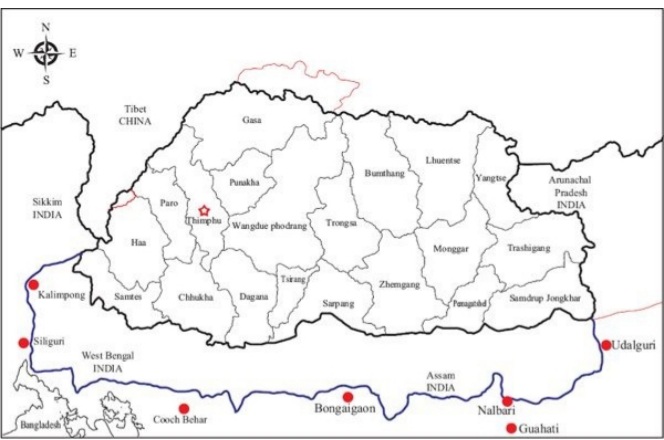

The History of Bhutan by Karma Phuntsho, published by Random House India in 2013, is the first comprehensive, single-author history of the Kingdom of Bhutan. Spanning the full arc of Bhutanese civilisation from its prehistoric origins to the democratic transition of 2008, the book represents a landmark in Bhutanese scholarship — the first time a Bhutanese author has produced a work of this scope and depth for an international audience. Phuntsho, a scholar trained at both the University of Oxford and traditional Bhutanese monastic institutions, brings a unique dual perspective to his subject, combining rigorous academic methodology with deep familiarity with Bhutanese religious and literary traditions.[1]
The book fills a significant gap in Himalayan historiography. Before Phuntsho’s work, the most substantial histories of Bhutan available in English were either colonial-era accounts by British officials or edited collections by Western scholars. No single work had attempted to narrate the entire history of Bhutan from within, drawing on the full range of Bhutanese-language sources — including Buddhist chronicles, royal biographies, legal codes, and oral traditions — alongside Tibetan, British, and Indian archival materials. The History of Bhutan has been described by reviewers as the work that establishes Bhutanese history as a mature field of academic study.[2]
Published by Random House India (now Penguin Random House India), the book has been widely adopted in university courses on South Asian and Himalayan studies and is frequently cited in academic publications on Bhutanese politics, culture, and society.
The Author
Karma Phuntsho was born in Bhutan and received a traditional monastic education before pursuing advanced studies at the University of Oxford, where he earned a doctorate in Oriental Studies. He is the founder and president of the Loden Foundation, a Bhutanese civil society organisation dedicated to education and cultural preservation. Phuntsho’s dual training — in the rigorous philological and historical methods of Western academia and in the textual and contemplative traditions of Bhutanese Buddhism — gives his work a distinctive authority. He is able to read and interpret primary sources in Dzongkha, Choekay (classical Tibetan), and English, and his analysis of Bhutanese religious history draws on a textual base that is largely inaccessible to scholars without training in the Tibetan Buddhist canon.[1]
Scope and Structure
The book is organised chronologically and covers the following major periods:
- Prehistoric and early Bhutan: Archaeological evidence, early settlement patterns, and the pre-Buddhist animistic traditions of the region.
- The arrival of Buddhism: The introduction of Buddhism to Bhutan, the role of Guru Rinpoche (Padmasambhava), and the establishment of the major Buddhist lineages.
- The Zhabdrung era: The life and legacy of Zhabdrung Ngawang Namgyal, the 17th-century Tibetan lama who unified Bhutan, established the dual system of government, built the great dzongs, and forged a distinctive Bhutanese national identity.
- The era of the Deb Rajas: The turbulent centuries of decentralised rule, civil conflict, and regional power struggles following the Zhabdrung’s death in 1651.
- The Wangchuck monarchy: The establishment of the hereditary monarchy in 1907, the modernisation programmes of the 20th century, and the reigns of the first four Druk Gyalpos.
- The democratic transition: The drafting of the Constitution of 2008 and the shift from absolute to constitutional monarchy.
Treatment of the Refugee Crisis
One of the most significant and sensitive aspects of the book is Phuntsho’s treatment of the Bhutanese refugee crisis of the late 1980s and 1990s. Phuntsho addresses the southern question — the political tensions surrounding the Lhotshampa (ethnic Nepali) population, the Citizenship Act of 1985, the census of 1988, the protests of 1990, and the mass displacement of approximately 100,000 people — with a degree of nuance that distinguishes his account from both the official Bhutanese government narrative and the advocacy literature of the refugee community.
Phuntsho acknowledges the suffering of the displaced population while also contextualising the government’s actions within broader concerns about national identity, sovereignty, and the perceived threat of demographic change. His account has been praised by some scholars for its balanced approach and criticised by others, particularly within the diaspora, for not going far enough in condemning the expulsions as ethnic cleansing. Regardless of one’s position, the book’s treatment of the crisis is the most substantive and sourced discussion of the issue by a Bhutanese author writing in an academic register.[1]
Scholarly Significance
The importance of The History of Bhutan lies not only in its narrative breadth but in its methodological contribution. Phuntsho’s work demonstrates that Bhutanese history can and should be written from within, drawing on indigenous sources that have been underutilised by Western scholars due to language barriers. The book’s extensive bibliography and endnotes constitute a research guide in themselves, pointing readers to primary and secondary sources in Dzongkha, Choekay, English, and other languages.
The book complements and in some areas supersedes earlier works, including Michael Aris’s Bhutan: The Early History of a Himalayan Kingdom (1979), which focused primarily on the medieval period, and Michael Hutt’s Unbecoming Citizens (2003), which concentrated specifically on the refugee crisis. Phuntsho’s work is the first to integrate all periods of Bhutanese history into a single, coherent narrative grounded in primary-source research.
The book has been reviewed positively in journals including the Journal of the Royal Asiatic Society, the Journal of Bhutan Studies, and Himalaya, with reviewers consistently noting the work’s accessibility to general readers as well as its scholarly depth. It has become a standard text in university courses on Bhutan and Himalayan studies and is frequently cited by researchers across disciplines.[2]
Publication Details
The History of Bhutan was published by Random House India (now Penguin Random House India) in 2013. It runs to approximately 700 pages, including maps, illustrations, a detailed timeline, glossary, bibliography, and index. The book is available in hardcover, paperback, and digital editions and has been reprinted multiple times to meet sustained demand. Its publication marked a turning point in how Bhutan’s history is understood and communicated, both within the country and internationally.
References
- Phuntsho, Karma. The History of Bhutan. Random House India, 2013. (Penguin Random House India listing)
- Review of The History of Bhutan in the Journal of the Royal Asiatic Society.
- “Karma Phuntsho.” Wikipedia.
Contributed by Anonymous Contributor, Akron, Ohio
Related articles
Know something about this topic? Edit this article or . Anonymous contributions welcome — no account required.