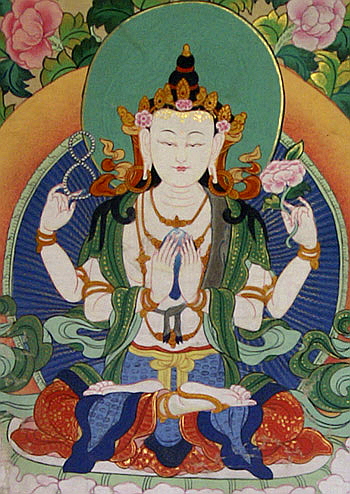

Phajo Drugom Zhigpo (Tibetan: pha jo 'brug sgom zhig po; c. 1184–1251, with some sources giving 1208–1276) was a Tibetan Buddhist lama from Kham in eastern Tibet who is credited with bringing the Drukpa Kagyu school of Buddhism to western Bhutan. His arrival in the early 13th century marked the beginning of the Drukpa tradition's deep roots in Bhutanese religious life, a tradition that would eventually shape the country's identity as Druk Yul, the "Land of the Thunder Dragon."[1]
Phajo is revered in Bhutan as an emanation of Avalokiteshvara, the bodhisattva of compassion. His life story interweaves spiritual accomplishment with political acumen: he not only transmitted esoteric Buddhist teachings but also forged alliances through marriage and appointed his sons as rulers over different regions, creating a network of religious authority that endured for centuries.[2]
The sacred sites associated with Phajo Drugom Zhigpo and his descendants — seventeen strongholds including meditation caves, temples, and monasteries — were inscribed on Bhutan's UNESCO World Heritage Tentative List in 2012, recognizing their outstanding cultural and spiritual significance.[3]
Early Life and Training in Tibet
Phajo was born in the Kham region of eastern Tibet. According to hagiographic accounts, the founder of the Drukpa school, Tsangpa Gyare Yeshe Dorje (1161–1211), prophesied his coming shortly before his death. Tsangpa Gyare reportedly told his nephew and spiritual heir, Onre Darma Sengye: "A Khampa son from Kham is coming. Send him to the southern valley that has been visited and blessed by Orgyen Padma Jungne [Guru Rinpoche]. He will be of great service to the Buddha Dharma."[1]
Phajo traveled to the Drukpa headquarters at Ralung Monastery in the Tsang region of central Tibet, where he studied under Onre Darma Sengye. His teacher bestowed upon him the name Phajo Drugom Zhigpo and granted him the complete empowerments and teachings of Rechungpa's Ear Whispered Transmission of Samvara — a set of esoteric tantric instructions transmitted through the lineage of Milarepa's disciple Rechungpa.[1]
Journey to Western Bhutan
Following the prophecy of Tsangpa Gyare and the instructions of his teacher, Phajo traveled southward into western Bhutan, arriving in the Thimphu valley region around 1222. The lands he entered were not without existing religious traditions; the Lhapa Kagyu school, another branch of the Kagyu lineage, already held considerable influence in western Bhutan. Phajo's arrival set the stage for a prolonged contest between the Drukpa and Lhapa traditions for religious and political supremacy in the region.[1]
Through a combination of spiritual authority, charisma, and strategic alliances, Phajo gradually displaced the Lhapa school's influence. He established meditation centres and teaching sites across the valleys of western Bhutan, systematically spreading the Drukpa Kagyu lineage's doctrines and practices among the local population.[2]
Marriage and the Consolidation of Power
A pivotal moment in Phajo's mission was his marriage to Khandro Sonam Peldon, a local woman whom Drukpa prophecy identified as a dakini (female embodiment of enlightened wisdom). Their union was both spiritual and political, lending Phajo local legitimacy and producing sons who would carry the Drukpa lineage throughout Bhutan. A memorial chorten near a stand of ancient cypress trees marks the place where Khandro Sonam Peldon died, with her personal belongings enshrined within.[2]
Division of Bhutan Among His Sons
Phajo divided western Bhutan among his sons, appointing each as both religious teacher and temporal ruler of a designated territory. According to traditional accounts, his son Garten was given authority over eastern Bhutan, including the regions of Dung, Hed, and Dong. Nima was appointed ruler of Gung and Chang and the frontier territories. Wangchuk received authority over Thed and the region of Wodi. Another son, referred to as Lama, was given responsibility for Paro and Thimphu. The youngest, Dampa, was instructed to remain at Tango and serve as custodian of the Drukpa teachings and its patrons.[2]
This division created a network of religious-political governance rooted in the Drukpa Kagyu lineage, a structure that would persist in various forms until the 17th-century unification of Bhutan under Zhabdrung Ngawang Namgyal.
Sacred Sites
Seventeen sacred sites are associated with Phajo Drugom Zhigpo and his descendants. Twelve of these are meditation sites said to have been entrusted to Phajo by Guru Rinpoche himself, while the remaining five are associated with the five clans descended from Phajo's sons. Notable sites include:[3]
- Tango Choying Dzong — founded by Phajo in the 13th century in the upper Thimphu valley, later rebuilt in its present form by Tenzin Rabgye, the 4th Desi, in 1688
- Phajoding Monastery — a major meditation centre above Thimphu named after Phajo, meaning "the temple of doctrine on the vulture peak"
- Changangkha Lhakhang — one of the oldest temples in the Thimphu valley, associated with Phajo's lineage
- Gomdrak, Thujedrak, and Dechen Drak — cliff-side meditation caves used by Phajo and his followers
Legacy
Phajo Drugom Zhigpo's legacy is foundational to Bhutanese identity. By transplanting the Drukpa Kagyu school from Tibet to Bhutan, he set in motion the religious tradition that would eventually give the country its name and its national symbol — the thunder dragon. Four centuries after Phajo's arrival, Zhabdrung Ngawang Namgyal, recognized as the fourth incarnation of Tsangpa Gyare, would build upon the Drukpa infrastructure that Phajo had established to unify Bhutan into a single nation-state.[4]
Phajo's descendants continued to wield significant religious and political influence in Bhutan for centuries, and many prominent Bhutanese families trace their lineage back to him. His life story remains a central narrative in Bhutanese Buddhist culture, taught in monasteries and celebrated at festivals across the western valleys he once wandered.
References
Related articles
Know something about this topic? Edit this article or . Anonymous contributions welcome — no account required.