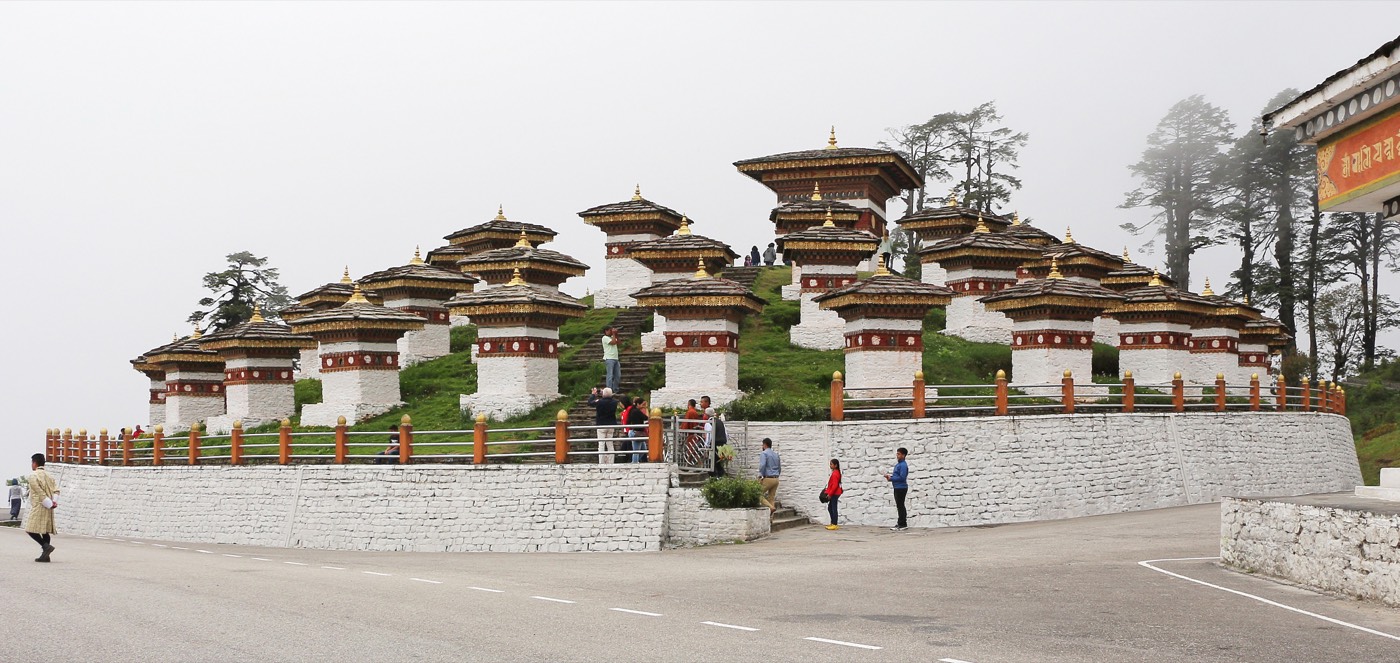
Dochula Pass (Dzongkha: རྡོ་ཆུ་ལ, also spelled Dochu La) is a high mountain pass situated at an elevation of 3,100 metres (10,171 feet) on the highway connecting Thimphu, Bhutan's capital, with the Punakha Valley to the east. Located approximately 30 kilometres from Thimphu, the pass marks the boundary between the Thimphu and Punakha districts and is one of the most photographed and frequently visited sites in the kingdom. On clear days, particularly during the autumn and winter months, the pass affords sweeping panoramic views of the snow-capped eastern Himalayan range, including several peaks exceeding 7,000 metres.[1]
The pass is best known for the 108 Druk Wangyal Chortens (memorial stupas), an impressive cluster of whitewashed structures built in 2005 by the eldest Queen Mother, Ashi Dorji Wangmo Wangchuck, in honour of Bhutanese soldiers who fell during the December 2003 military operation against Indian insurgent groups that had established camps in southern Bhutan. The chortens, arranged in three tiers on a hillock beside the road, have become one of Bhutan's most iconic landmarks and a powerful symbol of national sacrifice and resilience.[2]
In addition to the memorial chortens, Dochula Pass is home to the Druk Wangyal Lhakhang, a temple commissioned by the same Queen Mother, and the Royal Botanical Park, which preserves a diverse collection of Bhutan's highland flora. The pass serves as a natural gateway between the drier, more urbanised Thimphu valley and the warmer, subtropical Punakha Valley, and nearly every traveller journeying between the capital and the former winter capital at Punakha Dzong crosses it.[1]
Geography and Climate
Dochula Pass sits on the main ridge separating the Wang Chhu watershed (which drains Thimphu valley) from the Mo Chhu and Pho Chhu watersheds that drain the Punakha Valley. The pass occupies a saddle in the mountains covered in dense cloud forest — a mosaic of rhododendron, hemlock, fir, and dwarf bamboo typical of Bhutan's cool broadleaf and conifer zone.
The climate at the pass is markedly cooler and wetter than either valley it connects. Fog and low cloud are common throughout the year, particularly during the monsoon months of June to September, when the pass may be shrouded in mist for days at a time. Snowfall occasionally blankets the pass during winter, from December to February, creating a striking contrast with the white chortens. The best visibility — and the famous Himalayan panorama — typically occurs from late October through February, when clear skies reveal the peaks of Masang Gang (7,158 m), Tsenda Gang (6,960 m), Teri Gang (7,060 m), Jejegangphu Gang (7,158 m), Kangphu Gang (7,170 m), and Zongophu Gang (7,060 m), among others.[2]
The 108 Druk Wangyal Chortens
The 108 memorial chortens at Dochula Pass were built between 2004 and 2005 to commemorate the Bhutanese military operation of 15 December 2003, in which the Royal Bhutan Army, under the personal command of the Fourth King Jigme Singye Wangchuck, cleared camps of Indian insurgent groups — primarily the United Liberation Front of Assam (ULFA) and the National Democratic Front of Bodoland (NDFB) — from Bhutan's southern forests. The operation, which lasted approximately two weeks, was the first armed conflict involving the Bhutanese military in modern history and resulted in the deaths of several Bhutanese soldiers.[3]
The number 108 holds profound significance in Buddhism. It represents the number of delusions or afflictions (kleshas) that beings must overcome to achieve enlightenment, and it is a sacred number in Vajrayana Buddhist tradition. The chortens are arranged in three concentric tiers: the outermost ring contains 45 smaller chortens, the middle ring 36, and the innermost ring 27, each tier representing a different level of spiritual attainment. At the centre of the arrangement stands a larger chorten flanked by smaller ones.[2]
The architectural style of the chortens follows traditional Bhutanese design, with whitewashed stone bases tapering to gilded spires. Prayer flags in the five Buddhist colours (blue, white, red, green, yellow) flutter between the structures, their inscribed mantras carried by the wind. The entire site is maintained as a memorial garden with paved walking paths, allowing visitors to circumambulate the chortens in the traditional clockwise direction.
Druk Wangyal Lhakhang
Adjacent to the 108 chortens, the Druk Wangyal Lhakhang ("Temple of the Victory of the Thunder Dragon") was inaugurated in 2008. The temple was built by Queen Mother Ashi Dorji Wangmo Wangchuck and is dedicated to the Fourth King and the Bhutanese nation. Its interior features elaborate murals by the renowned Bhutanese artist Khandro Tshering Choden, depicting scenes from the 2003 military operation alongside traditional Buddhist imagery — an unusual blending of contemporary national history with religious art.[4]
The temple hosts the annual Druk Wangyal Tshechu, a festival held each December to mark the anniversary of the 2003 operation. Unlike most Bhutanese festivals, which feature masked dances with purely religious themes, the Druk Wangyal Tshechu incorporates patriotic performances celebrating the courage of the Fourth King and his soldiers. The festival has become a significant event on Bhutan's cultural calendar, attracting both domestic and international visitors.
Royal Botanical Park
The Dochula Royal Botanical Park, established near the pass, spans approximately 47 hectares and showcases Bhutan's remarkable highland plant diversity. The park contains nature trails winding through forests of native rhododendron (Bhutan has over 46 species), magnolia, primula, and other alpine and subalpine flora. It serves as both a conservation site and an educational resource, with interpretive signage identifying plant species and their traditional uses in Bhutanese medicine and culture.[2]
The park is particularly spectacular during the spring months of March to May, when the rhododendrons burst into bloom, covering the hillsides in shades of red, pink, purple, and white. The trails also offer opportunities for birdwatching, with species including the blood pheasant, satyr tragopan, and various laughingthrushes present in the surrounding forest.
Tourism
Dochula Pass is among the most visited sites in Bhutan, as virtually all tourists travelling between Thimphu and Punakha — the two most popular destinations in the country — cross the pass. Most visitors stop for between 30 minutes and an hour to photograph the chortens, visit the temple, and, if visibility permits, admire the Himalayan panorama. A small cafeteria at the pass offers hot drinks and light meals, a welcome respite on cold or rainy days.
The pass also serves as a starting point for several day hikes into the surrounding forests, including a popular trail to the Lungchutse Temple, a small monastery perched on a ridge above the pass at approximately 3,600 metres. The hike, which takes roughly two hours round trip, passes through pristine cloud forest and offers even more expansive mountain views than the pass itself.[2]
References
Related articles
Know something about this topic? Edit this article or . Anonymous contributions welcome — no account required.