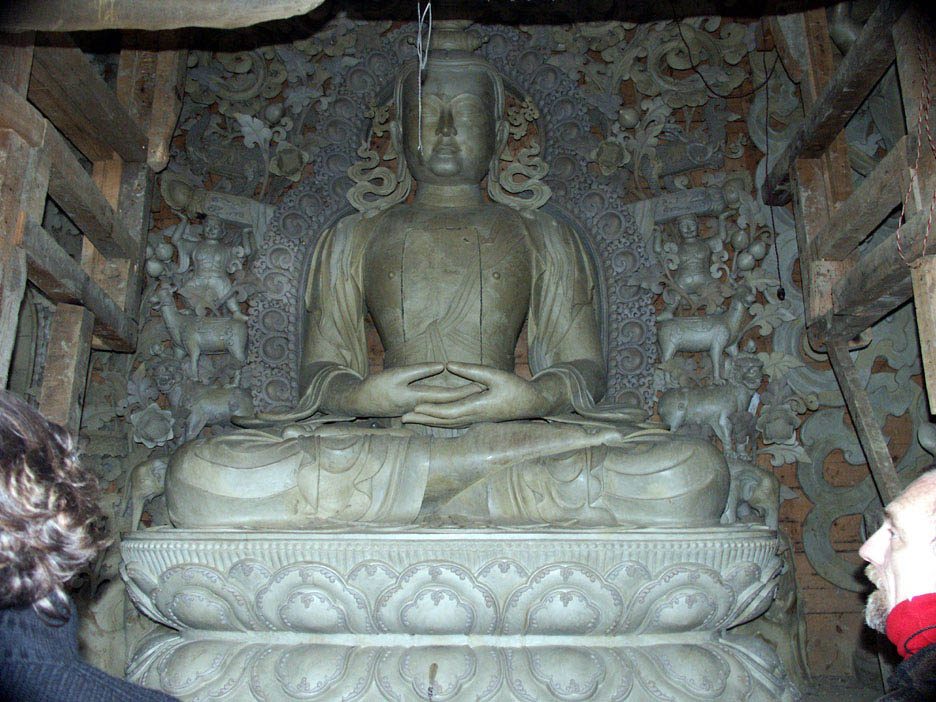

Clay sculpture, known in Dzongkha as jinzo, is one of the thirteen traditional arts and crafts (Zorig Chusum) of Bhutan. The art form encompasses the modelling of sacred Buddhist images, relief sculptures for temple and dzong interiors, and miniature votive tablets called tsa-tsa. Clay sculpture holds a position of particular religious importance in Bhutan because it produces the three-dimensional representations of Buddhas, bodhisattvas, and protective deities that serve as primary objects of veneration in monasteries, temples, and household shrines throughout the country.
The practice of clay sculpture in Bhutan is deeply intertwined with Vajrayana Buddhist liturgical requirements. Every temple requires consecrated images of specific deities appropriate to its dedication. The production of these images is governed by strict iconographic rules that prescribe proportions, postures, hand gestures, and attributes. A clay sculptor must therefore possess both artistic skill and substantial knowledge of Buddhist doctrine and iconography.
Historical Background
The tradition of sacred clay sculpture in Bhutan has roots stretching back to the earliest period of Buddhist influence in the Himalayan region. Indian and Tibetan Buddhist traditions both emphasised the creation of sacred images as acts of religious merit, and the establishment of Buddhism in Bhutan from the seventh century onward created sustained demand for skilled sculptors. The great period of dzong and monastery construction under Zhabdrung Ngawang Namgyal in the seventeenth century represented a high point for the art, as dozens of new religious institutions required full programmes of sculptural decoration.
Bhutanese clay sculpture absorbed influences from Tibetan, Newar (Nepalese), and Indian artistic traditions. Newar craftsmen from the Kathmandu Valley, renowned throughout the Buddhist world for their metalworking and sculptural skills, are known to have worked in Bhutan at various periods, contributing techniques and stylistic elements that Bhutanese artists adapted to local sensibilities. Over time, a distinctively Bhutanese approach to clay sculpture emerged, characterised by robust modelling, rich polychrome surfaces, and the integration of sculptural elements with architectural space.
Types of Clay Sculpture
Large-Scale Temple Images
The most important category of Bhutanese clay sculpture is the large-scale sacred image created for installation in temples and monastery halls. These figures, which may range from life-size to several metres in height, typically depict the historical Buddha Shakyamuni, Guru Rinpoche (Padmasambhava), Avalokiteshvara, or the particular patron deities of the institution. The largest images are built over an internal wooden or bamboo armature, with the clay applied in stages and allowed to dry between applications.
Completed images are painted in polychrome, with faces and hands receiving particularly fine treatment. Gold leaf is applied to highlight sacred features such as the ushnisha (cranial protuberance of the Buddha), the third eye, and ornamental elements. The eyes are painted last in a ceremony parallel to the eye-opening ritual observed in thangka painting. The finished sculpture is then consecrated by a lama, who inserts sacred substances — mantras written on paper, medicinal herbs, precious stones, and small relics — into a sealed cavity within the image, ritually transforming it from a material object into a vessel of spiritual power.
Relief Sculpture and Architectural Ornamentation
Clay is also used to create relief sculptures that adorn the walls, niches, and altars of religious buildings. These may depict individual deities, rows of identical Buddhas (representing the Thousand Buddhas motif), narrative scenes from Buddhist scripture, or decorative elements such as lotus borders and cloud motifs. Relief sculptures are typically modelled directly onto the wall surface or created on separate panels and installed.
Tsa-Tsa: Miniature Votive Tablets
Among the most widespread and culturally significant products of the Bhutanese clay sculptor's art are tsa-tsa — small moulded clay tablets bearing the image of a deity, a stupa, or a sacred syllable. Tsa-tsa are produced in large quantities by pressing clay into carved metal or stone moulds. They serve multiple purposes: as offerings deposited inside stupas and sacred cairns, as objects placed at pilgrimage sites and mountain passes, as funerary items mixed with the ashes of cremated individuals, and as personal devotional objects kept in household shrines.
The production of tsa-tsa is one of the most accessible forms of religious art-making in Bhutan. While master sculptors create the moulds, the actual pressing of tsa-tsa can be performed by monks, laypeople, and even children as an act of merit-making. Thousands of tsa-tsa may be produced during religious ceremonies or in memory of a deceased person. Travellers in Bhutan frequently encounter accumulations of tsa-tsa at mountain passes, cliff faces, and sacred springs, attesting to the widespread and ongoing nature of the practice.
Materials and Methods
The primary material for Bhutanese clay sculpture is a fine-grained clay mixed with fibrous materials such as chopped straw, cotton, or paper pulp to improve structural integrity and reduce cracking during drying. For large sculptures, the clay is applied over an internal framework of wood and bamboo, built up in successive layers. Each layer must dry thoroughly before the next is applied, making large-scale work a slow process that may extend over months.
Modelling tools include wooden spatulas, metal scrapers, and pointed sticks for fine detail work. The surface of a completed sculpture is smoothed, sealed with a ground preparation, and painted using mineral and organic pigments similar to those employed in thangka painting. For tsa-tsa production, the clay is mixed to a consistent texture and firmly pressed into moulds, then released and left to air-dry or, in some traditions, lightly fired.
Iconographic Requirements
As with all forms of sacred art in the Buddhist tradition, clay sculpture must conform to established proportional systems. These systems, codified in texts such as the Pratimalakshana and transmitted through oral instruction, specify the exact relationships between head, torso, limbs, and other body parts for each category of figure — Buddhas, bodhisattvas, wrathful deities, and human teachers each follow different proportional canons. Adherence to these rules is not merely an aesthetic convention but a religious requirement, as incorrectly proportioned images are considered spiritually ineffective.
Training and Contemporary Practice
Clay sculpture skills are transmitted through the traditional master-apprentice system and through formal instruction at the National Institute of Zorig Chusum. Students learn to prepare materials, construct armatures, model forms, and apply polychrome finishes over the course of several years of training.
Demand for clay sculpture remains strong in Bhutan, driven by the ongoing construction and renovation of temples and monasteries, the commissioning of images by private patrons, and the continuous production of tsa-tsa for religious observances. The art form thus remains a living tradition, serving the same devotional functions it has fulfilled for centuries while adapting to the conditions of contemporary Bhutanese life.
References
Related articles
Know something about this topic? Edit this article or . Anonymous contributions welcome — no account required.