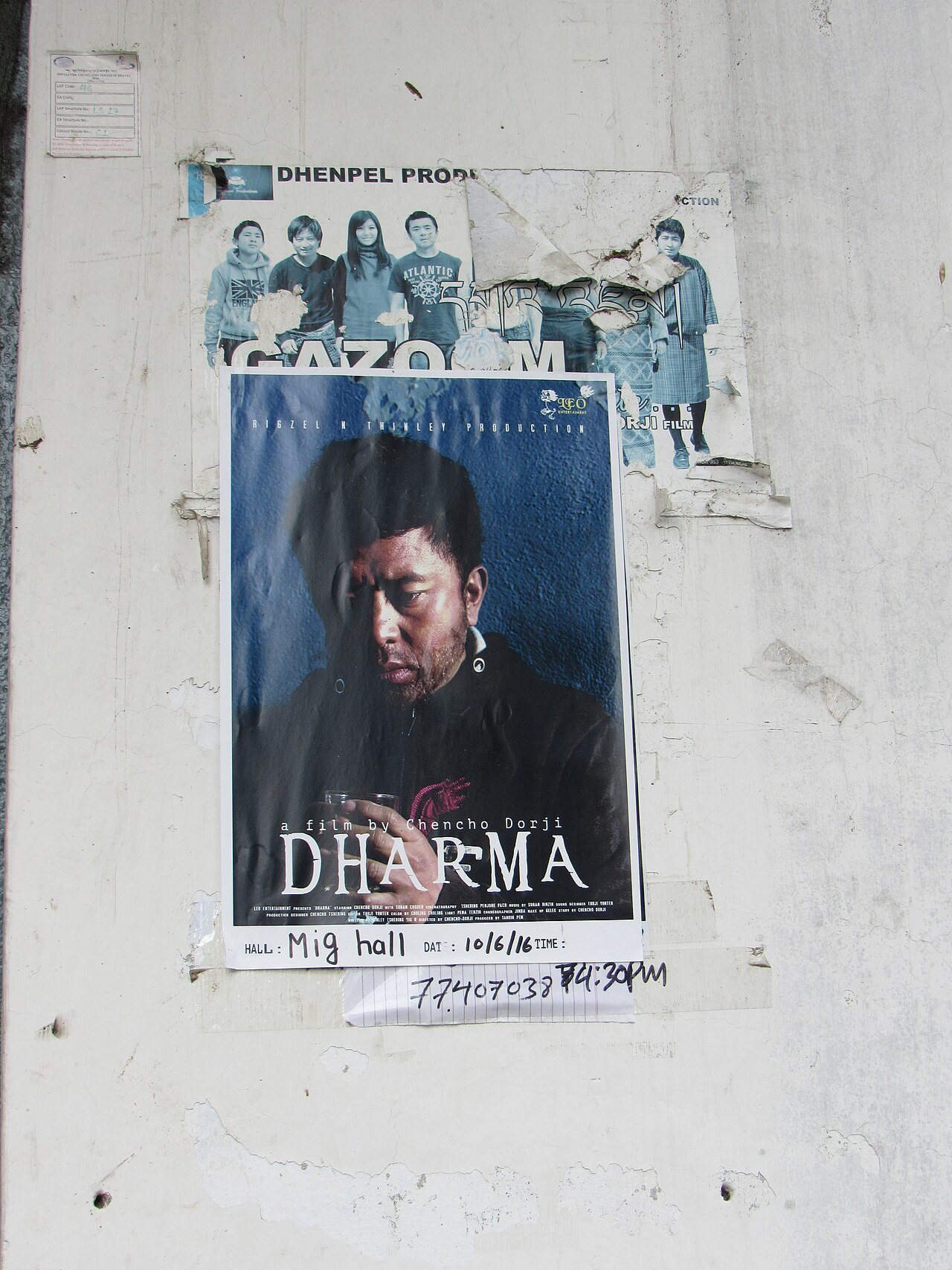

The cinema of Bhutan is among the youngest national film industries in the world. The country had no sustained domestic film production before the late 1980s, and the industry only grew into a recognisable sector after the introduction of television and the internet in 1999 — a change that happened later in Bhutan than in any other nation. Films are made almost exclusively in Dzongkha, with occasional productions in Sharchopkha, Nepali, or Tibetan, and are regulated by the Bhutan InfoComm and Media Authority (BICMA).[1]
Bhutanese cinema runs along two broadly distinct tracks. The first is a domestic commercial industry of rigsar-era romantic melodramas, musicals, and family dramas made on micro-budgets for audiences in Thimphu, Phuentsholing, Paro, and the larger district towns. The second is a slower, contemplative arthouse tradition closely identified with two filmmakers who trained or worked abroad: the Buddhist teacher and director Khyentse Norbu (Dzongsar Jamyang Khyentse Rinpoche) and Pawo Choyning Dorji, whose Lunana: A Yak in the Classroom (2019) was the first Bhutanese film nominated for an Academy Award.[2]
By the mid-2010s annual output had settled at roughly 20 to 30 Dzongkha-language features per year, though figures vary and dropped sharply during the COVID-19 pandemic. The Film Association of Bhutan (FAB), established in 1999, is the main industry body; BICMA certifies films for release.[3]
Before cinema: pre-1999 media
Bhutan had no cinema halls or broadcast television through most of the twentieth century. Urban audiences encountered film chiefly through Indian Hindi-language releases that circulated on VHS cassette and, in the 1990s, on VCD. Tibetan refugees and visiting lamas occasionally screened Buddhist films. The Fourth King, Jigme Singye Wangchuck, formally authorised television and internet access only on 2 June 1999 — a decision that made Bhutan the last country in the world to introduce television — and it is from that date that the domestic audiovisual economy is usually measured.[4]
A handful of Bhutanese-made productions predate television, but they were isolated efforts rather than a continuous industry. The film most often cited as Bhutan's first feature is Gasa Lamai Singye (also known as The Legend of Gasa Lamai and Singye), a tragic love story in the vein of Romeo and Juliet, directed in 1989 by the pioneer filmmaker Ugyen Wangdi. Wangdi, who had trained at the Film and Television Institute of India (FTII) in Pune, would later direct Bhutan's first documentary, Price of Knowledge (also known by its Dzongkha title Yonten Gi Kawa, 1999), which follows an eleven-year-old boy walking three hours each way to school in rural Bhutan.[5]
Khyentse Norbu and the arthouse tradition
The first Bhutanese-directed film to reach international audiences was The Cup (Phörpa, 1999), directed by Khyentse Norbu. Shot in a Tibetan monastery in exile in Bir, Himachal Pradesh, with a non-professional cast of young monks, the film follows a group of novices trying to watch the 1998 FIFA World Cup. The Cup premiered in the Directors' Fortnight at the 1999 Cannes Film Festival and was Bhutan's first submission to the Academy Award for Best International Feature Film. Although set in India, it was widely described as the first feature by a Bhutanese director.[6]
Khyentse Norbu's second feature, Travellers and Magicians (2003), was the first feature film shot entirely in Bhutan and in the Dzongkha language. The film interleaves the journey of a young government officer planning to emigrate to the United States with a cautionary tale told by a travelling monk. It screened at Venice, Toronto, and Berlin and established a recognisable Bhutanese arthouse idiom — slow-paced, landscape-conscious, and rooted in Buddhist moral argument. His later work includes Vara: A Blessing (2013), Hema Hema: Sing Me a Song While I Wait (2016), and Looking for a Lady with Fangs and a Moustache (2019).[7]
Rigsar-era commercial cinema
Parallel to the festival-oriented work of Khyentse Norbu, a domestic commercial industry emerged in the 2000s and expanded through the 2010s. These films are shot in Dzongkha, centre on romantic triangles, family melodrama, or comedy, and are closely bound to rigsar, the popular keyboard-driven musical style that became dominant in Bhutanese entertainment from the 1990s onward. Song-and-dance sequences, Bollywood pacing, and a small recurring pool of actors are typical features. Productions are financed largely from private savings, family contributions, and deferred payment, and most recoup costs — when they do — through ticket sales at the few urban cinema halls, VCD and DVD sales, and, since the mid-2010s, YouTube.[2]
According to figures compiled by the Film Association of Bhutan and reported in the trade press, annual production peaked around 2010 at roughly 30 films before stabilising at about 20 titles per year. The FAB has periodically organised national film awards and festival screenings to professionalise the sector and reward domestic productions.[3]
Pawo Choyning Dorji and the international breakthrough
The most visible international success of Bhutanese cinema came with Lunana: A Yak in the Classroom (2019), directed by Pawo Choyning Dorji, a producer on Vara and Hema Hema. The film follows a reluctant young teacher assigned to Lunana, a remote highland village in Gasa district said to be the most isolated school in the world, reached after an eight-day trek. Shot on location using solar power, with much of the cast composed of actual Lunana villagers, the film was selected by Bhutan as its submission to the 94th Academy Awards and was nominated for Best International Feature Film in February 2022 — the first Oscar nomination for any Bhutanese film.[8]
Dorji's follow-up, The Monk and the Gun (2023), a satirical comedy set against Bhutan's 2008 transition to parliamentary democracy, premiered at the Telluride and Toronto film festivals and was selected as Bhutan's entry for the 96th Academy Awards. It was one of fifteen films on the Academy's December 2023 shortlist for Best International Feature Film but did not advance to the final five nominees. A third Bhutanese film, I, the Song, directed by Dechen Roder, was selected as Bhutan's submission to the 98th Academy Awards after winning Best Director in the Critics' Picks section at the 2024 Tallinn Black Nights Film Festival.[9]
Other filmmakers
Ugyen Wangdi remains the senior figure of Bhutanese filmmaking; his documentary Price of Letter (2004) extended the documentary tradition he began with Price of Knowledge. Dechen Roder, one of the few women directing Bhutanese features, made her debut with Lo Sum Choe Sum (2013), followed by the noir mystery Honeygiver Among the Dogs (2016), which premiered at the Busan International Film Festival, and the 2024 feature I, the Song. Tashi Gyeltshen's The Red Phallus (2018) was a co-production with Nepal and Germany that screened at Busan and in the Berlinale Generation sidebar. Karma Deki directed Pawo (2016), a drama centred on the self-immolation of a Tibetan exile.[1]
Actors and craft
Bhutanese cinema has never supported a full-time professional acting workforce. Most actors appear in multiple films per year on deferred or modest fees and sustain themselves through day jobs, singing careers, or work in television. Among the most visible recurring performers are Tshewang Dendup, the lead in Travellers and Magicians; Sonam Lhamo; and Kheng Sonam Dorji, a cast member in Lunana and The Monk and the Gun. Many leading players are also rigsar singers, and crossover between music and cinema is normal rather than exceptional.[2]
Production and distribution
Production infrastructure is concentrated in Thimphu. There are no large studio complexes; most shoots are on location, and a significant share of post-production — colour grading, sound mixing, final digital intermediate — is done in India or Thailand. Distribution runs through a small network of urban cinema halls (the largest based in Thimphu), VCD and DVD sales (now largely residual), and, increasingly, YouTube and social-media-first releases. Piracy is a persistent constraint: pirated copies of new releases routinely appear online shortly after theatrical premieres, and the small market makes copyright enforcement difficult.[2]
Beyond the domestic market, Bhutanese filmmakers have sought diaspora audiences in Australia, the United States, Canada, and the Middle East — populations that expanded sharply in the 2010s and 2020s as emigration accelerated — though few films have been distributed internationally outside of the festival circuit and selected arthouse releases of the Khyentse Norbu and Dorji titles.
Regulation: BICMA and FAB
All films released in Bhutan must be certified by the Bhutan InfoComm and Media Authority, which applies content guidelines covering explicit sexual material, graphic violence, and content judged disrespectful to the monarchy, Buddhist institutions, or religious harmony. BICMA certification is a prerequisite for theatrical release and for domestic broadcast. The Film Association of Bhutan, the industry's principal trade body, represents producers, directors, actors, and crew; it was initiated in 1999 and organises national awards, workshops, and annual general meetings.[10]
The regulatory environment has been a source of debate within the industry. Filmmakers have argued at different times that BICMA guidelines, while less restrictive than in many neighbouring jurisdictions, limit the frankness with which Bhutanese cinema can address contemporary social questions — domestic violence, alcohol use, youth unemployment, corruption, and the emigration of the educated young. Others have argued that the guidelines are applied flexibly and that the greater constraints are economic.[2]
Festivals and criticism
Bhutanese films have screened at Cannes (Directors' Fortnight), Venice, Toronto, Berlin, Busan, Tallinn Black Nights, and the Asia Pacific Screen Awards. A domestic Bhutan International Film Festival has been organised intermittently in Thimphu; it has not yet established itself as a fixture comparable to the regional festivals of Nepal or India. Academic writing on Bhutanese cinema is limited. Jamie Zeppa's ethnographic work on modern Bhutan, Francisca Cho's scholarship on Buddhist cinema, and the Works That Work feature by Jonah Goodman are among the better-known English-language treatments.[2]
Current state and challenges
Bhutanese cinema faces the structural constraints of any small-language national industry. Domestic box office alone cannot recover even a modest feature budget; international sales are effectively reserved for the handful of arthouse titles that reach festivals; and the accelerating emigration of young Bhutanese to Australia has removed many of the craft workers and audiences on whom the commercial industry depends. No dedicated government film fund or tax incentive scheme exists on a scale comparable to Nepal's or India's, though the Royal Government has at times announced support for cultural production within broader Gross National Happiness programming. The industry's persistence under these conditions, and the unlikely fact that a country of 780,000 has twice been shortlisted for Academy Awards, is the most striking feature of its recent history.
See also
- Travellers and Magicians
- Lunana: A Yak in the Classroom
- Pawo Choyning Dorji
- Dzongsar Jamyang Khyentse Rinpoche
- Dechen Roder
- Rigsar
- Television in Bhutan
- Bhutan InfoComm and Media Authority
References
- "Cinema of Bhutan." Wikipedia.
- Jonah Goodman, "Moving Pictures." Works That Work, No. 8.
- Film Association of Bhutan — official site.
- "Television in Bhutan." Wikipedia.
- "The Legend of Galem and Singye (1989), directed by Ugyen Wangdi." Letterboxd.
- "The Cup (1999 film)." Wikipedia.
- "Khyentse Norbu." Wikipedia.
- "Lunana: A Yak in the Classroom." Wikipedia.
- "The Monk and the Gun Shortlisted for an Oscar." Buddhist Film Foundation.
- Bhutan InfoComm and Media Authority (BICMA) — official site.
- "Travellers and Magicians." Wikipedia.
- "Pawo Choyning Dorji." Wikipedia.
Related articles
Know something about this topic? Edit this article or . Anonymous contributions welcome — no account required.