culture
Tshangla Language
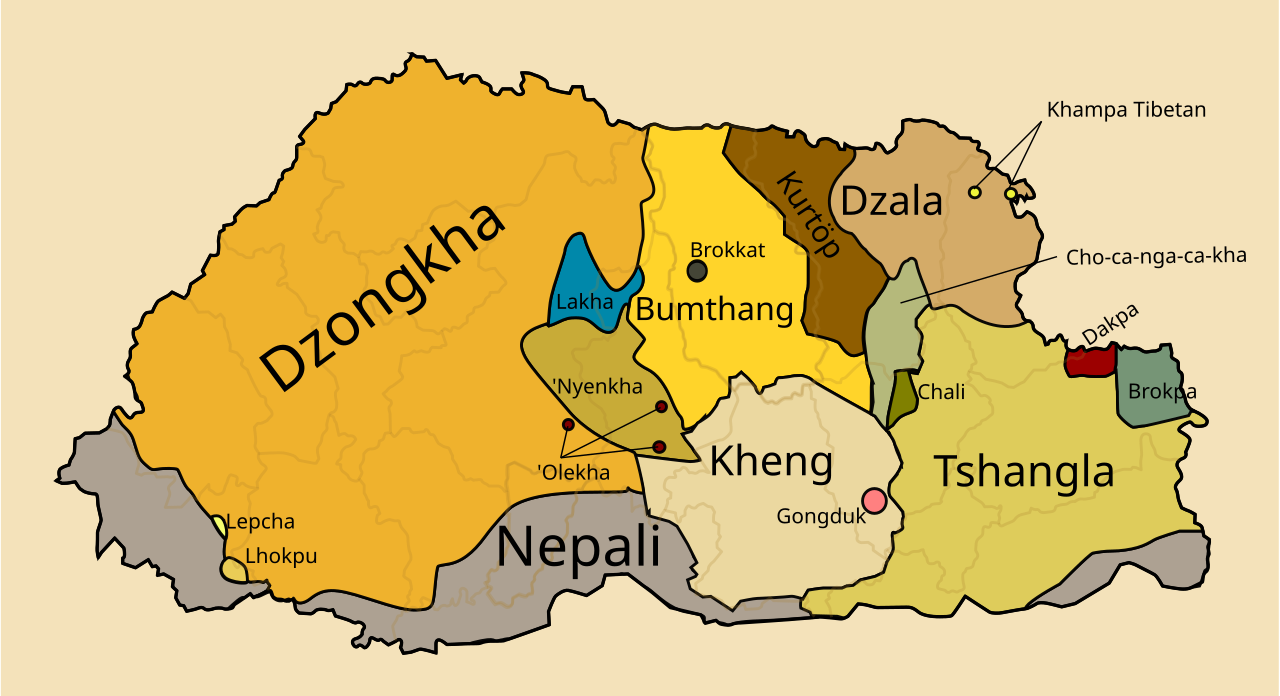
Tshangla, also known as Sharchopkha ("language of the east"), is the most widely spoken native language in Bhutan by number of speakers and the mother tongue of the Sharchop people of eastern Bhutan. A Sino-Tibetan language spoken across six eastern districts, it has approximately 157,000 speakers in Bhutan and a further 18,000 across northeast India and Tibet. Despite its demographic weight, Tshangla has no standardised written script and is not an official language of instruction, raising concerns about long-term language vitality.

Tshangla — also known as Sharchopkha, meaning "the language of the east" — is the most widely spoken native language in Bhutan in terms of mother-tongue speakers. It is the primary language of the Sharchop people, who constitute the majority of the population across six eastern districts: Trashigang, Mongar, Pema Gatshel, Samdrup Jongkhar, Trashi Yangtse, and Lhuentse. There are approximately 157,000 Tshangla speakers in Bhutan, with a further 11,000 in Arunachal Pradesh (northeast India), where the language is sometimes called Central Monpa, and around 7,000 in southeast Tibet. The Sharchop community accounts for an estimated 25–30 per cent of Bhutan's total population, making Tshangla demographically significant despite its absence from official institutional life.
Linguistic Classification
The precise classification of Tshangla within the Sino-Tibetan language family has been a matter of scholarly debate. The language is unambiguously Sino-Tibetan, but its exact position within that phylum is contested:
- David Bradley (2002) placed Tshangla within the East Bodish branch of Tibeto-Burman, grouping it with other languages of eastern Bhutan and Arunachal Pradesh.
- George van Driem (2011) left Tshangla unclassified within Sino-Tibetan, pending further research, noting that its position relative to the Bodish (Tibetan) languages requires additional clarification.
- Grollmann and Gerber (2023), drawing on more recent comparative data, argued that Tshangla is not particularly closely related to Bodish at all and should be considered a separate branch of the Trans-Himalayan linguistic phylum.
What is not in dispute is that Tshangla is mutually unintelligible with Dzongkha, Bhutan's national and official language. Despite both being Sino-Tibetan languages used within the same country, a speaker of Tshangla cannot understand a Dzongkha speaker without separate acquisition of the language, and vice versa. This mutual unintelligibility is a critical fact for understanding the linguistic situation of eastern Bhutan and the pressures that Tshangla faces.
Phonology and Structure
Tshangla is a tonal language with a phonological system that includes a relatively large consonant inventory, including aspirated and unaspirated stops, a series of affricates, and a retroflex series. Like other Tibeto-Burman languages, Tshangla is verb-final in its basic word order (Subject-Object-Verb) and makes use of case markers to indicate grammatical relationships. The language has been documented in linguistic descriptions, including a structural overview prepared at the University of Massachusetts Amherst, but the depth of grammatical and lexical documentation remains considerably less than that available for Dzongkha or Tibetan.
Script and Written Status
Tshangla has no standardised writing system of its own. Educated Sharchop write in Dzongkha script (the Uchen script derived from classical Tibetan) or in the Roman alphabet when writing in English, the medium of formal education. The absence of a native writing tradition means that Tshangla literature and oral history are transmitted exclusively through speech, placing them at greater risk of loss as younger generations are educated primarily through Dzongkha and English. The University of North Texas has developed a Tshangla Language Resource collection as part of its endangered language documentation work, reflecting international scholarly recognition of the language's vulnerability.
Institutional Status and Vitality
Despite being the most widely spoken native language in Bhutan by speakers, Tshangla holds no official status. Dzongkha is the national language and the medium of instruction at the primary level; English is used for secondary and tertiary education and in most formal written communication. Tshangla is not taught in schools, has no government-sponsored development programme, and has no representation in broadcast media. This institutional marginalisation, combined with the aspirational drive of Sharchop families to ensure their children achieve fluency in Dzongkha and English for educational and professional advancement, has produced significant pressure on Tshangla use among younger speakers.
Tshangla-speaking communities maintain their language with considerable vitality in rural eastern Bhutan, where Tshangla remains the language of the home, the market, and community social life. In urban settings, however, code-switching to Dzongkha is common and increasing. Linguists and cultural advocates within Bhutan and internationally have called for greater attention to the documentation and possible institutional support of Tshangla, though no significant policy response has yet been forthcoming from the Royal Government. The linguistic diversity of Bhutan — encompassing more than twenty distinct languages alongside Tshangla — presents a governance challenge to which Dzongkha-centred language policy has not fully responded.
References
- "Tshangla Language." Wikipedia.
- "Tsanglakha: The Main Language of Eastern Bhutan." Mandala Collections, University of Virginia.
- "Tshangla Language — Linguistic Overview." University of Massachusetts Amherst.
- "Tshangla Alphabet, Pronunciation and Language." Omniglot.
- "Languages in Bhutan: Dzongkha, Tibetan, Tshanglakha." Facts and Details.
View online: https://bhutanwiki.org/articles/tshangla-language · Content licensed CC BY-SA 4.0