editorial
The Happiest Country On Earth Is Running Out Of Bhutanese
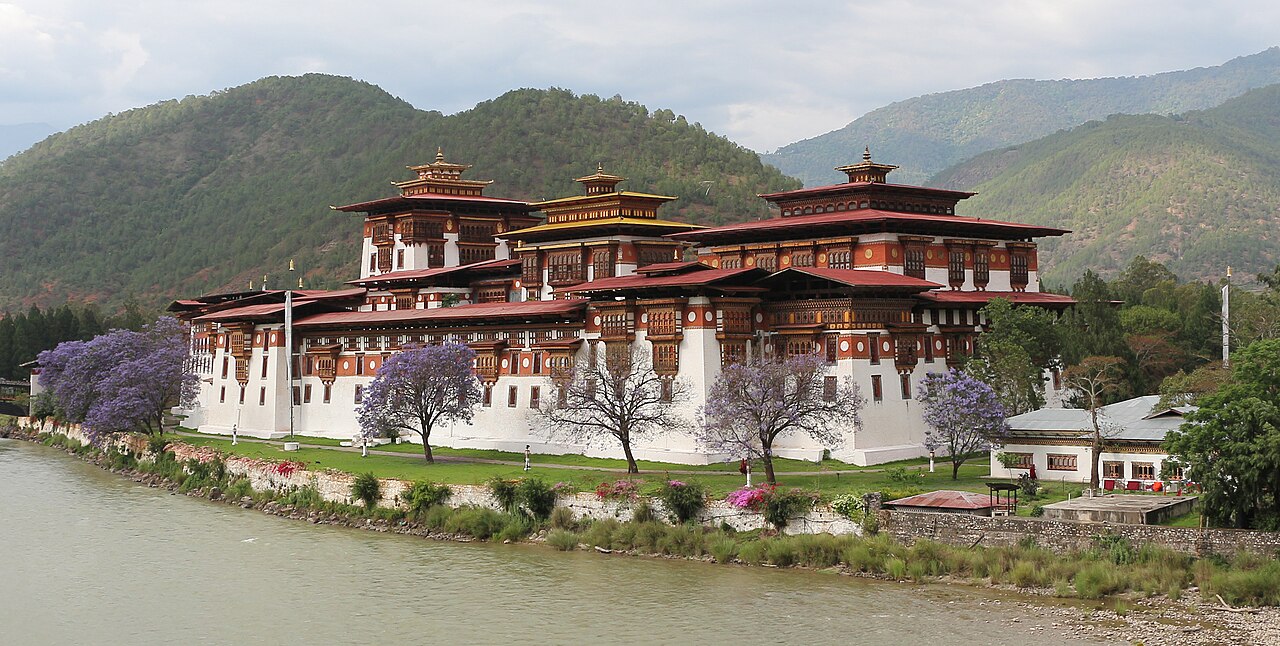
The Royal Government has just confirmed it will pay families Nu 10,000 a month (around USD 105) for every third child, because the birth rate has collapsed and the young will not stay. An editorial from the BhutanWiki Editorial Team on the Gross National Happiness brand versus the youth exodus, the TV and internet ban, the 1985 Citizenship Act and the Lhotshampa expulsion, and the policy machinery that produced both.

Read the next sentence twice.
The government of the country that gave the world Gross National Happiness has just confirmed that it will pay families Nu 10,000 a month (around USD 105) for every third child, because the birth rate has collapsed and the young will not stay. The Third Child Incentive Programme launches this month. The Prime Minister had to defend it in Parliament. A Member of Parliament — Dorji Wangmo of Kengkhar-Weringla — had to ask, on the floor of the National Assembly, why a country sold to the world as a paradise is so unrelaxed about its own population that it is now writing cheques to convince its people to procreate.
Welcome to the editorial section of BhutanWiki.
We are the editorial team behind the people's encyclopedia of Bhutan. The articles on this site are neutral by design — every fact double-cited, every claim sourced, every voice given its due. This is not that. This is the part where we put the encyclopedia down, sit on the porch, and say what we believe. We are Bhutanese. Some of us live in Thimphu. Some of us live in Sydney, Rochester, Toronto, Kathmandu, Brisbane. We are diaspora. We are patriots. We want the best for this country and the people who built it. Which is exactly why we are not going to pretend.
The exodus
Between 2022 and 2025 the Bhutan–Australia migration wave moved tens of thousands of Bhutanese — students, nurses, engineers, the country's most educated cohort — to a country on the other side of the world. The 2024 election ran, in part, on the question of why. The Tobgay government inherited the political problem of explaining why the next generation, the one the GNH brand was built for, would prefer Perth to Paro.
The new natalist scheme is a confession dressed up as policy. When the answer to "why is everyone leaving?" is "we will pay you to have more babies," the diagnosis has been made on the government's behalf. The young do not see a future in a country that brands its way through serious problems. So now the government bribes them to have children who, in fifteen years, will be making the same calculation about Perth.
Behind the brand
GNH was a beautiful idea. In 1972 the Fourth Druk Gyalpo, then a teenager on the throne, said happiness was more important than gross national product. It was the right thing for a small kingdom to say at the right moment, and the world has not stopped quoting him since. It sits on the back of guidebooks, in every Wikipedia paragraph, in every "10 Most Inspiring Quotes From World Leaders" listicle. By now it is a brand.
The brand is impressive; the execution has never matched it.
Every Western journalist files the same article. The opening paragraph notes that Bhutan measures happiness instead of GDP. The middle paragraph mentions a monastery, a dzong, and a smiling monk. The closing paragraph wonders, in soft prose, whether we might all learn something from this hidden Himalayan kingdom. The journalist then flies home, files expenses, and the Bhutanese reading the piece in Sydney sighs. We have read this article eight thousand times. The monks have read it. The bureaucrats clip it for press files. The young have stopped reading it. They are too busy filling out PR forms.
The monarchy is the most beloved institution in the country and one of the most successful brand assets any small state has ever managed. We say that with affection. We also say: a brand is not a policy. A photograph of a king planting a tree does not create a job for the 24-year-old who has just finished a computer-science degree and is wondering whether to stay. The country has been image-rich and policy-poor for a generation. The bureaucracy that is supposed to translate royal vision into outcomes has not produced a manufacturing sector, a software sector, or a labour market that can absorb its own graduates. It has produced a roadmap, several committees, and a great many ceremonial photographs.
The country that put itself behind on purpose
On 2 June 1999 — twenty-seven years ago today — Bhutan switched on television. The internet was legalised the same week. The country was one of the last on Earth without either. The official reason was the preservation of Bhutanese culture from Western influence. The actual result was that a generation grew up not learning to code while their counterparts in Bangalore and Hanoi were teaching themselves. The world changed whether the country watched or not. The country watched late.
We are not North Korea — not even close. North Korea built a wall; Bhutan built a brand. But somewhere between the two sits a real resemblance: a country that decided, on behalf of its citizens, that they were better off not seeing what the world was making and selling and inventing. The decision was made with good intentions. So are most.
You cannot run a 21st-century economy with a population that learned what an iPhone was at twenty. We are surprised that needs to be said out loud. We are even more surprised it is now embedded in the country's emigration statistics in ways nobody in Thimphu seems willing to write down.
The unhealable wound
This is the section we cannot make light of, because no one should.
In 1985 the National Assembly passed the Citizenship Act. It required documented proof of residence in Bhutan going back to 1958. It was drafted with one population in mind: the Lhotshampa, the Nepali-speaking Bhutanese of the south. Many of those families had been on that land throughout the 19th century — generations before the Wangchuck dynasty was founded in 1907, generations before there was a kingdom of Bhutan in anything like the modern sense. The same Nepali-origin people, across a porous Himalayan frontier that nobody had bothered to draw firmly, settled in what are now Darjeeling, Sikkim, and Assam. The Indian-side branches of those families are still there. They built schools, towns, tea estates. Nobody asked them for 1958 paperwork.
In 1989 a royal edict made Driglam Namzha — the dress code, the language, the etiquette of the north — the national standard for everyone. Wear the gho. Wear the kira. Speak Dzongkha. Be the official Bhutanese. The southerners, whose grandparents had been on that land for five or six generations, were told their language was no longer welcome in their schools and their dress was no longer welcome on their streets.
Between 1990 and 1993, roughly one-sixth of Bhutan's population — over 100,000 people — were expelled. Stripped of citizenship under the 1985 Act. Pushed across the southern border. Many spent the next two decades in UN refugee camps in eastern Nepal because the world was not paying attention and the brand was working too well to interrupt.
From 2007 onward, over 96,000 of them were resettled to the United States, Canada, Australia, the United Kingdom, Norway, the Netherlands. They built communities in Akron, Rochester, Pittsburgh, Brisbane, Adelaide, Burlington. They became American doctors, Canadian teachers, Australian engineers — in two decades, citizens of the world.
The country that emptied itself of one-sixth of its people in the name of "One Nation, One People" is now offering Nu 10,000 a month to convince the remaining people to have more babies.
We say this because the brand demands amnesia and we refuse. The Lhotshampa expulsion is documented history: Amnesty International's 1992 report, Michael Hutt's Unbecoming Citizens, the resettlement records of six countries, and the daily lives of a hundred thousand families who still remember the year their country decided their grandparents were not Bhutanese after all.
The door locked behind them
Bhutan today refuses tourist visas to the Lhotshampa diaspora when they apply on their American, Canadian, Australian, or British passports. A Bhutanese-American doctor in Akron, a Bhutanese-Canadian teacher in Toronto, a Bhutanese-Australian engineer in Brisbane — born on Bhutanese soil, raised on it, expelled from it — cannot now visit the village where their grandmother is buried. The official explanation is that visa policy is the same for every Western passport holder. The unofficial reality is that the system knows exactly which names to deny.
When His Majesty visited Australia in 2024 to address the Bhutanese diaspora and urge young Bhutanese to come home, the registration protocol for the event required attendees to upload a current or expired Bhutanese passport. Bhutanese-origin Australians — Australian citizens, holding Australian passports — were turned away from the booking page of a Royal event being held in their own country. The message could not have been clearer: even when the King is in front of you, you are not Bhutanese enough.
The diaspora the country sent away has not been idle. The 100,000-plus resettled Lhotshampa now work as doctors, nurses, engineers, IT professionals, teachers, accountants, and skilled tradespeople across six Western economies. Many run their own businesses — corner shops, trucking firms, restaurants, healthcare practices, IT consultancies. On a reasonable estimate of household earnings and small-business revenue, their collective annual economic output now exceeds twice Bhutan’s entire GDP, and their U.S. tax payments alone exceed the Royal Government of Bhutan’s total annual tax revenue many times over. The country did not just expel one-sixth of its people. It expelled the most economically productive sixth.
There is a particular bitterness in the history. Bhutan evicted the most hard-working community within its borders because a young Fourth King — gullible to the hardliners around him, the careerists in the Druk political establishment who had whispered for years about a southern threat — was convinced that the most loyal of his subjects were a demographic time bomb. They were not. The Lhotshampa had farmed the south for generations. They paid their taxes. They served in the Royal Bhutan Army. They sent their children to government schools. They wore the gho and the kira when the edict came down. The only "threat" they posed was that they existed in numbers the hardliners disliked. A young king believed them. A country lost one-sixth of its people. The advisers kept their offices.
This is the editorial truth: the country that turned away its most loyal citizens, and then locked the door behind them, is now wondering why its remaining children will not stay.
Where the policy machinery sits today
The country is making expensive bets. Gelephu Mindfulness City is a city-sized wager that Bhutan can be aspirational at scale — a special administrative region built on a green field with foreign capital and a constitutional carve-out. We hope it works. We are not unkind people. But we note that the country's first big economic move of the century is, again, a brand play: a city marketed on a feeling. Where are the steel mills, the manufacturing belt, the IT corridor — the boring, durable, employment-generating sectors that retain twenty-five-year-olds with mortgages and ambitions?
The green policies that earn standing ovations at climate summits — carbon-negative, 70 per cent forest cover, no mass tourism — also happen to be policies that suppress jobs. There is a serious conversation to be had about whether a country can be both the West's favourite climate poster child and an economy capable of absorbing its own labour force. That conversation is not happening, because the standing ovations are too good.
Tourism is "high value, low impact." Translated: high price, low volume, low employment. The country admitted 287 tourists in all of 1974, and the policy has barely loosened in the 52 years since. Nobody is asking for Goa — only for somewhere between Goa and 1974.
The country's foreign policy is conducted in close consultation with India under the 2007 friendship treaty, which is the right framework. But the country's domestic policy machinery has not produced an answer to the only question that matters to a 25-year-old in Thimphu: what do I do here?
What we want
We want the country we love to stop being a postcard and start being a country.
We want the monarchy to remain. It is the most beloved institution in the kingdom and one of the few centripetal forces holding a small state together. We are patriots, not republicans. We want the institution to demand more of the bureaucracy that serves under it.
We want the country to open. Open tourism that admits more than the global one per cent. Open immigration policy that brings in the talent the country needs. Open internet, open trade, open media. The protectionist instinct of the 1990s gave us a generation behind. The next generation does not have to repeat the mistake.
We want the Lhotshampa welcomed back — not as a footnote in a future treaty or a side-letter to a regional negotiation, but as citizens. Their grandparents were Bhutanese. Their parents were Bhutanese. They are Bhutanese. The 1985 Act was an act of state we are obligated to call by its proper name: an injustice. The country that did it is the country that can undo it.
We want a country where the third-child cash incentive is not necessary because the first child has a reason to stay.
We are the BhutanWiki Editorial Team. We write the encyclopedia. The encyclopedia is neutral. This is not. This is what we believe.
Bhutan is worth more than the brand. The Bhutanese — every Bhutanese — are worth more than the policies that drove them out.
See also
View online: https://bhutanwiki.org/articles/happiest-country-running-out · Content licensed CC BY-SA 4.0