people
Dimple Thapa
Lyonpo Dimple Thapa is a Bhutanese politician and former forestry officer serving as the Minister of Education and Skills Development since January 2024. She is the only female minister in the fourth democratically elected cabinet and one of only two women elected to the National Assembly in the 2024 general election. She represents the Ugyentse-Yoeseltse constituency in Samtse District.
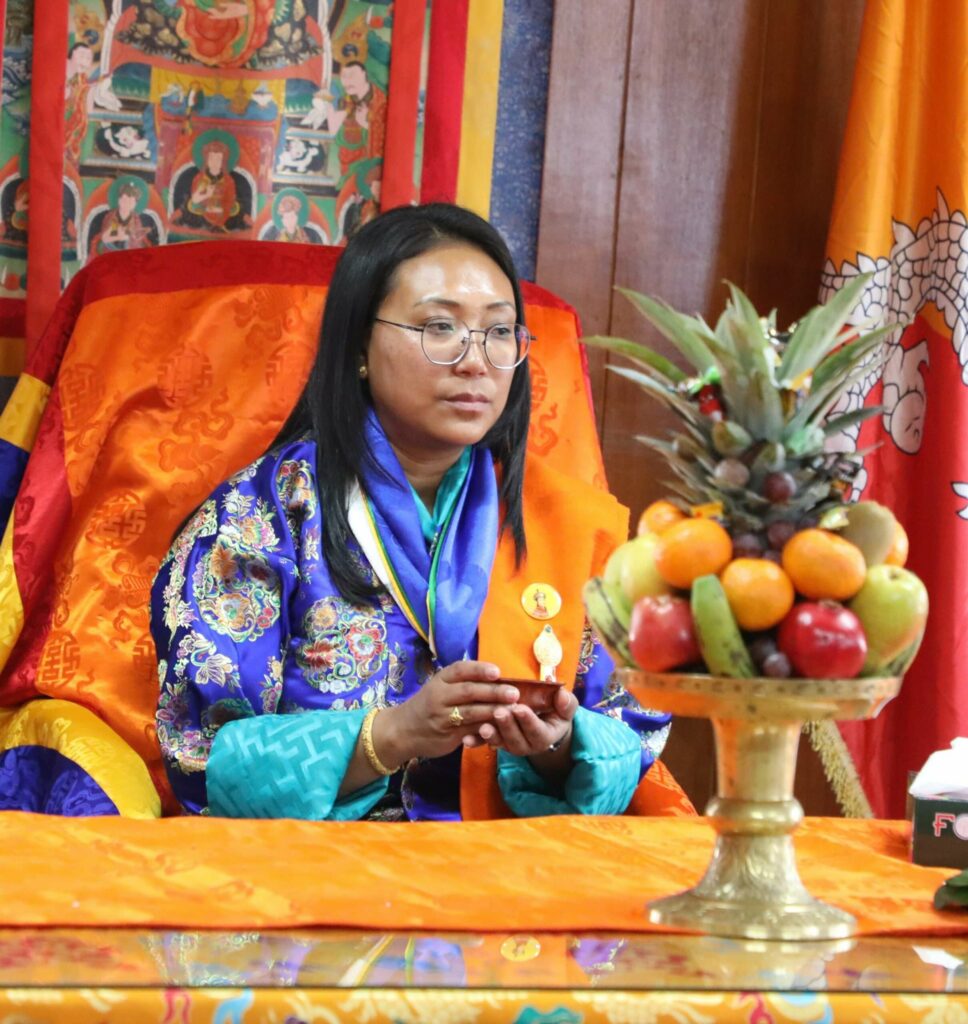
Lyonpo Dimple Thapa is a Bhutanese politician and former forestry officer serving as the Minister of Education and Skills Development in the fourth democratically elected government of Bhutan, led by Prime Minister Tshering Tobgay of the People's Democratic Party (PDP). She received the Dakyen from His Majesty King Jigme Khesar Namgyel Wangchuck on 28 January 2024. Thapa is the only woman in the current cabinet and one of only two women elected to the National Assembly in the January 2024 general election — the lowest representation of women in parliament since Bhutan's transition to democracy in 2008.[1]
Thapa represents the Ugyentse-Yoeseltse constituency in Samtse District in southern Bhutan. Before entering politics, she had a nearly two-decade career in the Royal Government's Department of Forests and Park Services, rising to the rank of Chief Forestry Officer. Her appointment to the education portfolio has been notable for bringing a fresh perspective from outside the education sector to a ministry widely acknowledged as requiring comprehensive reform.[2]
Early Life and Education
Dimple Thapa hails from Samtse District, one of Bhutan's southern dzongkhags bordering the Indian state of West Bengal. Samtse is home to a diverse population including Lhotshampa (ethnic Nepali-speaking Bhutanese) communities, and the district has historically been one of the more economically disadvantaged areas of the country. Thapa pursued her higher education abroad, obtaining a Bachelor of Science in Forestry from Dr Y.S. Parmar University of Horticulture and Forestry in Himachal Pradesh, India, and subsequently a Master of Science in Mountain Forestry from the University of Natural Resources and Life Sciences (BOKU) in Vienna, Austria. Her specialised training in mountain forestry was directly relevant to Bhutan, where more than 70 per cent of the land area is forested.[3]
Career in Forestry
Thapa's civil service career began in 2005 when she joined the Department of Forests and Park Services as a Forestry Officer. Over the following seventeen years, she held various positions within the department, gaining experience in forest management, conservation, and environmental governance. Bhutan is constitutionally mandated to maintain at least 60 per cent forest cover — a unique environmental commitment enshrined in the 2008 Constitution — and the Department of Forests and Park Services plays a central role in upholding this commitment. Prior to her resignation from the civil service in April 2022 to contest the upcoming general election, Thapa served as Chief Forestry Officer for the Territorial Divisional Office in Tsirang District, a position of considerable responsibility overseeing forest management across an entire district.[3]
Entry into Politics
Thapa's decision to enter politics was notable in a country where women's political representation has remained persistently low despite the absence of formal legal barriers. In the January 2024 general election, only six women candidates stood in the final round of voting — a significant decline from previous elections. Thapa was one of only two women elected to the 47-member National Assembly, representing the PDP in her home constituency of Ugyentse-Yoeseltse in Samtse. The low number of women in parliament has drawn comment from both domestic civil society organisations and international observers, who have noted that Bhutan's progress on gender equality in political representation has not kept pace with its achievements in other development indicators.[2]
Her selection by Prime Minister Tobgay for a cabinet position — and specifically for the high-profile education portfolio — was seen as a signal of the government's commitment to including women in senior decision-making roles, even as the broader trends in women's political participation remained discouraging.[4]
Minister of Education and Skills Development (2024-)
Reform Agenda
Upon taking office, Thapa identified a comprehensive overhaul of the education system as her foremost priority. In an early interview with The Bhutanese newspaper, she stated that she "cannot compromise in education," signalling an ambitious reform agenda. Bhutan's education system has undergone significant expansion since the 1960s — when the country had only a handful of schools — but persistent challenges remain, including variable quality of instruction, a mismatch between educational outputs and labour market needs, high rates of youth unemployment among graduates, and difficulties in retaining qualified teachers in remote rural schools.[4]
The Ministry of Education and Skills Development oversees the entire spectrum of formal education in Bhutan, from early childhood development through to tertiary education and technical and vocational education and training (TVET). Under the 13th Five-Year Plan (2024-2029), the government has prioritised skills development and the alignment of educational curricula with the needs of a diversifying economy. Thapa's background in forestry and natural resource management, while not in the education field, has been seen as an asset in bringing practical, outcomes-oriented thinking to a sector that has been criticised for excessive focus on academic qualifications at the expense of practical skills.[5]
Key Challenges
Among the most pressing challenges facing Thapa's ministry is the phenomenon of youth emigration. Thousands of young Bhutanese have left the country in recent years, primarily to Australia, in search of better economic opportunities — a trend that has alarmed the government and been described by some commentators as a "brain drain." The education system is seen as part of both the problem and the solution: graduates frequently report that their qualifications do not translate into meaningful employment within Bhutan, while the economy lacks the diversification to absorb the growing number of degree-holders. Thapa's ministry has been tasked with strengthening vocational and technical training pathways to create alternatives to purely academic education and to equip young Bhutanese with skills that are in demand both domestically and internationally.[6]
Significance as a Female Leader
Thapa's role as the sole woman in the current cabinet has drawn attention to the broader issue of women's political participation in Bhutan. While Bhutanese women enjoy legal equality and relatively high rates of participation in the workforce and education, their representation in elected office has remained low. The 2024 election result — with only two women among 47 National Assembly members — represented a regression from previous elections, prompting renewed discussions about the structural and cultural barriers that discourage women from standing for office. Thapa has been cited as a role model for aspiring female politicians, particularly from southern Bhutan and rural communities.[2]
References
- Ministry of Foreign Affairs — Dakyen Conferment, 28 January 2024
- BBS — "Meet the Cabinet Ministers of the Fourth Democratically Elected Government"
- Dimple Thapa — Wikipedia
- The Bhutanese — "'Cannot Compromise in Education': New Education Minister Dimple Thapa"
- Ministry of Education and Skills Development — Welcome to Minister Dimple Thapa
- Kuensel — "Reforming Education Sector a Priority: Minister"
View online: https://bhutanwiki.org/articles/dimple-thapa-education-minister · Content licensed CC BY-SA 4.0