Third Child Plus Program (TCPP)
From BhutanWiki, the people's encyclopedia of Bhutan · politics · Verified
The Third Child Plus Program (TCPP), earlier known as the Third Child Incentive Programme, is a cash-transfer scheme of the Royal Government of Bhutan that pays families Nu 10,000 (~USD 105) per month for a third or subsequent child until that child reaches the age of three. It was an election pledge of the People's Democratic Party in the January 2024 National Assembly election and is the central plank of the government's response to Bhutan's demographic crisis of falling fertility and outmigration.[1] The government formally launched the scheme on 4 June 2026, the birth anniversary of Her Majesty The Gyaltsuen Jetsun Pema Wangchuck.[7]
The scheme had a difficult path to launch. In March 2026 the Cabinet announced that it was being put on hold, on the view that a cash incentive alone was "too narrow a solution" to address a complex demographic problem, and that a comprehensive demographic study should be completed first.[2] Two months later, during the National Assembly's Fifth Session of the Fourth Parliament (14 May to 17 June 2026), Prime Minister Tshering Tobgay told the House that the programme would in fact be rolled out the following month, in June 2026.[3]
Official launch as the Third Child Plus Program (June 2026)
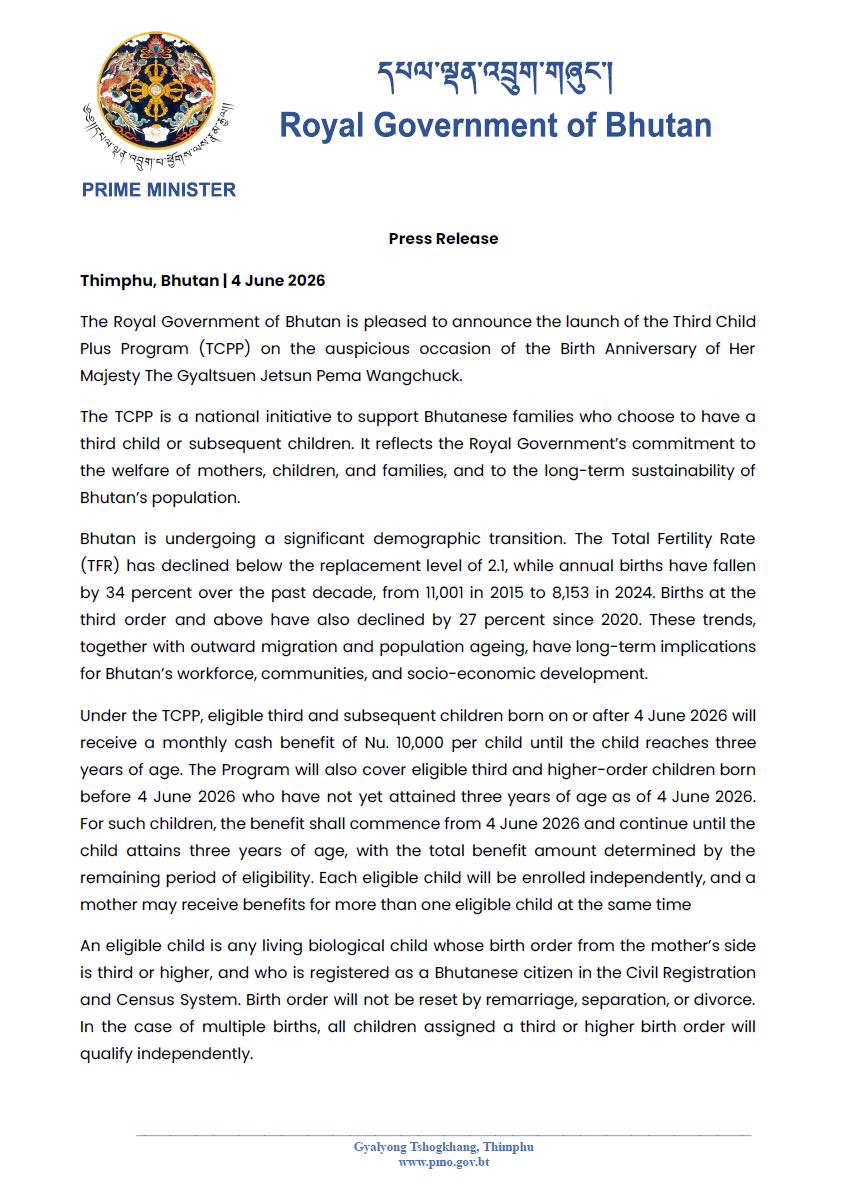
On 4 June 2026 — the birth anniversary of Her Majesty The Gyaltsuen Jetsun Pema Wangchuck — the Prime Minister's Office announced the formal launch of the scheme under the official name the Third Child Plus Program (TCPP). The press release framed the TCPP as a national initiative to support families who have a third or subsequent child, tied to the welfare of mothers and children and the long-term sustainability of Bhutan's population.[7]
The Prime Minister's Office set out the official demographic figures behind the policy: Bhutan's total fertility rate has fallen below the replacement level of 2.1, while annual births dropped 34 per cent over the past decade, from 11,001 in 2015 to 8,153 in 2024. Births at the third order and above fell 27 per cent over the shorter period since 2020. The government tied these trends, together with outward migration and population ageing, to long-term risks for the country's workforce, communities and socio-economic development.[7]
Under the launched programme, eligible third and subsequent children born on or after 4 June 2026 receive a monthly cash benefit of Nu 10,000 (~USD 105) per child until the child turns three. The TCPP also extends retroactively to eligible third and higher-order children born before 4 June 2026 who had not yet reached the age of three on that date; for them the benefit begins on 4 June 2026 and runs until the child's third birthday, with the total determined by the remaining period of eligibility. Each eligible child is enrolled independently, and a mother may draw benefits for more than one eligible child at the same time.[7]
The press release defined an eligible child as any living biological child whose birth order from the mother's side is third or higher and who is registered as a Bhutanese citizen in the Civil Registration and Census System. Birth order is not reset by remarriage, separation or divorce, and in the case of multiple births every child assigned a third or higher birth order qualifies independently.[7]
Background
Bhutan's total fertility rate has fallen from about six children per woman in the 1980s to roughly 1.4 in the mid-2020s, well below the 2.1 replacement rate. Only 5,784 babies were born in the country in 2025, compared with 15,580 in 1990 — a decline of more than 60 per cent in 35 years. The drop is compounded by the large-scale emigration of working-age Bhutanese to Australia and other countries, which the government regards as the country's most serious long-term policy challenge.[3]
The Third Child Incentive Programme was first floated during the 2024 election campaign and formally adopted as a policy commitment when the PDP took office. The government allocated Nu 31.5 million in the 2025-26 budget as a first tranche, with the Ministry of Health identified as the lead agency and indications of co-financing interest from the Japan International Cooperation Agency (JICA) and the World Bank.[4]
Provisions of the scheme
Under the design announced by the Prime Minister, mothers of a third or subsequent child receive a direct cash transfer of Nu 10,000 (~USD 105) each month from the child's birth until the child's third birthday. As originally designed, the benefit applied to children born after the scheme's commencement and is paid per qualifying child (at launch this was broadened to also cover qualifying children already born but under the age of three — see above), so a family with a third and a fourth child under three would draw two payments concurrently.[4]
The cash transfer sits alongside a set of complementary tax measures contained in the 2025-26 budget: an income-tax deduction of Nu 1,000 for a first child, Nu 1,250 for a second, Nu 5,000 for a third and Nu 10,000 for each additional child, with an annual deduction of Nu 40,000 for parents of children with disabilities. The Finance Minister identified a target replacement fertility rate of at least 2.2 children per woman as the policy objective.[4]
Internal projections used in the original costing assumed that around 2,100 third children are born in Bhutan each year on a five-year average, with an anticipated 30 per cent uplift attributable to the incentive. On those assumptions the scheme was estimated to cost Nu 300-400 million in its first year, rising towards Nu 1.6 billion by 2029, for a five-year total of about Nu 6.1-6.4 billion.[1]
Cabinet pause, March 2026
On 7 March 2026, at the regular Meet the Press briefing, Cabinet Secretary Dasho Kesang Deki announced that the Cabinet had put the cash incentive on hold. Speaking on behalf of the Prime Minister, she said the government had concluded that "a cash incentive alone is too narrow a solution to address the country's complex demographic challenges" and that a comprehensive study of fertility, marriage and migration patterns would be commissioned first. The reframed approach emphasised economic stability, job creation, childcare infrastructure, gender-responsive workplace policies and a broader social protection strategy alongside any cash transfer.[2]
Parliamentary confirmation, May 2026
The programme returned to the political agenda during the Fifth Session of the Fourth Parliament, which opened on 14 May 2026. In a question-hour exchange, Dorji Wangmo, the National Assembly Member for the Kengkhar-Weringla constituency in Mongar, pressed the government on its earlier pledge. She cited the 62.9 per cent fall in annual births over the previous 35 years and pointed to the cost of living and the limited availability of early childhood care and development (ECCD) facilities as obstacles to family formation.[3]
In reply, Prime Minister Tshering Tobgay said: "We have pledged to provide Nu 10,000 for the third child. We expect to begin the initiative next month." He confirmed a June 2026 launch and described the programme as part of a wider package of measures including expanded ECCD facilities and a National Social Protection strategy intended to address the ageing of the Bhutanese population.[3]
Implementation and contingency
The Prime Minister presented the June 2026 roll-out as an initial implementation, with the scope and design of the scheme potentially to be modified once the comprehensive demographic study is completed. The Ministry of Health remains the lead implementing agency, with disbursement expected through the existing public payment infrastructure used for other social benefits.[5]
The size of the monthly transfer is significant in Bhutanese terms. Nu 10,000 is roughly comparable to the entry-level monthly civil-service stipend for a junior position, and for rural families it represents a meaningful share of household cash income. Whether the cash alone will move the fertility rate, or whether the structural drivers identified by the Cabinet in March — housing costs, childcare, employment quality and emigration — will dominate, is the question the parallel demographic study is intended to answer.
Reception
Coverage in Kuensel, The Bhutanese and the Bhutan Broadcasting Service has been broadly descriptive rather than evaluative. International comparison has been made with other low-fertility states' baby-bonus schemes, most of which have produced modest and short-lived effects. Bhutanese demographers cited in domestic press coverage have noted that the Bhutanese case is unusual in combining low fertility with substantial emigration of the working-age population, which complicates any simple read-across from countries such as Singapore, South Korea or Hungary.[6]
Enquiries and contact channels
On 10 June 2026, six days after the launch, the Prime Minister's Office issued a follow-up public notification setting out the official channels for enquiries relating to the programme.[8] Enquiries are directed to two bodies: the Public Service Delivery Division (PSDD) of the Prime Minister's Office, and the Project Management Unit (PMU) of the Ministry of Health.
The PSDD runs a toll-free helpline on 1199, available from 9:00 am to 5:00 pm on weekdays, and a WhatsApp and on-call line on +975 17191199, available from 9:00 am to 9:00 pm seven days a week; it can also be reached by email at g2c@cabinet.gov.bt. The Ministry of Health's Project Management Unit can be contacted by telephone on 02-333335.[8]
See also
- Bhutan's demographic crisis
- Bhutanese emigration to Australia
- National Assembly of Bhutan
- Tshering Tobgay
- People's Democratic Party
- Third-Country Resettlement of Bhutanese Refugees (2007–2016)
- Desuung Programme
- Child Care and Protection Act of Bhutan 2011
- Tax and incentive regime of Gelephu Mindfulness City
- Fiscal Incentives Act of Bhutan 2021
- Child Malnutrition in Bhutan
References
- "Nu 10,000 third Child Incentive Program to be launched this year says PM" — The Bhutanese
- "Government's third-child cash incentive on hold" — Bhutan Broadcasting Service, 7 March 2026
- "Govt. to roll out Nu 10,000 monthly payout for third child in June" — Kuensel
- "Government set aside Nu 31.5 M for third child policy" — Bhutan Broadcasting Service
- "Government to launch Third Child Incentive Programme next month" — Bhutan Broadcasting Service
- "Bhutanese government working on population strategy to tackle low fertility and migration" — Asia News Network
- "Press Release: Launch of the Third Child Plus Program (TCPP)" — Prime Minister's Office, Royal Government of Bhutan, 4 June 2026
- "Public Notification: Designated Contact Details for the Third Child Plus Program (TCPP)" — Prime Minister's Office, Royal Government of Bhutan, 10 June 2026
Related articles
Know something about this topic? Edit this article or . Anonymous contributions welcome — no account required.