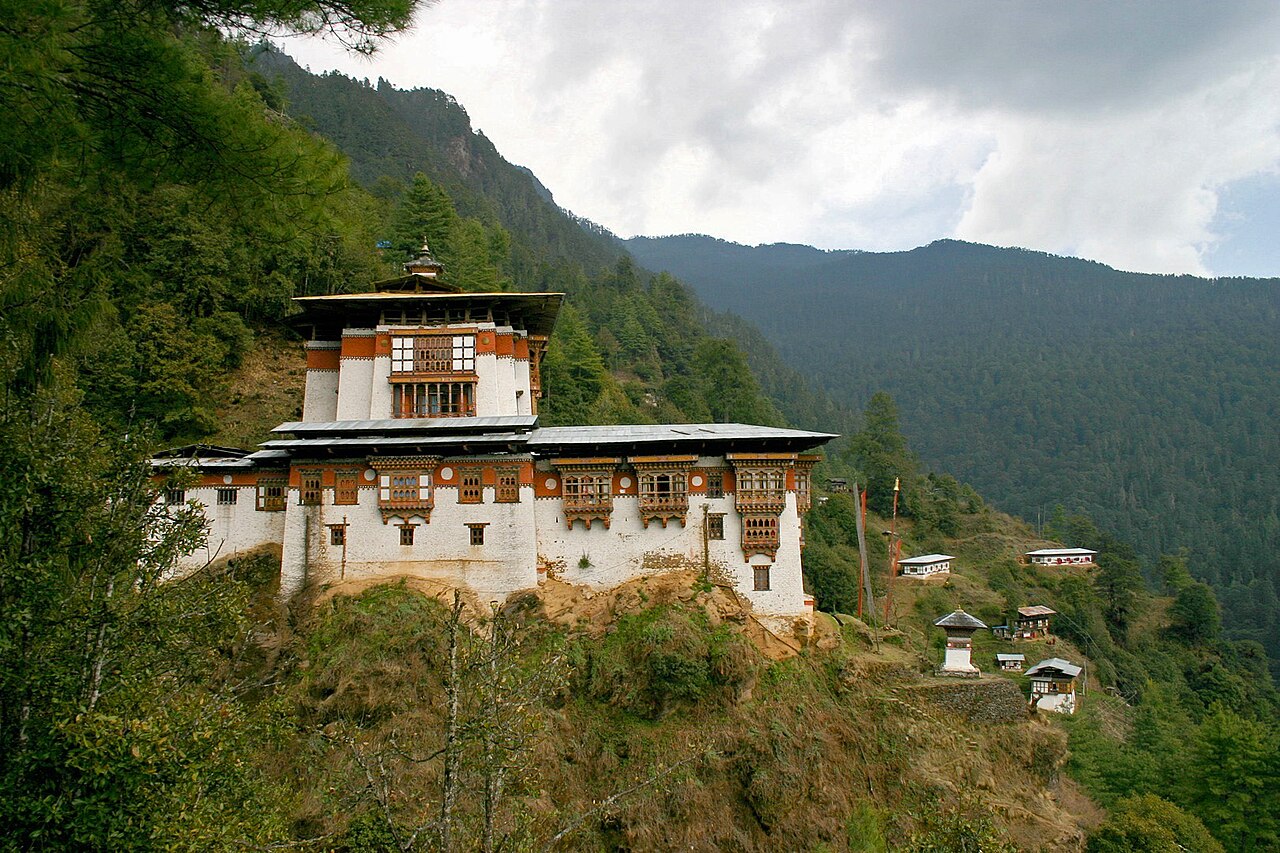

Tango Monastery (Dzongkha: རྟ་མགོ་དགོན་པ), formally known as Tango Cheri Dordenma, is a prominent Buddhist monastery situated on a densely forested hillside in the upper Thimphu Valley, approximately fourteen kilometres north of Thimphu, the capital of Bhutan. The name "Tango" is believed to derive from the Tibetan ta (horse) and mgo (head), referring to a horse-head shaped rock formation at the site associated with the deity Hayagriva (Tamdrin), a wrathful manifestation of Avalokiteshvara.[1]
The monastery was founded in the thirteenth century by Phajo Drugom Zhigpo (1184-1251), the Tibetan lama who is credited with introducing the Drukpa Kagyu school of Buddhism to western Bhutan. Phajo Drugom Zhigpo's arrival and the establishment of the Drukpa Kagyu tradition laid the groundwork for the later unification of Bhutan under Zhabdrung Ngawang Namgyal in the seventeenth century. The present structure dates largely to renovations carried out in the fifteenth century by the "Divine Madman" Drukpa Kunley, and further reconstruction in the eighteenth century after earthquake damage.[2]
Today, Tango Monastery serves as one of the most important centres of Buddhist higher education in Bhutan. It houses a monastic college (shedra) where monks undertake an intensive course of study in Buddhist philosophy, logic, and scripture spanning six to nine years. The monastery's combination of historical significance, active scholarly mission, and dramatic natural setting makes it one of the most important religious institutions in the Thimphu area.[3]
History
The history of Tango Monastery is intertwined with the introduction of the Drukpa Kagyu lineage to Bhutan. Phajo Drugom Zhigpo was born in Tibet in 1184 and received teachings from Tsangpa Gyare Yeshe Dorje, the founder of the Drukpa Kagyu school. Following a prophetic instruction, he travelled southward into the Himalayan borderlands and arrived in the Thimphu Valley in the early thirteenth century. He established meditation sites in the upper valley, including the location that would become Tango Monastery. His successful propagation of the Drukpa Kagyu teachings among the local population established the school's dominance in western Bhutan, displacing the earlier Lhapa Kagyu tradition.[4]
In the fifteenth century, the site was significantly expanded by Drukpa Kunley (1455-1529), the eccentric yogi also associated with Chimi Lhakhang in the Punakha Valley. Drukpa Kunley is credited with constructing portions of the monastery and blessing the site through his characteristic blend of unconventional spiritual practice.[5]
The monastery gained additional prestige in the seventeenth century when Zhabdrung Ngawang Namgyal, the unifier of Bhutan, used Tango as a meditation retreat. The Zhabdrung had already established Cheri Monastery (Chagri Dorjeden) nearby in 1620 — the first monastery he founded upon arriving in Bhutan — and the two monasteries formed a pair of closely linked institutions in the upper Thimphu Valley. The fourth Desi (secular ruler), Tenzin Rabgye (r. 1680-1694), carried out significant reconstruction of Tango in the characteristic tower form (utse) that the building retains today.[6]
An earthquake in the eighteenth century caused substantial damage, leading to further reconstruction. The monastery has been restored and maintained continuously since then, most recently with repairs following earthquake damage in 2011. Despite these interventions, the core structure and sacred spaces of the monastery have been preserved.[7]
Architecture
Tango Monastery is built in a tower-like form characteristic of Bhutanese monastic architecture, rising several storeys up the steep hillside. The whitewashed walls, red-band trim, and gilded roof ornaments follow the conventions of Drukpa Kagyu institutional architecture. The building is set against a dramatic backdrop of old-growth forest, with the monastery appearing to emerge from the mountainside itself.[8]
The interior contains multiple chapels on successive floors. The main prayer hall houses images of Chenrezig (Avalokiteshvara) and Guru Rinpoche, along with thangka paintings and relics associated with the monastery's founding figures. A meditation cave attributed to Phajo Drugom Zhigpo is incorporated into the complex. The monastic college classrooms and monks' quarters are arranged around and below the main temple structure.[9]
The approach to the monastery requires a steep uphill walk of approximately thirty to forty-five minutes through dense blue pine and rhododendron forest, adding to the sense of pilgrimage and seclusion. Prayer flags and small chortens line the path, and the sound of the monastery's horns and drums can sometimes be heard echoing through the trees during prayer sessions.[10]
Religious Significance
Tango Monastery is significant on multiple levels. As the site associated with Phajo Drugom Zhigpo, it represents the point of origin of the Drukpa Kagyu tradition in Bhutan — the school that would become the state religion and the defining spiritual identity of the nation. The monastery thus holds a foundational place in Bhutanese religious history, analogous to the role of Ralung Monastery in Tibet for the wider Drukpa lineage.[11]
The monastery's function as a centre of Buddhist higher learning gives it contemporary significance as well. The shedra at Tango is one of the most respected in Bhutan, attracting monks from across the country for advanced study. The curriculum follows the traditional Kagyu programme of philosophical study, including works by Nagarjuna, Chandrakirti, Dharmakirti, and other classical Indian Buddhist scholars, as well as texts from the Tibetan commentarial tradition. Graduates of the Tango shedra go on to serve as teachers, ritual specialists, and administrators throughout the Bhutanese monastic establishment.[12]
Festivals
Tango Monastery does not host a large public tshechu in the manner of the major dzongs. However, the monastic community observes the full calendar of Drukpa Kagyu religious dates, including Guru Rinpoche's birthday (on the tenth day of the sixth Bhutanese month), the anniversary of Buddha's first teaching (Chökhor Düchen), and other significant occasions. These observances include extended prayer sessions, ritual offerings, and meditation practices that are primarily internal to the monastic community rather than public festivals.[13]
Visiting
Tango Monastery is located approximately fourteen kilometres north of Thimphu, at the end of a road that follows the upper Thimphu Valley past the telecommunications tower at Sangaygang. From the road's end, visitors must walk uphill for approximately thirty to forty-five minutes through forest to reach the monastery. The trail is moderately steep and well-maintained. Visitors are permitted to enter the monastery compound and visit the main temple, though some areas may be restricted during study sessions or retreats. The nearby Cheri Monastery, founded by the Zhabdrung in 1620, can be visited on the same excursion, though it requires crossing the river and a separate uphill walk. Both monasteries are best visited as a half-day trip from Thimphu. Comfortable walking shoes and modest dress are recommended.[14]
References
- "Tango Monastery." Wikipedia.
- "Tango Monastery." Wikipedia.
- "Tango Monastery." Wikipedia.
- "Phajo Drugom Zhigpo." Wikipedia.
- "Tango Monastery." Wikipedia.
- "Tango Monastery." Wikipedia.
- "Tango Monastery." Wikipedia.
- "Tango Monastery." Wikipedia.
- "Tango Monastery." Wikipedia.
- "Tango Monastery." Wikipedia.
- "Phajo Drugom Zhigpo." Wikipedia.
- "Tango Monastery." Wikipedia.
- "Tango Monastery." Wikipedia.
- "Tango Monastery." Wikipedia.
Related articles
Know something about this topic? Edit this article or . Anonymous contributions welcome — no account required.