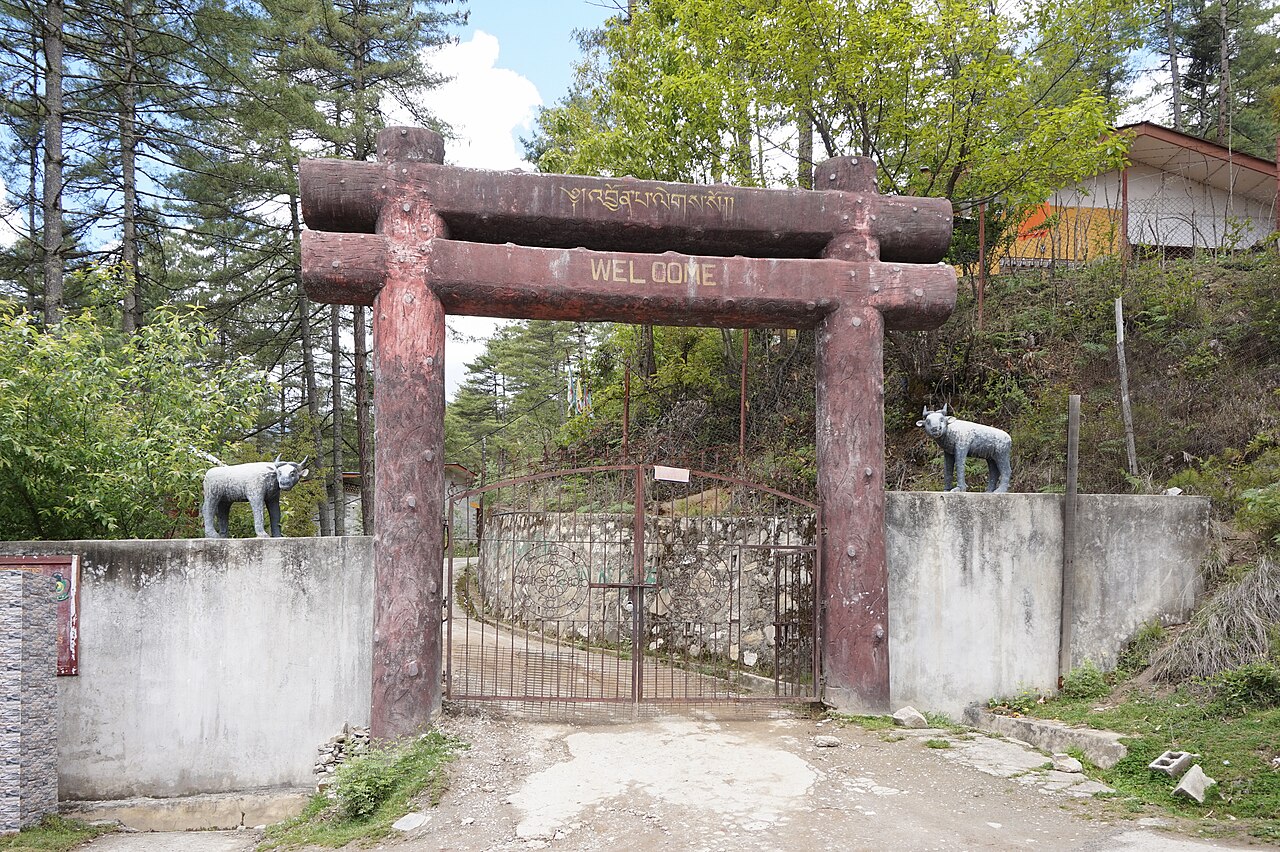

The Motithang Takin Preserve is a wildlife enclosure located in the Motithang neighbourhood of Thimphu, the capital of Bhutan. Situated at an elevation of approximately 2,400 metres in a forested hillside area on the outskirts of the city, the preserve is dedicated to the conservation and exhibition of the takin (Budorcas taxicolor whitei), a large, unusual-looking bovid that is Bhutan's national animal. The facility occupies an area of approximately 5.5 hectares of temperate forest and meadow, providing a semi-natural habitat for a herd of takin along with a small number of other native species including sambar deer and barking deer.[1]
The preserve has an unusual origin story that reflects Bhutan's distinctive approach to environmental ethics. It was originally established as a conventional mini-zoo in the 1990s. However, the fourth King of Bhutan, Jigme Singye Wangchuck, ordered the zoo closed, declaring that keeping animals in cages was incompatible with Bhutan's Buddhist principles and the country's commitment to environmental harmony. When the animals were released, the takin — having become habituated to human presence and feeding — refused to leave the area and instead wandered into the streets of Thimphu. The government then established the current preserve as a compromise: a spacious, fenced enclosure where the takin could live in semi-natural conditions while remaining accessible to visitors.[2]
Today, the Motithang Takin Preserve is one of the most visited attractions in Thimphu and serves as an important site for educating both domestic and international visitors about Bhutan's national animal and the country's broader commitment to biodiversity conservation. Bhutan, which has enshrined environmental protection in its constitution, maintains at least 60 per cent of its land under forest cover — a commitment that provides critical habitat for the takin and hundreds of other species in the wild.[3]
The Takin: Bhutan's National Animal
The takin (Budorcas taxicolor) is a large, stocky bovid found in the eastern Himalayas and the mountains of western China. Adults typically weigh between 150 and 350 kilograms and stand about 100 to 130 centimetres at the shoulder. The animal's appearance is often described as a combination of features from several different species — it has been likened to a "bee-stung moose" or compared to the mythical golden fleece animal. Its thick, oily coat provides insulation against the cold temperatures of its high-altitude habitat, and both males and females bear short, curved horns.[4]
The takin was designated as Bhutan's national animal in connection with a popular legend involving the fifteenth-century Buddhist saint Drukpa Kunley, known as the "Divine Madman." According to tradition, Drukpa Kunley was asked by a crowd to perform a miracle. He requested that they first bring him a cow and a goat. After consuming both animals, he placed the goat's head on the cow's skeleton and commanded the creature to rise — and so arose the takin, with its goat-like face and cow-like body. While the legend is whimsical, it reflects the deep cultural significance of the takin in Bhutanese folklore and explains why this particular animal was chosen as a national symbol.[5]
Conservation Status
The takin is classified as "Vulnerable" on the IUCN Red List. The Bhutanese subspecies, Budorcas taxicolor whitei (the Bhutan takin), is found primarily in the alpine and subalpine zones of northern and central Bhutan at elevations between 1,000 and 4,500 metres. Wild populations are threatened by habitat fragmentation, competition with domestic livestock for grazing land, and poaching, though the latter is relatively limited in Bhutan due to strong Buddhist cultural prohibitions against hunting and the country's robust conservation laws.[6]
Bhutan's extensive protected area network, which covers more than 51 per cent of the country's land area, provides substantial habitat for wild takin populations. Key protected areas for takin include Jigme Dorji National Park in the north and Wangchuck Centennial National Park. The biological corridors connecting these protected areas are critical for maintaining genetic diversity among scattered takin herds.
The Preserve
Layout and Facilities
The Motithang Takin Preserve encompasses a gently sloping area of temperate forest dominated by blue pine and oak species. The enclosure is designed to approximate the takin's natural habitat, with dense vegetation providing shade and cover. A stream runs through the preserve, and supplemental feeding stations ensure the animals receive adequate nutrition. The herd typically numbers between 20 and 30 individuals, including calves born in the preserve.[7]
Visitors access the preserve via a short walking trail from the Motithang area of Thimphu. An elevated viewing platform and several observation points along the perimeter fence allow visitors to observe the takin at close range. Informational signboards provide details about the takin's biology, behaviour, and conservation status, as well as the legend of Drukpa Kunley. In addition to takin, the preserve houses a small number of sambar deer (Rusa unicolor) and Himalayan barking deer (Muntiacus muntjak), both native to Bhutan's forests.
Management and Conservation Role
The preserve is managed by the Department of Forests and Park Services under Bhutan's Ministry of Agriculture and Forests. While the Motithang facility is primarily an exhibition and education site rather than a breeding centre, the takin born in the preserve contribute to the understanding of the species' reproductive biology and behaviour. Veterinary care is provided to the captive herd, and the animals are monitored for health and welfare.[8]
The preserve also serves an important role in raising public awareness about wildlife conservation among Bhutanese citizens and international tourists. School groups regularly visit the facility as part of environmental education programmes. For many international visitors, the takin preserve provides their first and often only opportunity to see this unusual and elusive animal, which is extremely difficult to observe in the wild due to its preference for dense, high-altitude forests and its wary nature.
Thimphu and the Motithang Area
The Motithang neighbourhood, where the preserve is located, is a residential area in the western part of Thimphu. The area sits on forested hillsides above the main city centre and is also home to several government offices and diplomatic residences. The Buddha Dordenma statue, a 51.5-metre gilded bronze statue of Shakyamuni Buddha, is located on a neighbouring hilltop and is visible from the preserve area. The proximity of these attractions makes the Motithang area a popular zone for tourist excursions in Thimphu.[9]
The presence of the takin preserve within the city limits of Thimphu is emblematic of Bhutan's relationship with its natural environment. Unlike many capital cities in the region, Thimphu maintains extensive green spaces and forested areas within its boundaries. The city's development is governed by regulations that limit building heights and mandate traditional architectural styles, and the takin preserve represents a commitment to maintaining wildlife habitat even within the country's most urbanised area.
Visitor Information
The Motithang Takin Preserve is open to visitors throughout the year. The best time to observe the takin is in the early morning, when the animals are most active and tend to gather at feeding stations. During the warmer months, the takin may retreat into the forested areas of the enclosure and can be more difficult to spot. The preserve is included in most standard Thimphu sightseeing itineraries offered by licensed Bhutanese tour operators and is accessible by road from the city centre in approximately ten minutes.[10]
International visitors to Bhutan are required to travel through a licensed tour operator and pay a daily Sustainable Development Fee (SDF), which funds conservation programmes and public services. Revenue from tourism thus indirectly supports the preservation of habitats for takin and other wildlife throughout Bhutan. The Motithang preserve, by serving as an accessible introduction to Bhutan's unique fauna, contributes to the broader narrative of sustainable tourism that the country promotes.
References
- "Motithang Takin Preserve." Wikipedia.
- "Motithang Takin Preserve." Wikipedia.
- "Bhutan." Wikipedia.
- "Takin." Wikipedia.
- "Drukpa Kunley." Wikipedia.
- "Budorcas taxicolor." IUCN Red List of Threatened Species.
- "Motithang Takin Preserve." Wikipedia.
- "Department of Forests and Park Services." Royal Government of Bhutan.
- "Buddha Dordenma statue." Wikipedia.
- "Tourism Council of Bhutan." Royal Government of Bhutan.
Related articles
Know something about this topic? Edit this article or . Anonymous contributions welcome — no account required.