Sonam Tobgye
From BhutanWiki, the people's encyclopedia of Bhutan · people · Verified
This article is about a living or recently deceased person. Edits must be supported by reliable, verifiable sources. Unsupported or potentially defamatory content will be removed.
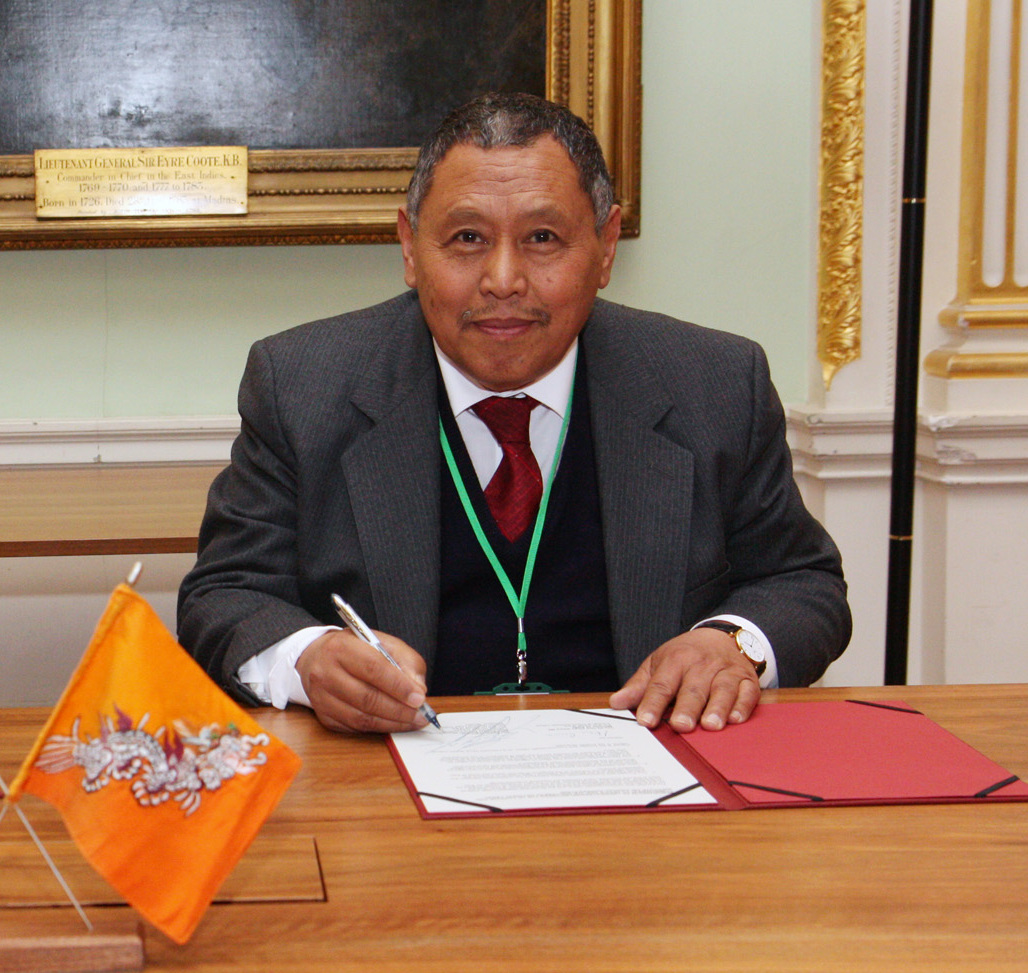
Lyonpo Sonam Tobgye (born 15 November 1949) is an eminent Bhutanese jurist and legal scholar who served as the first Chief Justice of the Supreme Court of Bhutan from 21 February 2010 to 14 November 2014. Prior to this historic appointment, he served as Chief Justice of the High Court of Bhutan for nearly two decades, from 1991 to 2009, making him the longest-serving head of the Bhutanese judiciary. His career has been inextricably linked to the development of Bhutan's modern legal system and its transition from a traditional monarchical legal framework to a constitutional democracy.[1]
Tobgye's most consequential contribution to Bhutanese history was his leadership of the 39-member Constitution Drafting Committee, which was tasked by His Majesty the Fourth King, Jigme Singye Wangchuck, with creating Bhutan's first written constitution. The formal drafting process, inaugurated on 30 November 2001, culminated in the adoption of the Constitution of Bhutan on 18 July 2008 by the first democratically elected Parliament. Tobgye has described the constitution as "not a product of demand and revolution or an imposed constitution" but rather "a constitution given by the throne and accepted by the people with full trust."[2]
Early Life and Education
Tobgye was born on 15 November 1949 in Bhutan. He received his early education at Dr. Graham's Homes, a boarding school in Kalimpong, India — the same institution that educated several other prominent Bhutanese leaders, including future Prime Minister Jigme Thinley. He pursued legal studies and entered the Bhutanese judiciary, where he would spend his entire career. He was later honoured with a Degree of Doctorate of Law by the NALSAR University of India in recognition of his contributions to jurisprudence and legal reform.[1]
Chief Justice of the High Court (1991–2009)
In 1991, Tobgye was appointed Chief Justice of the High Court of Bhutan, the country's highest court at that time. He held this position for eighteen years, overseeing the modernization and professionalization of the Bhutanese judiciary during a period of rapid national transformation. Under his stewardship, the High Court evolved from a largely traditional institution applying customary Bhutanese law to a more formalized judicial body capable of interpreting codified statutes and, eventually, a written constitution.[1]
During his tenure, Tobgye championed judicial independence, the training of Bhutanese legal professionals, and the codification of Bhutanese law. He worked to balance the preservation of traditional Bhutanese legal principles — many rooted in Buddhist ethics and customary practice — with the requirements of a modernizing state engaged in international trade, diplomacy, and, ultimately, democratic governance.[2]
Drafting the Constitution of Bhutan
In 2001, the Fourth King announced his intention to give Bhutan a written constitution and to transition the country from an absolute monarchy to a constitutional monarchy with democratic parliamentary governance. This decision was remarkable in that it was initiated by the monarch himself, rather than in response to popular demand or political crisis. Tobgye was appointed to lead the 39-member Constitution Drafting Committee entrusted with this historic task.[2]
The drafting process involved extensive consultation with Bhutanese communities across the country. The committee traveled to all twenty districts (dzongkhags) to gather public input, holding public meetings where citizens could comment on draft provisions. This consultative approach was designed to ensure that the constitution reflected the values and aspirations of the Bhutanese people while incorporating the institutional reforms envisioned by the monarchy.[2]
The resulting document established a bicameral parliament, an independent judiciary, fundamental rights protections, and the institutional framework for a constitutional monarchy. It enshrined Gross National Happiness as a guiding principle of governance, mandated environmental conservation, and created independent constitutional bodies including the Anti-Corruption Commission and the Election Commission. The Constitution was formally adopted on 18 July 2008, shortly after Bhutan's first democratic elections.[1]
First Chief Justice of the Supreme Court (2010–2014)
The Constitution of Bhutan established the Supreme Court as the country's apex judicial body, replacing the High Court as the final court of appeal. In December 2009, Tobgye was appointed as the first Chief Justice of the Supreme Court, and he formally assumed the position on 21 February 2010. This appointment was a natural extension of his decades of judicial leadership and his central role in drafting the constitutional framework that created the court itself.[1]
As Chief Justice of the Supreme Court, Tobgye presided over the establishment of the court's procedures, the development of its jurisprudence, and the interpretation of the new constitution's provisions. He navigated the delicate balance between the court's role as guardian of constitutional rights and its relationship with the other branches of government in a newly democratic system. He retired from the position on 14 November 2014.[3]
SAARCLAW Presidency and International Engagement
From 2011 to 2014, Tobgye served as president of SAARCLAW, the South Asian Association for Regional Co-operation in Law. This organization promotes legal cooperation, judicial training, and the exchange of legal expertise among the member states of SAARC — Bangladesh, Bhutan, India, Maldives, Nepal, Pakistan, and Sri Lanka. His presidency gave him a platform to share Bhutan's unique legal experience, particularly its approach to balancing traditional values with modern constitutional governance, with the broader South Asian legal community.[1]
Publications and Scholarly Work
Tobgye is the author of The Constitution of Bhutan: Principles and Philosophies, a comprehensive work that explains the historical context, drafting process, and philosophical foundations of the Bhutanese constitution. The book draws on Buddhist political philosophy, Bhutanese legal traditions, and comparative constitutional law to illuminate the choices made by the Drafting Committee. He has also written papers on Buddhist philosophies and their relationship to governance, and he maintains a keen interest in political philosophy more broadly.[4]
Legacy
Sonam Tobgye's legacy is inseparable from the legal and constitutional architecture of modern Bhutan. As the principal drafter of the constitution, the longest-serving chief justice of the High Court, and the first chief justice of the Supreme Court, he has shaped every dimension of Bhutan's judiciary and legal system. His work ensured that Bhutan's transition to democracy was grounded in a carefully crafted constitutional framework that balanced tradition and modernity, royal authority and popular sovereignty, individual rights and communal values.
References
- Sonam Tobgye — Wikipedia
- Sonam Tobgye Interview — Princeton Innovations for Successful Societies
- Chief Justice of Supreme Court Retires — The Bhutanese
- Hon'ble Mr. Justice Lyonpo Sonam Tobgye — National Law University Delhi
- "Sonam Tobgye." Royal Institute for Governance and Strategic Studies (RIGSS), Bhutan.
- "Judiciary of Bhutan." Supreme Court of Bhutan.
Related articles
Know something about this topic? Edit this article or . Anonymous contributions welcome — no account required.