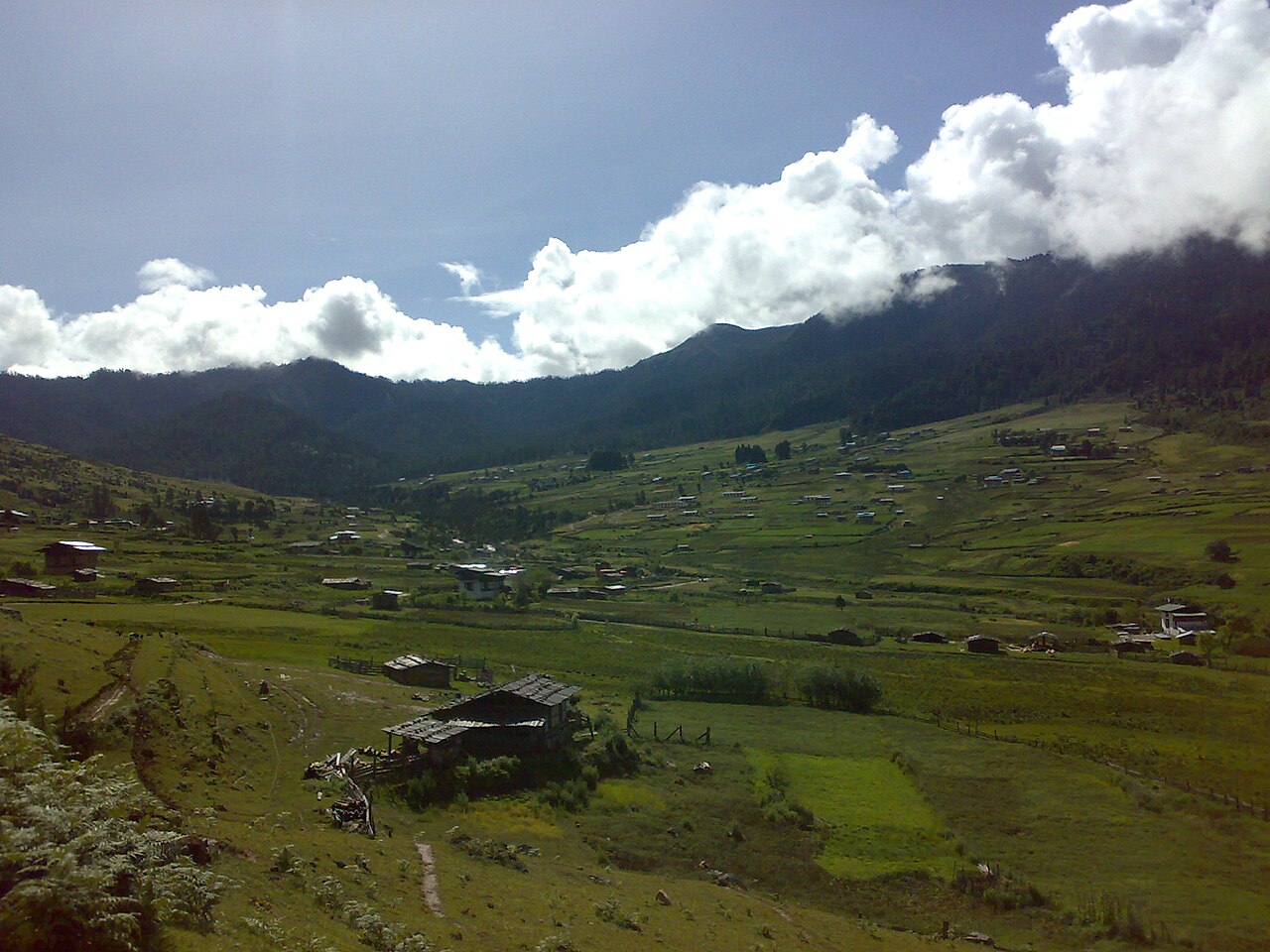

Phobjikha Valley (Dzongkha: ཕོབས་བྱི་ཁ; also spelled Phobjika) is a broad, bowl-shaped glacial valley in central Bhutan, located within Wangdue Phodrang District at an average elevation of approximately 2,900 metres (9,500 ft) above sea level. The valley is one of the few glacial valleys in Bhutan, formed by ancient glacier activity that carved a wide, flat-bottomed depression surrounded by gently sloping mountains — a landscape markedly different from Bhutan's typical steep-sided river gorges. Phobjikha is best known internationally as the primary wintering ground of the endangered black-necked crane (Grus nigricollis), which migrates from the Tibetan Plateau each autumn to spend the winter months in the valley's marshy grasslands.[1]
Dominating the valley's eastern ridge is the 17th-century Gangtey Goenpa (Gangtey Monastery), an important Nyingmapa Buddhist monastery that serves as the seat of the Gangtey Tulku, a significant reincarnate lama in the Bhutanese religious tradition. The monastery and the valley together form a landscape of profound spiritual and ecological importance, where human habitation, agricultural practice, and wildlife conservation have coexisted in a delicate balance for centuries.[2]
In recognition of its ecological significance, the Phobjikha Valley has been designated as a conservation area under Bhutan's extensive protected areas network. The valley is also part of the biological corridor linking Jigme Singye Wangchuck National Park to the broader landscape, enabling wildlife movement across a vast swathe of central Bhutan's forests and highlands.[3]
Geography
The Phobjikha Valley lies on the western slopes of the Black Mountains (Jigme Singye Wangchuck National Park), accessible from the east-west highway via the Lawala Pass (3,360 m). Unlike most Bhutanese valleys, which are V-shaped and carved by rivers, Phobjikha's U-shaped profile reveals its glacial origins. The valley floor, approximately 7 kilometres long and 2 kilometres wide, is characterised by marshy wetlands, dwarf bamboo thickets, and grasslands that provide ideal foraging habitat for cranes and other waterbirds.[4]
The Nakay Chhu stream meanders through the valley floor, draining the wetlands before flowing south to join the Dang Chhu. The surrounding hillsides are covered in mixed conifer and broadleaf forests, with blue pine and hemlock predominating at lower elevations and fir forests higher up. The valley experiences cold winters with occasional snowfall and cool, misty summers characteristic of Bhutan's temperate highland climate zone.[5]
Ecology
The Phobjikha Valley's global significance rests primarily on its role as the most important wintering site for the black-necked crane in Bhutan. Each year between late October and mid-February, approximately 300–500 cranes arrive from their breeding grounds on the Tibetan Plateau, making Phobjikha home to one of the largest wintering populations of this vulnerable species. The cranes are said to circle Gangtey Monastery three times upon arrival and departure — a behaviour that local tradition interprets as an act of reverence toward the sacred site.[6]
The Royal Society for Protection of Nature (RSPN), Bhutan's leading conservation organisation, operates the Black-Necked Crane Information Centre in Phobjikha, which serves as both a research station and an educational facility for visitors and local communities. Conservation efforts have included restricting the installation of overhead power lines through the valley (electricity was instead delivered via underground cables at considerable additional expense), controlling development in the wetland areas, and engaging local farmers in crane-friendly agricultural practices.[7]
Beyond the cranes, the valley supports a diverse assemblage of birds, mammals, and plants. Spotted deer, wild boar, Himalayan black bear, and red fox inhabit the surrounding forests, while the wetlands host a variety of waterfowl, raptors, and passerines. The marshy grasslands contain several species of medicinal plants and are botanically rich despite the valley's relatively high elevation.[8]
Cultural Significance
Gangtey Goenpa, the monastery that presides over the valley from its ridgetop perch, was founded in the 17th century by Gyalse Pema Thinley, the grandson and mind reincarnation of Pema Lingpa, one of Bhutan's most revered treasure discoverers (tertons). The monastery is one of the most important Nyingmapa establishments in western and central Bhutan, and the Gangtey Tulku lineage continues to play a significant role in Bhutanese religious life. The current incarnation, the ninth Gangtey Tulku, has been active in promoting both spiritual education and environmental conservation in the valley.[9]
The annual Black-Necked Crane Festival, held on 11 November in the valley, has become one of Bhutan's most distinctive cultural events. Organised by RSPN in collaboration with local communities and schools, the festival features traditional dances, songs, and performances by schoolchildren dressed as cranes, intended to foster appreciation for the birds and the wetland ecosystem. The festival draws both domestic and international visitors and has been instrumental in raising conservation awareness.[10]
Economy
The economy of Phobjikha is predominantly agricultural, with potato farming serving as the primary cash crop. The valley's cool climate and well-drained soils produce high-quality potatoes that are marketed throughout Bhutan and, to some extent, exported to India. Cattle rearing, particularly of yak-cow hybrids at higher elevations and dairy cattle on the valley floor, supplements farming income. The production of buckwheat and turnips is also common, reflecting traditional highland agricultural practices.[11]
Ecotourism has emerged as an increasingly important livelihood source. Several community-run homestays and small lodges offer accommodation to visitors drawn by the cranes, the Gangtey Nature Trail (a gentle hike through the valley floor), and the serene landscape. The government and conservation organisations have promoted ecotourism as a means of providing economic incentives for habitat protection, ensuring that local communities benefit directly from the valley's natural heritage.[12]
Tourism
Phobjikha Valley is a popular stop on the east-west touring circuit through Bhutan. The Gangtey Nature Trail, a well-maintained path that descends from Gangtey Monastery through pine forest and along the valley floor, offers a leisurely walk of approximately three hours with excellent opportunities for birdwatching and photography. During the crane season (November to February), visitors can observe the birds from observation points near the RSPN centre, using telescopes provided by the facility.[13]
Other attractions include the Kumbu Lhakhang and Damcho Lhakhang temples, both of historical importance to the Nyingmapa tradition, and the opportunity to experience rural Bhutanese life through homestay programmes. The valley's relative remoteness and the absence of large-scale development give Phobjikha a peaceful, timeless quality that contrasts with the busier tourist centres of Paro and Thimphu.[14]
References
- "Phobjikha Valley." Wikipedia.
- "Gangtey-Phobjikha." Wikipedia.
- "Phobjikha Conservation Area." RSPN Bhutan.
- "Phobjikha Valley." Wikipedia.
- "Phobjikha Conservation Area." RSPN Bhutan.
- "Black-Necked Crane." RSPN Bhutan.
- "Black-Necked Crane." RSPN Bhutan.
- "Biodiversity." WWF Bhutan.
- "Gangtey Monastery." Wikipedia.
- "Black-Necked Crane Festival." RSPN Bhutan.
- "Bhutan at a Glance." FAO.
- "Gangtey-Phobjikha." Wikipedia.
- "Gangtey-Phobjikha." Wikipedia.
- "Phobjikha Valley." Lonely Planet.
Related articles
Know something about this topic? Edit this article or . Anonymous contributions welcome — no account required.