Pema Lingpa (Tertön)
This article is about a living or recently deceased person. Edits must be supported by reliable, verifiable sources. Unsupported or potentially defamatory content will be removed.
Pema Lingpa (1450–1521) was a Bhutanese Buddhist treasure revealer (tertön) of the Nyingma school, recognised as one of the Five Tertön Kings. Born a blacksmith's grandson in Bumthang's Tang Valley, he discovered sacred texts and objects hidden by Padmasambhava, founded important temples, and established a spiritual lineage from which the Wangchuck royal dynasty claims descent.
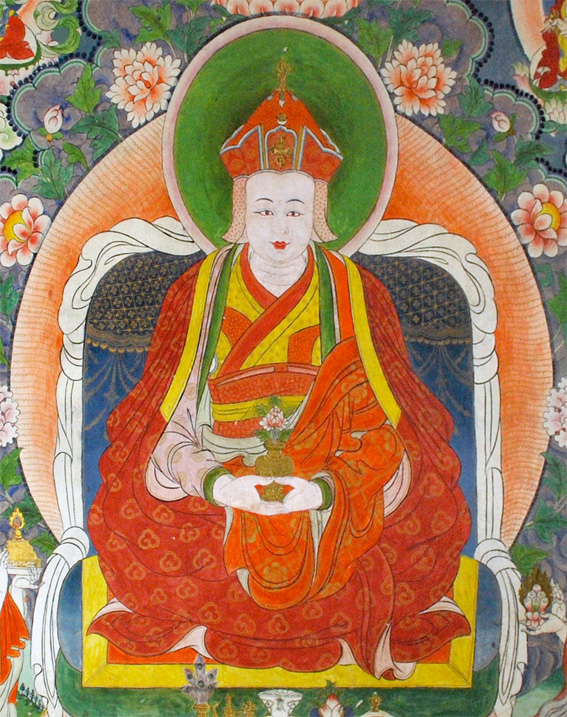
Pema Lingpa (1450–1521) was a Bhutanese Buddhist saint, visionary, and treasure revealer (tertön) of the Nyingma school of Tibetan Buddhism. Revered as one of the Five Tertön Kings (Tertön Gyi Gyalpo Nga), the supreme discoverers of spiritual treasures (terma) hidden by Guru Rinpoche (Padmasambhava) in the 8th century, Pema Lingpa occupies a place in Bhutanese religious history second only to Padmasambhava himself. His life combined mystical revelation with artistic creativity, temple-building, and the establishment of a religious lineage that continues to shape Bhutan's spiritual and political landscape to the present day.[1]
Born into a humble family in the Tang Valley of Bumthang, Pema Lingpa received no formal monastic education and trained initially as a blacksmith, following in his grandfather's craft. His emergence as one of the most important religious figures in Bhutanese history — through a series of treasure discoveries that began when he was in his twenties — illustrates a recurring pattern in Tibetan Buddhist tradition, where spiritual authority can arise from visionary experience rather than institutional training. His discoveries of sacred texts, ritual objects, statues, and relics from lakes, cliffs, and temples across the Himalayan region provided the Nyingma school with an extensive body of liturgical and philosophical material that is still used in practice today.[2]
Beyond his religious significance, Pema Lingpa holds a unique position in Bhutanese national identity. The Wangchuck dynasty, which has ruled Bhutan since 1907, traces its ancestry to Pema Lingpa through the Gangteng and Sungtrul incarnation lines, making the treasure revealer not merely a religious figure but the genealogical and spiritual ancestor of the modern Bhutanese state.
Early Life and the Burning Lake
Pema Lingpa was born in 1450 in Chel village (present-day Baribrang) in the Tang Valley of Bumthang, central Bhutan. His grandfather, Sonam Gyalpo, was a blacksmith — a profession of low social standing — and the young Pema Lingpa received no formal religious training. According to hagiographic accounts, he was an unremarkable youth who showed little outward indication of the spiritual destiny that awaited him. He learned his grandfather's trade and lived as an ordinary craftsman.[3]
The pivotal event of Pema Lingpa's life occurred in 1476 when, according to tradition, he received a vision directing him to a sacred text hidden beneath the waters of Mebar Tsho (the Burning Lake) in the Tang Valley. The story of this first discovery is central to Bhutanese religious identity. Pema Lingpa is said to have waded into the lake at night, holding a burning butter lamp, and to have emerged with a sacred text and a statue while the lamp still burned — taken as proof of the authenticity of his revelation. When sceptics, including a local chieftain, demanded a public demonstration, he repeated the feat before witnesses, plunging into the lake with a lit lamp and emerging with both the lamp still burning and a treasure chest containing sacred objects. This event gave Mebar Tsho its name, and the lake remains one of the most important pilgrimage sites in Bhutan.[4]
Treasure Discoveries
Over the course of his life, Pema Lingpa is credited with discovering more than thirty major treasures (terma) from locations across Bhutan and neighbouring regions. These included sacred texts containing liturgies, meditation instructions, and prophecies; ritual objects; and statues believed to have been concealed by Padmasambhava in the 8th century for discovery at a time when they would be most needed. The concept of terma is central to the Nyingma school of Tibetan Buddhism, which holds that Padmasambhava hid teachings throughout the Himalayan region, to be revealed by predestined tertön when conditions were ripe.[5]
Not all contemporaries accepted Pema Lingpa's claims. Some rival religious figures questioned the authenticity of his discoveries, and his humble origins — lacking the monastic credentials that typically accompanied claims of spiritual authority — made him a controversial figure during his lifetime. The tension between those who venerated him as a genuine tertön and those who regarded him with suspicion reflects broader debates within Tibetan Buddhism about the nature and validation of revealed treasures. Over time, however, the weight of tradition and the institutional power of his lineage firmly established his status among the greatest of the tertön.[6]
Temples and Sacred Sites
Pema Lingpa was not only a revealer of hidden teachings but also a builder of sacred spaces. He founded several important temples and monasteries in Bumthang and beyond. The most significant of these is Tamshing Lhakhang (Temple of the Good Message), founded in 1501 in the Chokhor Valley of Bumthang. Tamshing Lhakhang houses some of the oldest surviving wall paintings in Bhutan, believed to have been painted by Pema Lingpa himself, and it remains an active centre of worship and pilgrimage. The temple is also the traditional seat of the Sungtrul incarnation line, one of the two principal lines of Pema Lingpa's reincarnations.[7]
He also contributed to the development of sacred dance (cham) traditions in Bhutan. Several of the masked dances performed at tshechu festivals throughout the country are attributed to Pema Lingpa, who is said to have received their choreography and costumes through visions. These dances remain integral to Bhutanese religious and cultural life, performed annually at festivals across the country.
Lineage and the Wangchuck Connection
Pema Lingpa's descendants formed a powerful class of religious nobility in Bumthang. His lineage split into two principal incarnation lines: the Gangteng Tulku line, based at Gangteng Monastery in the Phobjikha Valley, and the Sungtrul line, based at Tamshing Lhakhang in Bumthang. Both lines have wielded significant religious authority in Bhutan for over five centuries.[8]
The connection between Pema Lingpa's lineage and the Wangchuck dynasty is of particular political importance. Ugyen Wangchuck, who became the first King of Bhutan in 1907, claimed descent from Pema Lingpa through the Trongsa Penlop (governor) line. This genealogical link provided the new monarchy with a powerful source of religious legitimacy, connecting the ruling house to one of Bhutan's most revered spiritual figures. The Wangchuck dynasty has continued to emphasise this connection, and Pema Lingpa's legacy remains intertwined with the legitimacy and identity of the Bhutanese state.[9]
Spiritual Legacy
Pema Lingpa's spiritual legacy extends beyond the specific texts and objects he discovered. He is remembered as a figure who democratised access to spiritual authority in the Bhutanese context — a blacksmith's grandson whose visionary gifts transcended the hierarchies of birth and monastic training. His story resonates in Bhutanese culture as evidence that spiritual realisation is not confined to the formally educated or socially privileged.
The terma literature he revealed remains in active liturgical use across Nyingma monasteries in Bhutan and the broader Himalayan region. His sacred dances are performed every year. His temples stand as centres of worship and pilgrimage. And his bloodline occupies the throne of Bhutan. Few figures in Bhutanese history can claim a legacy so multifaceted — at once mystical and institutional, spiritual and political, ancient and enduringly present.
References
- "Pema Lingpa." Wikipedia.
- "Biography of Pema Lingpa, Bhutan's Famous Treasure Revealer." Daily Bhutan.
- "Tertön Pema Lingpa." Padling Choeki Ga Tshal Foundation.
- "Biography of Pema Lingpa." Daily Bhutan.
- "Pema Lingpa." Wikipedia.
- "Pema Lingpa." Treasury of Lives.
- "Biography of Pema Lingpa." Daily Bhutan.
- "Pema Lingpa." Wikipedia.
- "House of Wangchuck." Wikipedia.
Contributed by Anonymous Contributor, Harrisburg
See also
Pema Gyamtsho
Bhutanese agricultural scientist, former Minister of Agriculture and Forests (2008–2013), former Leader of the Opposition, and Director General of the International Centre for Integrated Mountain Development (ICIMOD) since October 2020.
people·8 min readPema Yangzom (Entrepreneur)
Pema Yangzom is a Bhutanese entrepreneur who founded Bhutan Alternatives, the country's first dedicated electronic waste (e-waste) recycling and management business, addressing a growing environmental gap in a nation constitutionally committed to ecological conservation.
people·3 min readShabdrung Jigme Norbu
Jigme Norbu (1831–1861) was the fourth mind incarnation of Zhabdrung Ngawang Namgyal. Born into the Drametse Choje family, recognised in childhood and briefly enthroned as Druk Desi in 1851, he resigned the office the following year to take a consort and pursue tantric practice, and died at the age of about thirty.
people·6 min readLila K. Chamlagai
Lila K. Chamlagai is a Bhutanese-American public health scholar, researcher, and community advocate. Born in a Bhutanese refugee camp in Nepal, he is the founder of Helping Hands America and a Gates Millennium Scholar pursuing a PhD at Brown University.
people·3 min readRongthong Kuenley Dorji
Rongthong Kuenley Dorji (c.1938 – 19 October 2011) was an exiled Bhutanese political activist and the founding chairman of the Druk National Congress. His 1997 arrest in New Delhi and the subsequent extradition proceedings drew international human rights attention. The Royal Government of Bhutan characterised him as ngolop (anti-national); Amnesty International and other human rights bodies treated him as a peaceful political opposition figure.
people·6 min readTrulku Jigme Choedra
Trulku Jigme Choedra (born 5 August 1955) is the 70th Je Khenpo of Bhutan, head of the Zhung Dratshang or Central Monastic Body since 1996. He is the longest-serving holder of the office in modern Bhutanese history and one of the two highest-ranking authorities under the dual system of governance.
people·5 min read
Test Your Knowledge
Think you know about this topic? Try a quick quiz!
Help improve this article
Do you have personal knowledge about this topic? Were you there? Your experience matters. BhutanWiki is built by the community, for the community.
Anonymous contributions welcome. No account required.