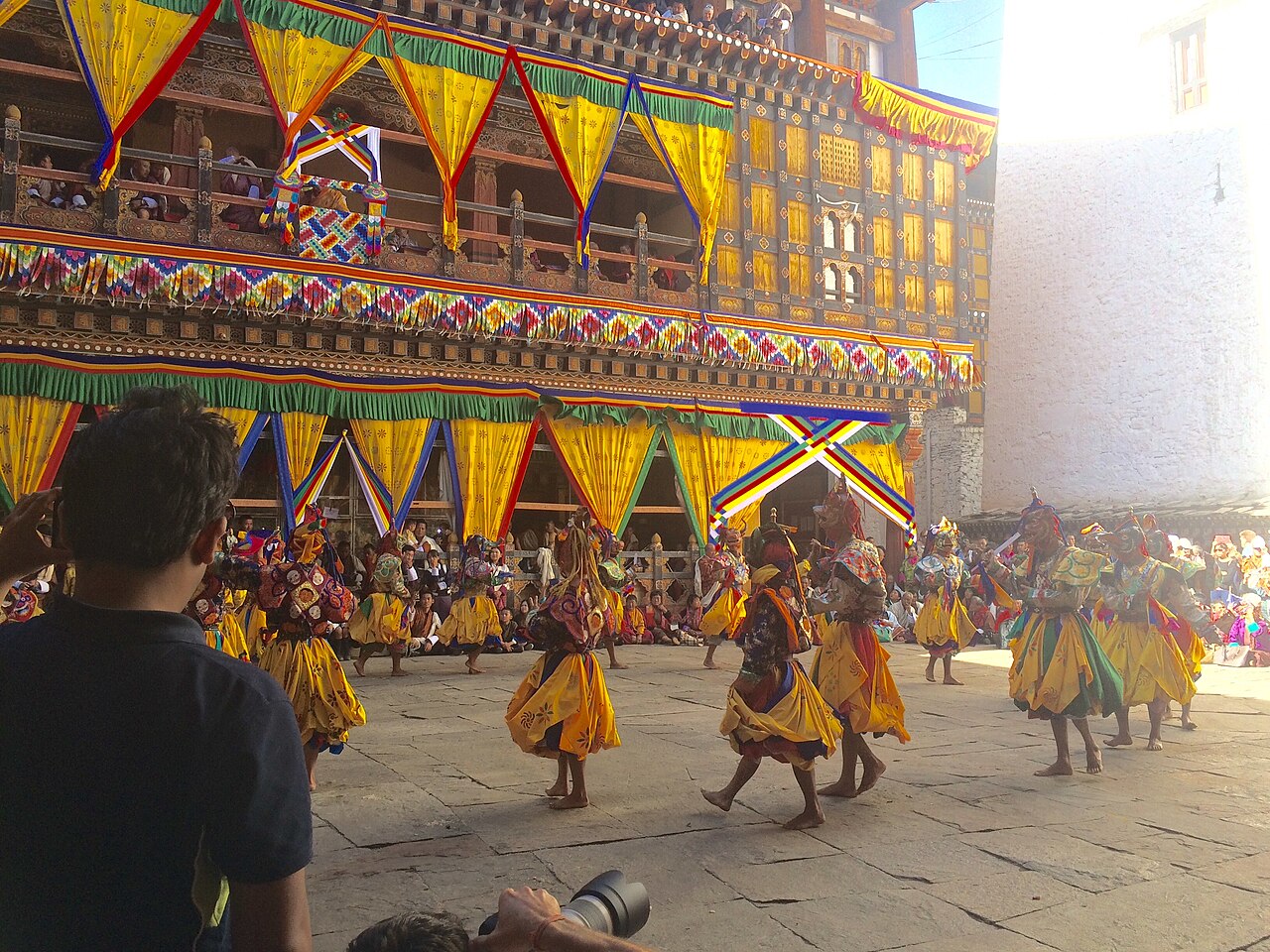

The Paro Tshechu is Bhutan's largest, most celebrated, and most internationally renowned religious festival, held annually over five days in the spring, typically in March or April according to the Bhutanese lunar calendar. The festival takes place in and around Rinpung Dzong, the imposing fortress-monastery that dominates the Paro Valley, one of the most historically significant and scenic regions of the country. The Paro Tshechu draws tens of thousands of Bhutanese from across the nation, along with a significant number of international visitors who time their trips specifically to attend.[1]
Like all tshechu festivals, the Paro Tshechu honours Guru Rinpoche (Padmasambhava) and features a programme of sacred masked dances (cham), religious music, and community celebration. However, it is distinguished by the exceptional range and elaborateness of its dances, the grandeur of its setting, and the display of one of Bhutan's most revered thongdrel — a giant silk appliqué image of Guru Rinpoche that is unfurled before dawn on the final day. The sheer scale and spectacle of the Paro Tshechu have made it a defining symbol of Bhutanese cultural identity.[2]
The festival is deeply embedded in the religious life of the Paro Valley and its surrounding communities. For local families, attending the tshechu is both a spiritual obligation and a joyous social occasion. The five days of the festival transform the normally quiet valley into a vibrant gathering, with markets, food stalls, and informal camps surrounding the dzong. Bhutanese wear their finest traditional dress, and the atmosphere combines devout worship with festive celebration.[3]
History
The origins of the Paro Tshechu are traced to the construction of Rinpung Dzong in 1644 by Zhabdrung Ngawang Namgyal, the unifier of Bhutan. The Zhabdrung established the festival as part of his programme to consolidate Bhutanese identity through a network of religious observances centred on the dzong system. The festival has been held annually for nearly four centuries, interrupted only rarely by extraordinary circumstances such as natural disasters or national emergencies.[4]
Over the centuries, the Paro Tshechu has grown in scale and importance. Paro's status as one of Bhutan's most prosperous and accessible valleys, and later as the location of the country's only international airport (Paro International Airport), has contributed to the festival's prominence. The royal family regularly attends, reinforcing the event's status as a national occasion of the first order.
Programme of Dances
The Paro Tshechu features one of the most extensive programmes of cham dances of any Bhutanese festival, typically including over a dozen distinct performances spread across the five days. The dances are performed by monks of Rinpung Dzong and trained lay dancers in the dzong's main courtyard, before an audience that fills every available space including the surrounding hillsides.
Key dances include the Guru Tshengye (Eight Manifestations of Guru Rinpoche), a cycle of dances depicting the eight forms assumed by the master in his mission to spread Buddhism; the Shawa Shachi (Dance of the Stags), portraying the conversion of the hunter Gonpo Dorji by the saint Milarepa; the Dramitse Nga Cham (Drum Dance of Dramitse), a UNESCO-recognised Intangible Cultural Heritage dance featuring drummers wearing elaborate animal masks; and the Raksha Mangcham (Judgment of the Dead), a vivid morality play in which souls are weighed and judged by the Lord of Death.[5]
One dance unique to the Paro Tshechu is the Cham of the Ging and Tsholing, performed on the final day in conjunction with the thongdrel display. In this dance, masked figures representing enlightened beings and terrifying spirits emerge from the dzong to bless and purify the gathered crowd. The performance is accompanied by music of extraordinary intensity, creating a powerful sensory experience.
The Thongdrel
The climax of the Paro Tshechu is the unfurling of the thongdrel, a gigantic silk appliqué image of Guru Rinpoche that is displayed on the outer wall of Rinpung Dzong in the hours before dawn on the final day of the festival. The thongdrel measures approximately 30 by 45 metres and depicts Guru Rinpoche in his eight manifestations, surrounded by celestial beings and Buddhist iconography. It is one of the largest and most sacred religious artefacts in Bhutan.[6]
The thongdrel is carried out and unrolled by a team of monks and soldiers working in coordinated effort, a process that takes considerable physical strength and choreographed timing. It must be displayed before sunrise and rolled up again before the sun's rays reach it, as prolonged exposure to sunlight is believed to damage its sacred power. Thousands of devotees gather in the darkness, often having walked through the night from distant villages, to witness this moment. The act of seeing a thongdrel is believed to grant "liberation upon sight" (thong-drol), cleansing the viewer of sin and advancing them toward enlightenment.[7]
Cultural and Economic Impact
The Paro Tshechu is a significant driver of domestic and international tourism. The Bhutanese government and tour operators actively promote the festival to visitors, and it is frequently cited as a highlight of travel in Bhutan. The festival's timing in spring, combined with the scenic beauty of the Paro Valley and its proximity to the airport, makes it the most accessible major tshechu for foreign tourists.
For the local economy, the festival generates substantial activity in hospitality, food services, handicrafts, and transport. The annual influx of visitors supports livelihoods in the valley and surrounding areas. The Paro Tshechu also serves as a marketplace for traditional textiles, religious objects, and local produce, with vendors setting up temporary stalls in the area around the dzong.
Preservation and Challenges
As with other traditional festivals in Bhutan, the Paro Tshechu faces challenges related to modernisation and cultural change. Ensuring the transmission of dance traditions, mask-making skills, and musical knowledge to younger generations requires sustained institutional support. The growing presence of tourists has also raised questions about maintaining the festival's sacred character while accommodating international interest. The Royal Government of Bhutan, through the Department of Culture and the Commission for Religious Organisations of Bhutan, oversees the festival's conduct and works to balance preservation with accessibility.[8]
References
Related articles
Know something about this topic? Edit this article or . Anonymous contributions welcome — no account required.