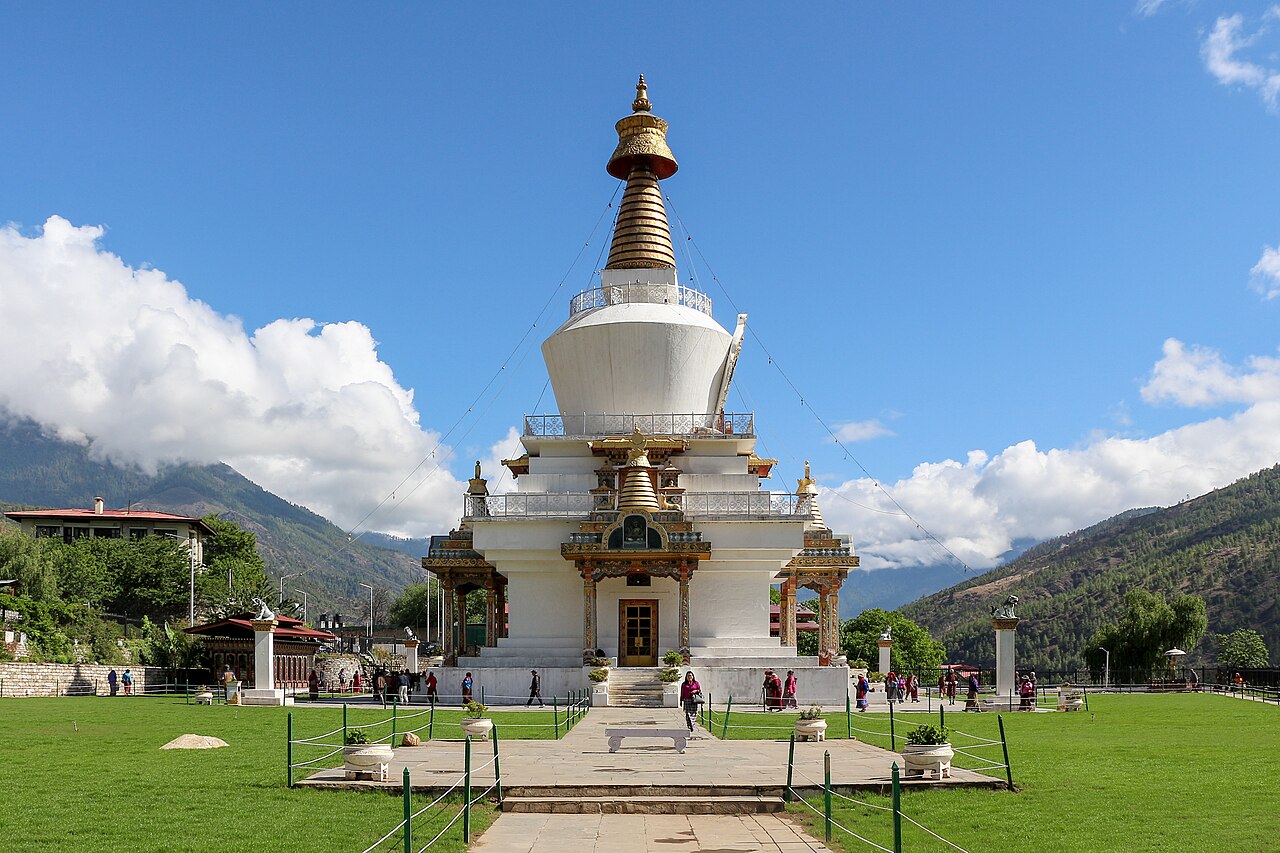

The National Memorial Chorten (Thimphu Chorten) is a large Buddhist stupa located in the heart of Thimphu, the capital of Bhutan. Built in 1974, it was constructed in memory of the third Druk Gyalpo (King of Bhutan), Jigme Dorji Wangchuck (1928–1972), who is often referred to as the "father of modern Bhutan" for his role in opening the country to modernisation and democratic reforms. The chorten was conceived by Jigme Dorji Wangchuck himself as a monument to world peace and prosperity, but he died before its completion, and it was subsequently dedicated as a memorial to him by the Royal Family and the people of Bhutan.[1]
Standing at a major traffic circle in central Thimphu, the National Memorial Chorten is one of the most recognisable landmarks in the capital and one of the most frequented religious sites in Bhutan. Every day, hundreds of devotees — from elderly citizens performing kora (circumambulation) to monks and schoolchildren — gather at the chorten to pray, spin prayer wheels, and make offerings. The site functions simultaneously as a national monument, a functioning place of worship, and a communal gathering space, embodying the integration of religion and daily life that characterises Bhutanese society.[2]
History and Purpose
The idea for the chorten originated with the third king himself, who wished to build a stupa embodying the Buddhist ideal of peace in the mind. Jigme Dorji Wangchuck envisioned a monument that would serve as a focus for contemplation and merit-making, inspired by the tradition of great stupas across the Buddhist world. The project was designed in consultation with Dilgo Khyentse Rinpoche, one of the most revered Buddhist masters of the twentieth century, and Dudjom Rinpoche, the head of the Nyingma school of Tibetan Buddhism.[3]
When the third king passed away unexpectedly in Nairobi, Kenya, on 21 July 1972 at the age of forty-three, the chorten project took on new significance. His son and successor, Jigme Singye Wangchuck, the fourth king, oversaw the completion of the monument, which was consecrated in 1974. The chorten was dedicated not only as a memorial to the late king but also as a physical representation of the Buddhist teachings on the nature of mind, with its interior paintings and statuary arranged according to a programme devised by Dilgo Khyentse Rinpoche.[4]
Architecture and Interior
The National Memorial Chorten is built in the Tibetan Buddhist style, featuring a whitewashed base, a bell-shaped dome (bumpa), and a gilded spire crowned by a crescent moon and sun disc. The chorten does not contain the remains of the third king; unlike many memorial stupas, it was designed primarily as a receptacle for sacred teachings and images rather than relics. Its exterior is surrounded by a paved circumambulation path lined with prayer wheels, each containing thousands of printed mantras.[5]
The interior of the chorten is richly decorated with paintings, statues, and mandalas representing the Nyingma and Kagyu traditions of Vajrayana Buddhism. The ground floor contains large statues of Guru Rinpoche and other deities, while the upper levels house elaborate three-dimensional mandalas depicting the pure realms of Buddhist cosmology. The iconographic programme was designed by Dilgo Khyentse Rinpoche as a comprehensive visual representation of the Buddhist path from ordinary consciousness to enlightenment. Access to the interior is periodically restricted for conservation purposes.[6]
Daily Worship and Community Life
The National Memorial Chorten is arguably the most socially vibrant religious site in Thimphu. From dawn to dusk, a steady stream of devotees visits the chorten. Elderly Bhutanese, many dressed in traditional kira and gho, perform dozens or even hundreds of circumambulations as a form of meditative practice and merit-making. Prayer flags flutter on all sides, and the sound of mantras being chanted mingles with the spinning of the large prayer wheels that line the perimeter. Butter lamps burn at the base of the chorten, and vendors sell offerings including flowers, incense, and ceremonial scarves (khata).[7]
The chorten grounds also serve as an informal community space where friends and neighbours meet, gossip, and rest on benches under pine trees. This social function makes the National Memorial Chorten a uniquely democratic sacred space — a place where Bhutanese of all ages, social positions, and backgrounds mingle freely around a shared devotional practice.
Cultural Significance
As a memorial to the third king, the chorten carries deep national significance. Jigme Dorji Wangchuck is widely revered for abolishing serfdom, establishing the National Assembly (Tshogdu), joining the United Nations, and initiating Bhutan's first planned development programmes. The chorten thus serves as a tangible link between Bhutan's Buddhist spiritual heritage and its modern political development, reminding visitors that the modernisation of the state was undertaken by a Buddhist king who conceived of progress in spiritual as well as material terms.
See also
Practical Information
- Location: Doeboom Lam, central Thimphu, opposite the Indian Embassy and adjacent to the Royal Bhutan Police Headquarters compound
- Coordinates: approximately 27.4632 N, 89.6394 E
- Hours: open daily during daylight hours; circumambulation begins at first light and continues until dusk
- Admission: free for Bhutanese; nominal entry fee for foreign visitors
- Photography: permitted in the outer compound; restricted within the inner shrines
- Dress: modest dress required; visitors are expected to remove hats and shoes before entering the inner temple floors
References
Related articles
Know something about this topic? Edit this article or . Anonymous contributions welcome — no account required.