Musical Instruments of Bhutan
From BhutanWiki, the people's encyclopedia of Bhutan · culture · Verified

The musical instruments of Bhutan reflect the kingdom's position at the crossroads of Tibetan, South Asian, and indigenous Himalayan cultural influences. Bhutanese traditional music employs instruments from all major organological families — chordophones (stringed instruments), aerophones (wind instruments), and membranophones and idiophones (percussion instruments) — each serving distinct roles in the country's rich tapestry of sacred, courtly, and folk musical traditions. The preservation and continued practice of these instruments is closely tied to Bhutan's broader commitment to safeguarding its intangible cultural heritage.[1]
Bhutanese instruments can be broadly grouped by their primary musical context: monastic ritual instruments used in Buddhist liturgical ceremonies; court and classical instruments associated with the zhungdra tradition; and folk instruments used in communal celebrations, pastoral settings, and popular entertainment. Many instruments cross these boundaries, appearing in both sacred and secular contexts depending on the region and occasion.[2]
Stringed Instruments
Drangyen
The drangyen is Bhutan's most iconic stringed instrument, a seven-stringed plucked lute with an ornately carved dragon-head pegbox. It serves as the primary accompanying instrument for both zhungdra (court songs) and boedra (folk songs of Tibetan origin). The drangyen's deep, resonant tone and its symbolic association with the thunder dragon (druk) make it a powerful emblem of Bhutanese cultural identity. It is typically crafted from a single piece of hollowed hardwood with a flat soundboard and gut, nylon, or steel strings.[3]
Chiwang
The chiwang (also pi wang) is a two-stringed bowed fiddle particularly associated with the folk music of eastern Bhutan and the Sharchop communities. Constructed from bamboo or hollowed wood with an animal-skin soundboard, it is played upright on the knee with a horsehair bow. Its warm, slightly nasal tone accompanies love songs, pastoral ballads, and narrative performances in the eastern dzongkhags of Trashigang, Mongar, Lhuentse, and Pemagatshel.[4]
Yangchen
The yangchen is a hammered dulcimer, closely related to the Tibetan gyumang and the Chinese yangqin. It consists of a trapezoidal wooden box over which metal strings are stretched on bridges. The strings are struck with lightweight bamboo mallets to produce a bright, shimmering tone. The yangchen entered Bhutanese musical practice through cultural exchange with Tibet and China and is used primarily in ensemble settings, providing harmonic and rhythmic support to vocal performances. It is taught at the Royal Academy of Performing Arts in Thimphu.[5]
Wind Instruments
Lingm
The lingm is a transverse bamboo flute and one of Bhutan's most beloved folk instruments. Typically made from a single length of bamboo with six finger holes and a blowing hole, the lingm produces a sweet, clear tone suited to both solo performance and accompaniment of folk songs. It is found throughout the country and is particularly associated with pastoral music — shepherds and yak herders traditionally played the lingm while tending their animals in high mountain pastures. The instrument's portability and simple construction have ensured its survival across generations.[6]
Ritual Wind Instruments
Bhutanese Buddhist monasteries employ a suite of wind instruments in liturgical ceremonies. The dungchen is a massive telescoping copper or brass trumpet, sometimes exceeding three metres in length, which produces deep, resonant tones used to mark the beginning of ceremonies and to invoke the presence of protective deities. The gyaling (also rgya gling) is a double-reed oboe-like instrument that produces a penetrating, nasal sound and is played in pairs during masked dance performances (cham) and ritual processions. The kangling, a short trumpet traditionally made from a human femur bone (or, in modern practice, from metal or wood), is used in tantric rituals symbolising the impermanence of life.[7]
Percussion Instruments
Drums
Drums of various sizes and types are fundamental to Bhutanese music, serving both rhythmic and ritual functions. The nga is the general term for drum, encompassing a range of instruments:
- Nga chen — a large two-headed frame drum suspended from a stand and struck with a curved beater during monastic ceremonies. It provides the rhythmic foundation for chanting and marks the structural divisions of liturgical texts.
- Lag nga — a hand-held frame drum used by monks and ritual practitioners, often painted with auspicious symbols. It accompanies prayer recitation and is portable enough for use in processions.
- Cham drum — drums of various sizes used specifically to accompany the sacred masked dances (cham) performed at tshechu festivals. The drummer sets the tempo and signals transitions between dance sections.
- Damaru — a small double-headed pellet drum, derived from the Indian damaru, used in tantric Buddhist rituals. It is rotated rapidly so that attached pellets strike the drumheads, symbolising the union of wisdom and compassion.[8]
Cymbals and Bells
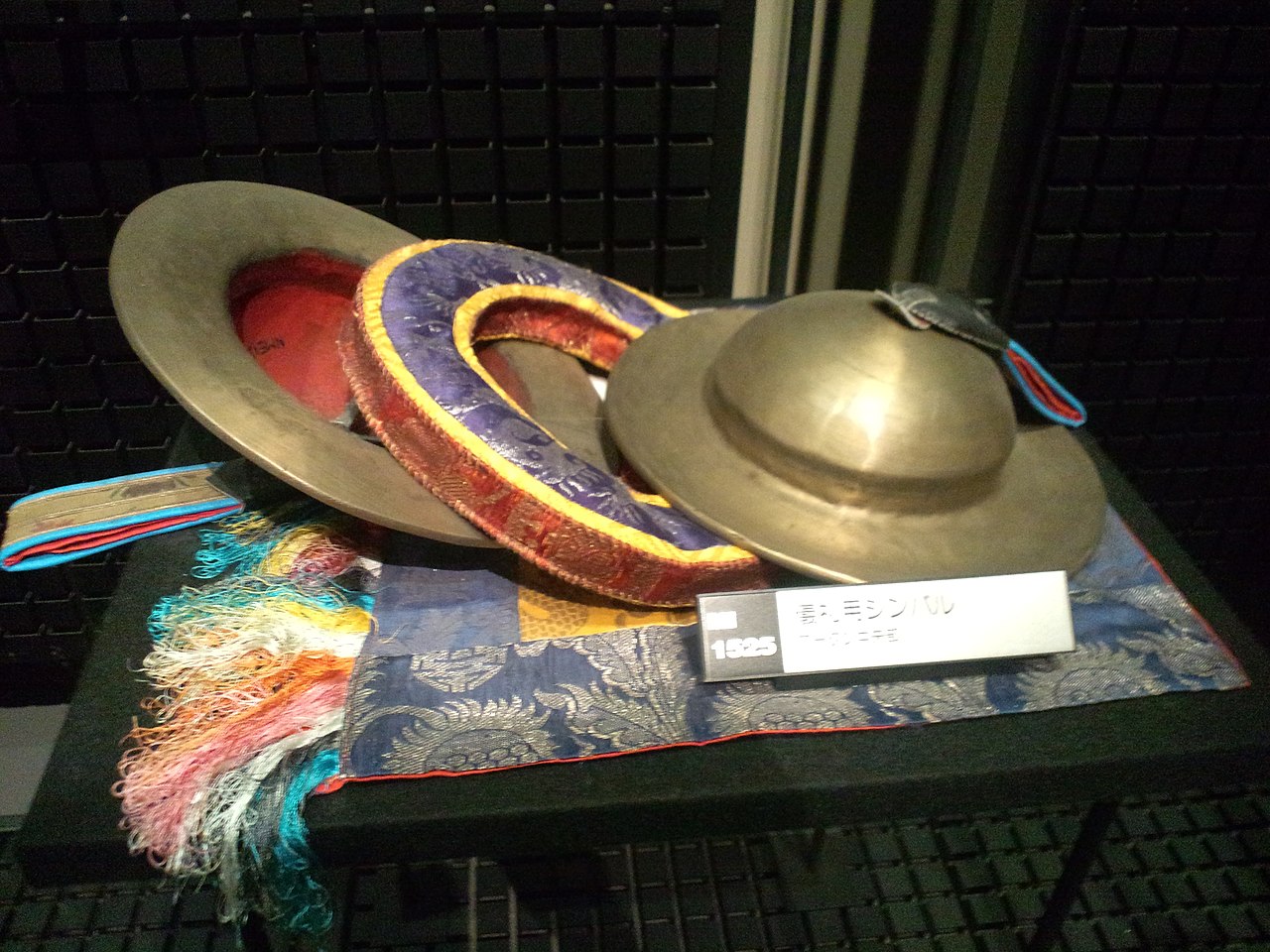
The silnyen and rolmo are pairs of cymbals used in monastic rituals, differing in size and timbre. Silnyen are smaller and produce a higher-pitched clash, while rolmo are larger with a more sustained, resonant tone. The drilbu (ritual bell) is used in conjunction with the dorje (vajra) during tantric ceremonies and is considered a sacred implement rather than a purely musical instrument. Its clear ring symbolises the perfection of wisdom.[9]
Instruments in Bhutanese Musical Traditions
Bhutanese music is broadly divided into three traditions, each with characteristic instrumentation. Zhungdra, the classical court tradition attributed to the era of Zhabdrung Ngawang Namgyal, features the drangyen as its primary instrument alongside vocal performance. Boedra, folk songs of Tibetan origin, employs the drangyen, chiwang, lingm, and yangchen in various combinations depending on the region. Monastic ritual music uses the full ensemble of dungchen, gyaling, drums, and cymbals to create the powerful sonic environment considered essential for effective liturgical practice.[10]
Preservation and Contemporary Practice
The Royal Academy of Performing Arts (RAPA) in Thimphu, established in 1967, is the principal institution responsible for training musicians and preserving instrumental traditions. RAPA offers instruction in drangyen, chiwang, lingm, yangchen, and ritual instruments, and its performers represent Bhutan at international cultural events. Additionally, the Royal University of Bhutan and various dzongkhag cultural programmes support the teaching of traditional music.[11]
Contemporary Bhutanese musicians increasingly blend traditional instruments with modern genres, incorporating the drangyen and lingm into pop, rock, and hip-hop arrangements. This fusion has introduced traditional sounds to younger audiences while sparking debate about authenticity and cultural preservation. The Bhutanese government's emphasis on Gross National Happiness and the safeguarding of cultural heritage through the Driglam Namzha framework continues to support the practice and transmission of traditional instrumental music. See also: Cinema of Bhutan.[12]
References
- "Music of Bhutan." Wikipedia.
- Music of Bhutan Project.
- "Dranyen." Wikipedia.
- "Music of Bhutan." Wikipedia.
- Music of Bhutan Project.
- "Music of Bhutan." Wikipedia.
- "Dungchen." Wikipedia.
- "Damaru." Wikipedia.
- "Ghanta." Wikipedia.
- "Music of Bhutan." Wikipedia.
- "Royal Academy of Performing Arts (Bhutan)." Wikipedia.
- UNESCO Intangible Cultural Heritage. Bhutan.
Related articles
Know something about this topic? Edit this article or . Anonymous contributions welcome — no account required.