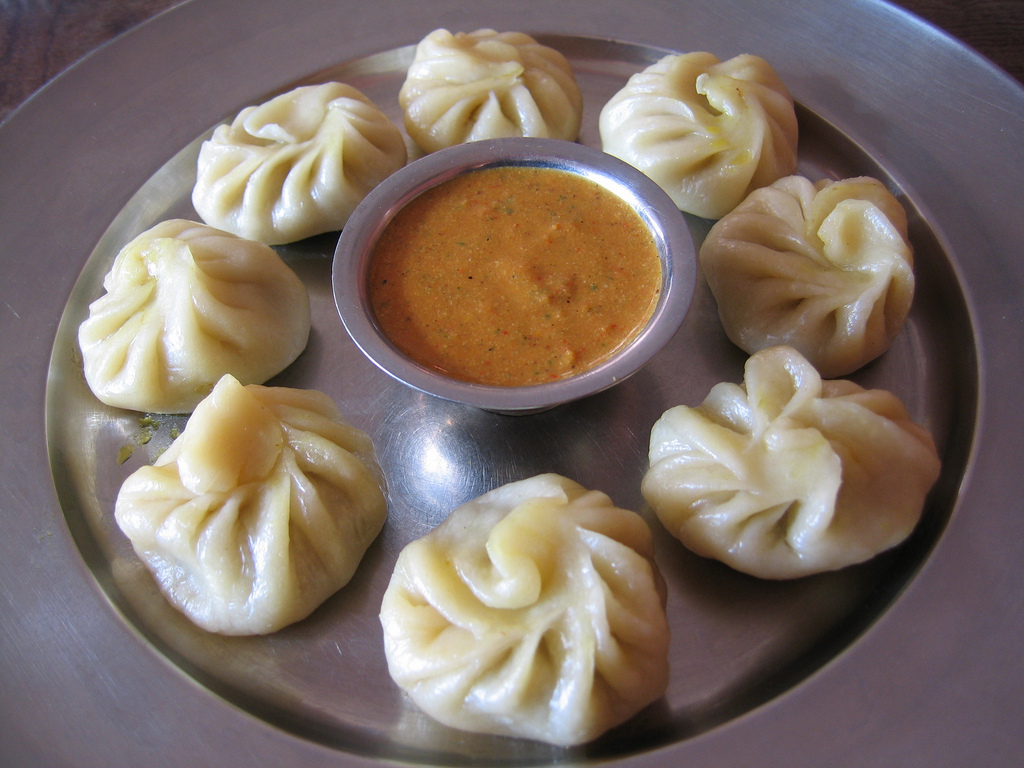

Momos (Dzongkha: མོག་མོག་; also spelled momo or mog mog) are stuffed dumplings that rank among the most popular and widely consumed foods in modern Bhutan. Consisting of a thin dough wrapper enclosing a filling of seasoned meat or vegetables, momos are steamed, fried, or boiled and served with a spicy dipping sauce. They are found in every corner of Bhutanese food culture — from humble roadside stalls and school canteens to upscale restaurants and family kitchens — and have become as much a part of the Bhutanese culinary landscape as ema datshi itself.[1]
The momo belongs to the vast family of Asian dumplings that spans from Chinese jiaozi and Japanese gyoza to Tibetan momos and Nepalese momos. In the Himalayan context, the dumpling tradition is most closely associated with Tibet, from where it spread to Nepal, Bhutan, and the northeastern Indian states through centuries of trade, migration, and cultural exchange. Bhutan's geographic position between Tibet and the Indian subcontinent made it a natural recipient of this culinary tradition, and Bhutanese momos have developed distinctive characteristics that set them apart from their neighbours' versions.[1]
Today, momos serve as both a snack and a main course in Bhutan. They are eaten at any time of day, from breakfast to late-night suppers, and are a fixture at celebrations, picnics, and social gatherings. The act of making momos is itself a social event, with families and friends gathering to fold dumplings together in a communal ritual that strengthens bonds and transmits culinary knowledge across generations.[2]
History
The dumpling tradition in the Himalayan region is believed to have originated in Tibet, where momos were prepared with yak meat and served as a portable, energy-dense food suited to the nomadic pastoral lifestyle of the Tibetan Plateau. The word "momo" is thought to derive from the Chinese momo (馍馍), a general term for steamed bread, reflecting the historical culinary exchange along the Silk Road and trans-Himalayan trade routes that connected China, Tibet, and South Asia.[1]
In Bhutan, momos likely entered the culinary repertoire through multiple channels: trade with Tibet across the northern border, cultural exchange with Nepalese communities in the south, and the broader diffusion of dumpling-making techniques across the eastern Himalayas. The presence of significant Tibetan-origin populations in Bhutan, as well as the Lhotshampa (southern Bhutanese) communities with cultural ties to Nepal, ensured that momos were familiar to diverse segments of Bhutanese society.[3]
The late twentieth and early twenty-first centuries saw an explosion in the popularity of momos across Bhutan, driven by urbanisation, the growth of the restaurant sector, and the influence of media from India and Nepal where momos had already achieved widespread street-food status. Today, momo shops and stalls are ubiquitous in Bhutanese towns and cities, and the dumpling has transcended its origins to become a truly pan-Bhutanese food.[2]
Ingredients
Momo dough is made from white wheat flour and water, kneaded until smooth and elastic, then rolled thin and cut into circular wrappers. The filling varies widely but the most common versions in Bhutan use minced pork, beef, or chicken seasoned with onions, garlic, ginger, spring onions, coriander, soy sauce, and sometimes a touch of Sichuan pepper. Vegetable momos filled with cabbage, carrots, and mushrooms are also popular, reflecting both Buddhist dietary preferences and the growing availability of diverse vegetables in Bhutanese markets.[1]
What distinguishes Bhutanese momos from their Tibetan and Nepalese cousins is often the accompaniment: a fiery dipping sauce known as ezay, which is made from ground chilies, tomatoes, garlic, and coriander. The ezay provides the quintessentially Bhutanese blast of chili heat that transforms a relatively mild dumpling into a dish consistent with the national palate. Some Bhutanese versions also incorporate datshi (cheese) into the filling, creating a uniquely Bhutanese fusion.[4]
Preparation
Making momos is a multi-step process that begins with preparing the dough, which must rest for at least thirty minutes to develop its elasticity. Meanwhile, the filling is prepared by finely mincing the meat (or vegetables) and mixing it thoroughly with the seasonings. Small portions of dough are rolled into thin circles, a spoonful of filling is placed in the centre, and the wrapper is folded and pleated shut — the pleating technique varying from cook to cook, with some producing elegant, rosette-like folds and others favouring simpler half-moon shapes.[1]
The assembled momos are most commonly steamed in a multi-tiered bamboo or metal steamer for ten to fifteen minutes, until the dough becomes translucent and the filling is cooked through. Fried momos (kothey momo) are first pan-fried until the bottom is crisp and golden, then steamed with a splash of water under a lid — a technique that yields a dumpling that is simultaneously crunchy and tender. Boiled momos, served in a light broth, represent a third cooking method that is especially popular in colder weather.[4]
Cultural Significance
Momos hold a special place in Bhutanese social life as a food that brings people together. The labour-intensive process of wrapping dozens or hundreds of dumplings is traditionally a communal activity, with family members and neighbours sitting together around a table or on the floor, folding momos while sharing conversation and stories. This communal aspect elevates the momo from mere food to a vehicle for social cohesion, particularly during festivals, holidays, and family celebrations.[2]
In Bhutan's rapidly urbanising society, momos have also become an important marker of contemporary food culture. Momo restaurants and street stalls represent one of the most visible forms of entrepreneurship in Bhutanese towns, and the competition among vendors has driven innovation in fillings, cooking techniques, and presentation. For younger Bhutanese, momos are a social food associated with outings with friends, casual dining, and the vibrant street-food scene that has emerged in cities like Thimphu.[3]
Regional Differences
Within Bhutan, regional momo traditions reflect the country's cultural diversity. In the northern districts bordering Tibet, momos tend to be larger and filled with yak meat, adhering more closely to the Tibetan tradition. In the southern and eastern regions, fillings may incorporate ingredients and spicing influenced by Indian and Nepalese cuisines, including the use of cumin, turmeric, and a wider range of vegetable fillings. The western valleys around Thimphu and Paro have developed the most commercialised momo culture, with specialised restaurants offering extensive momo menus.[3]
The Bhutanese innovation of datshi momos — dumplings filled with a mixture of cheese and chilies — represents a uniquely local adaptation that merges the imported dumpling format with the indigenous datshi tradition. This hybrid creation is found almost exclusively in Bhutan and has become a point of culinary pride, demonstrating the capacity of Bhutanese food culture to absorb external influences and transform them into something distinctly its own.[4]
References
Related articles
Know something about this topic? Edit this article or . Anonymous contributions welcome — no account required.