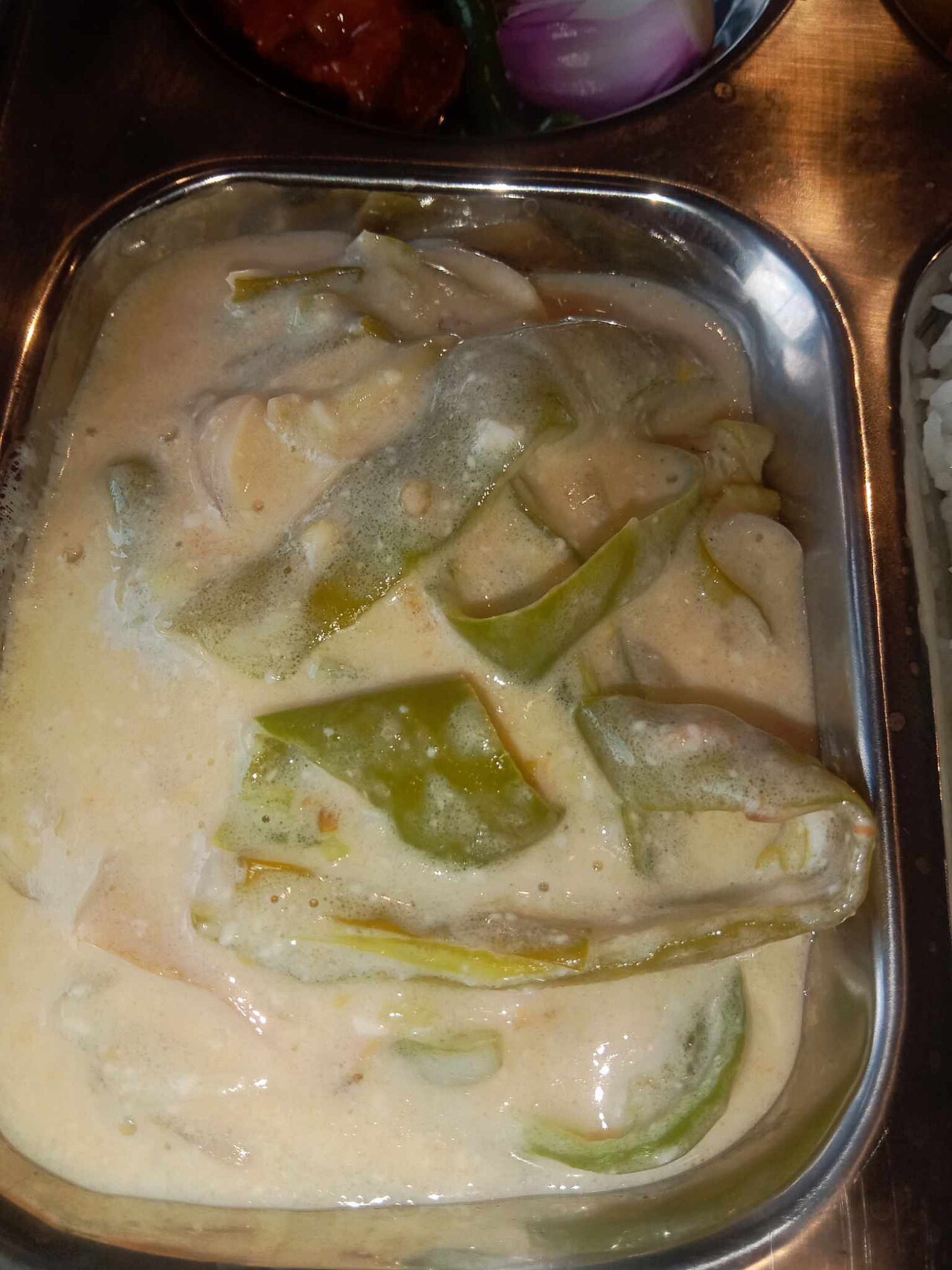

Ema datshi (Dzongkha: ཨེ་མ་དར་ཚི) is the national dish of Bhutan and the single most recognisable element of Bhutanese cuisine. The name translates literally as "chili cheese" — ema meaning chili pepper and datshi meaning cheese — and the dish consists of large green or red chili peppers stewed in a rich sauce made from local farmer's cheese. It is served at virtually every meal in Bhutan, from the simplest rural household to state banquets, and its status as a culinary emblem is undisputed.[1]
Unlike many cuisines where chilies serve merely as a condiment or seasoning, Bhutanese cooking treats the chili pepper as a primary vegetable. In ema datshi, the peppers are not a garnish but the main ingredient, cooked whole or split and simmered until tender in a generous quantity of melted cheese. The result is a fiery, creamy dish that accompanies the red rice (eue chum) that forms the staple carbohydrate of the Bhutanese diet. For most Bhutanese, a meal without ema datshi — or at least some variant of chili and cheese — is scarcely considered a meal at all.[2]
The dish's simplicity belies its cultural weight. Ema datshi embodies values central to Bhutanese identity: reliance on local ingredients, communal eating, and an unapologetic embrace of intense flavour. Visitors to Bhutan invariably encounter it within hours of arrival, and the dish has become a point of national pride frequently cited in discussions of Gross National Happiness and cultural preservation.[3]
History
The precise origins of ema datshi are not documented in historical records, but the dish is understood to have evolved over centuries from the convergence of two abundant resources in Bhutan's mountainous terrain: dairy cattle kept by pastoral communities and chili peppers that thrived in the warm valleys of the southern and central regions. Chili peppers, originally native to the Americas, reached South Asia through Portuguese trade routes in the sixteenth and seventeenth centuries and were rapidly adopted across the Himalayan region.[4]
Before the arrival of chili peppers, Bhutanese cuisine likely relied on Sichuan pepper (thingye) and other indigenous spices for heat. The integration of capsicum peppers transformed the cuisine, and by the eighteenth and nineteenth centuries, chilies had become so central to the Bhutanese diet that early European visitors remarked with astonishment on the quantity consumed. The pairing of chilies with the soft, locally produced cheese became the foundation of what is now ema datshi.[5]
Ingredients
The essential ingredients of ema datshi are remarkably few. The dish requires fresh chili peppers — typically the large, moderately hot green chilies known locally as ema, though dried red chilies may be substituted or combined — and datshi, a fresh farmer's cheese similar in texture to a crumbly feta or Indian paneer but with a distinctly tangy, slightly fermented flavour produced by Bhutanese dairy methods. Onions, tomatoes, garlic, and a small amount of oil or butter round out the preparation.[1]
The cheese is the soul of the dish. Bhutanese datshi is traditionally made from cow's or yak's milk that is curdled and lightly pressed, yielding a soft, white cheese with a high moisture content. Unlike aged cheeses, datshi melts readily into a thick, coating sauce when heated. The quality of the cheese varies by region and altitude, with yak-milk datshi from the higher valleys prized for its richness. Commercially produced processed cheese is sometimes used as a modern substitute, though purists consider this inferior.[6]
Preparation
To prepare ema datshi, the chili peppers are first washed, slit lengthwise, and deseeded if a milder dish is desired — though many Bhutanese cooks leave the seeds intact for maximum heat. The peppers are placed in a pot with sliced onions, chopped tomatoes, a little water, and oil or butter, then brought to a simmer. As the vegetables soften, generous chunks of datshi are added and stirred until the cheese melts into a thick, creamy sauce that coats the peppers.[1]
The cooking time is short — typically fifteen to twenty minutes — and the technique is straightforward, requiring no specialised equipment beyond a pot and a heat source. The finished dish should have a consistency between a stew and a sauce, with the peppers tender but still holding their shape and the cheese forming a glossy, cohesive coating. It is served immediately over steaming red rice.[3]
Cultural Significance
Ema datshi occupies a unique position in Bhutanese culture as both everyday sustenance and national symbol. It is the dish most commonly prepared in Bhutanese homes, served at communal meals where family members sit on the floor and eat from shared plates. It appears at festivals, religious ceremonies, and official functions. When Bhutanese people travel abroad, ema datshi is the dish they most frequently cite as a marker of home and identity.[3]
The centrality of chilies to Bhutanese identity extends beyond cuisine. During the chili harvest season in autumn, strings of red chilies are draped over rooftops and fences to dry, creating one of Bhutan's most iconic visual tableaux. The phrase "Is there ema datshi?" is a common way of asking whether food is ready, underscoring the dish's synonymy with the concept of a meal itself. International awareness of ema datshi has grown with Bhutan's increasing visibility as a tourist destination, and the dish is now featured in global food media as one of the world's most distinctive national dishes.[7]
Variations
While the classic ema datshi uses green chilies and plain datshi, numerous variations exist throughout Bhutan. Kewa datshi substitutes potatoes for the chilies as the primary ingredient, while shamu datshi uses mushrooms — both are prepared with the same cheese sauce technique. Goep datshi uses turnip greens, and various other vegetables may be cooked in the datshi style. These dishes collectively form the "datshi family" of Bhutanese cooking, unified by the cheese sauce that defines them all.[1]
Regional differences also shape the dish. In the western valleys around Thimphu and Paro, cooks may use a milder variety of pepper and a creamier cheese. In the central and eastern districts, hotter peppers and a drier cheese yield a more intensely spiced version. Some cooks add butter for richness, while others prefer a leaner preparation. Despite these variations, the fundamental identity of ema datshi — chilies and cheese, simply cooked — remains constant across the country.[6]
References
Related articles
Know something about this topic? Edit this article or . Anonymous contributions welcome — no account required.