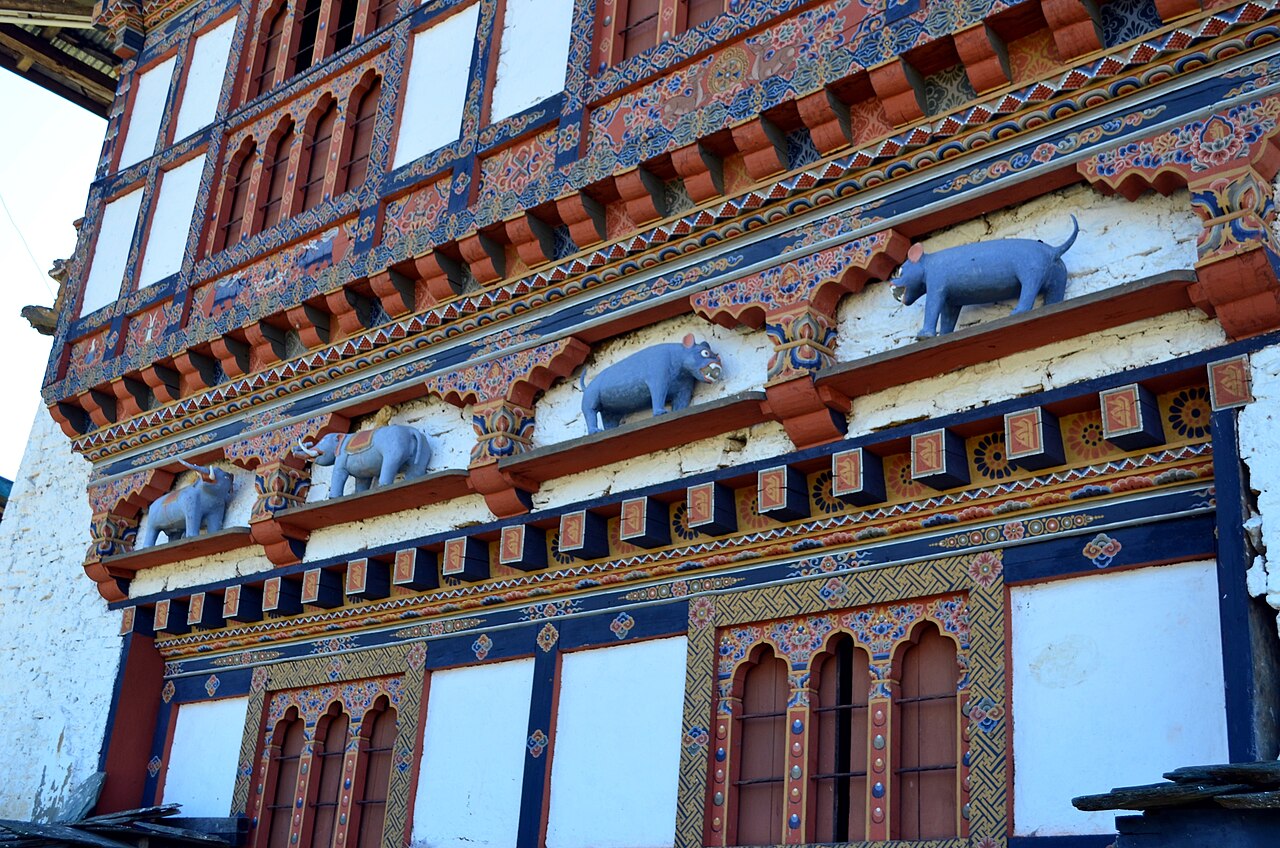

A lhakhang (Dzongkha: ལྷ་ཁང་; Wylie: lha khang; literally "house of the gods" or "divine dwelling") is a Buddhist temple in Bhutan. Lhakhangs are the most numerous and widely distributed type of religious building in the country, found in every village, valley, and district — from tiny single-room shrines at mountain passes to grand multi-story temple complexes that rival dzongs in scale and splendour. The architecture of the lhakhang follows a set of principles rooted in Vajrayana Buddhist cosmology, prescribing the building's orientation, proportions, spatial hierarchy, mural programme, and altar arrangement according to religious convention that has been transmitted through centuries of monastic scholarship and building practice.[1]
While the dzong is the most iconic Bhutanese building type, it is the lhakhang that forms the fabric of Bhutanese religious life. Bhutanese Buddhists visit lhakhangs to pray, make offerings, receive blessings, attend teachings, and participate in annual festivals. Many of Bhutan's most revered sacred sites — Tiger's Nest (Taktsang), Jambay Lhakhang, Kyichu Lhakhang — are lhakhangs rather than dzongs.
Historical Development
The earliest lhakhangs in Bhutan date to the 7th century, when the Tibetan emperor Songtsen Gampo (r. 604–650) is said to have ordered the construction of 108 temples across the Himalayan region to pin down a giant demoness whose body was believed to cover Tibet and the surrounding lands. Two of these border-taming temples — Kyichu Lhakhang in the Paro valley and Jambay Lhakhang in Bumthang — are among the oldest surviving structures in Bhutan and remain active centres of worship.[2]
A second great wave of temple building occurred in the 8th century, associated with the visit of Guru Rinpoche (Padmasambhava) to Bhutan. According to tradition, Guru Rinpoche consecrated numerous meditation sites and temple locations across Bhutan, many of which later became the sites of important lhakhangs. The 15th through 17th centuries saw a third major period of lhakhang construction, driven by the activities of the great Buddhist teachers Pema Lingpa (1450–1521) and, later, Zhabdrung Ngawang Namgyal.
Site Selection and Orientation
The site of a lhakhang is not chosen arbitrarily. Religious convention, geomantic principles, and practical considerations all play a role. Many lhakhangs are built on sites that were consecrated by Guru Rinpoche or by other revered Buddhist masters, giving the location an inherent sacredness that predates the building itself. Where no pre-existing sacred association exists, site selection may involve astrological consultation and the reading of landscape features according to Tibetan geomantic traditions (sa-che).[1]
The ideal orientation for a lhakhang is with the main entrance facing east or south, so that the morning or midday sun illuminates the entrance and the main altar catches the light. In practice, topography often constrains orientation, and many lhakhangs face whatever direction the terrain permits. The building should ideally be backed by a mountain (for protection), face an open valley (for auspiciousness), and be near flowing water (for purity).
Structural Form
The typical lhakhang is a rectangular or square structure with thick rammed-earth or stone walls, a timber-framed interior, and a roof structure that may be flat, gently pitched, or — in larger temples — a multi-tiered pagoda form with gilded finials. Walls taper inward (batter) in the manner of all traditional Bhutanese construction, and the exterior is whitewashed with a band of red ochre paint (khemar) at the top of the walls, marking the building as a religious structure. This red ochre band is a distinguishing feature that immediately identifies a lhakhang from a distance.[1]
The entrance is typically approached through a covered portico (gokhor) supported by timber columns, whose capitals and beams are carved and painted with Buddhist motifs. The main door is a massive timber assembly, often painted with images of the Four Guardian Kings (Gyalchen Zhi) or with protective symbols. Above the entrance, a dharma wheel flanked by two deer — representing the Buddha's first sermon at Sarnath — is a near-universal feature.
Interior Layout
The interior of a lhakhang follows a spatial hierarchy that moves from the profane to the sacred as one progresses from the entrance toward the altar:
Portico (gokhor): The covered porch or vestibule at the entrance, sometimes containing murals of wrathful protector deities (dharmapalas) and the Wheel of Life (sipa khorlo). These images serve both a didactic purpose (teaching visitors about karma and the cycle of rebirth) and a protective function (guarding the sacred interior from malevolent forces).[1]
Assembly hall (dukhang): The main interior space, where monks and lay worshippers gather for prayer, teaching, and ritual. The dukhang is typically a large, dimly lit room with rows of timber columns supporting the ceiling. The columns are wrapped in coloured cloth or painted. The floor is often polished wood, with cushions or carpets for seated worshippers. The walls of the dukhang are covered with murals depicting Buddhist deities, mandalas, narrative scenes from the lives of great masters, and representations of Buddhist paradises.
Inner sanctum (gokhang or tshamkhang): Behind or above the main assembly hall lies the most sacred space of the lhakhang, which may be a separate room or an elevated alcove. This innermost chamber typically houses the most sacred relics, images, or texts of the temple. Access may be restricted to monks or to specific occasions.
Altar Arrangement
The altar (choeshom) is the focal point of the lhakhang interior, positioned against the wall opposite the entrance so that worshippers face it upon entering. The arrangement of the altar follows prescribed conventions:
- Central image: The principal statue or image of the temple's presiding deity — most commonly Shakyamuni Buddha, Guru Rinpoche, or Avalokiteshvara — occupies the centre of the altar, often housed in a gilded shrine cabinet (kusung chorten)
- Flanking figures: Secondary images of buddhas, bodhisattvas, or lineage masters are placed on either side of the central figure, following a hierarchical arrangement
- Offering bowls (yonchab): Seven or eight silver or brass bowls containing water offerings are placed in a row before the images, representing the seven traditional offerings to a guest (water for drinking, water for washing, flowers, incense, light, perfume, and food)
- Butter lamps (konchok mebar): Rows of brass or silver lamps fuelled by clarified butter, symbolizing the light of wisdom that dispels the darkness of ignorance
- Torma: Sculptured ritual cakes made of butter and barley flour, placed as offerings during specific ceremonies
- Sacred texts: Volumes of Buddhist scripture (pechas), wrapped in cloth and stacked on shelves flanking the altar
Notable Lhakhangs
- Taktsang (Tiger's Nest) — Bhutan's most famous temple, clinging to a cliff face 900 metres above the Paro valley floor, built around the cave where Guru Rinpoche is said to have meditated in the 8th century
- Kyichu Lhakhang — one of the two oldest temples in Bhutan (7th century), located in the Paro valley, containing a revered image of Jowo Shakyamuni[2]
- Jambay Lhakhang — the other 7th-century border-taming temple, located in Bumthang, famous for its annual naked fire dance (Mewang) and torch festival (Jambay Lhakhang Drup)
- Gangtey Goenpa — a 17th-century temple in the Phobjikha valley, the only Nyingma monastery in western Bhutan, overlooking the winter habitat of the endangered black-necked crane
- Chimi Lhakhang — the "Temple of Fertility" in Punakha, founded by Drukpa Kunley in the 15th century, visited by couples seeking blessings for children
Continuity and Change
Lhakhang construction continues in contemporary Bhutan. New temples are built to serve growing communities, to replace structures damaged by earthquake or fire, and to commemorate royal occasions or religious milestones. While construction materials increasingly include concrete and steel framing, the exterior appearance and interior layout of new lhakhangs adhere closely to traditional conventions — the red ochre band, the dharma wheel and deer above the entrance, the prescribed altar arrangement, and the mural programme all remain essentially unchanged from historical precedent.
The continuity of lhakhang architecture reflects the centrality of Buddhist practice in Bhutanese daily life. In a country where the built environment is understood as a vehicle for spiritual expression, the lhakhang remains the most intimate and pervasive architectural manifestation of Bhutan's Buddhist identity — the "house of the gods" that grounds the sacred in the everyday landscape.
References
Related articles
Know something about this topic? Edit this article or . Anonymous contributions welcome — no account required.