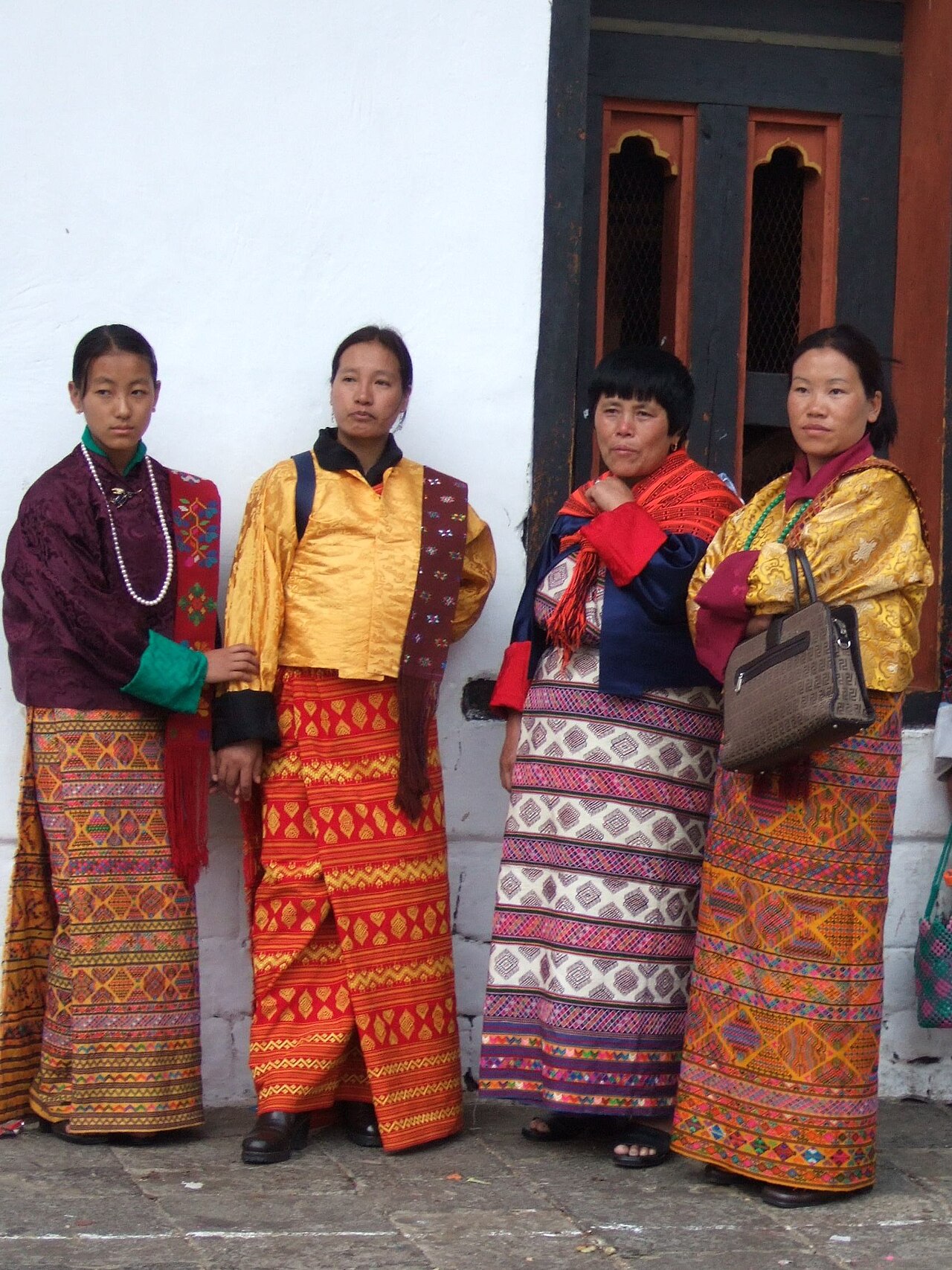

The kira (Dzongkha: ཀི་ར) is the national dress for women in Bhutan, consisting of a large rectangular piece of woven cloth wrapped around the body from the shoulders to the ankles and fastened at each shoulder by a pair of silver or gold brooches known as koma. A woven belt called a kera secures the kira at the waist, and the ensemble is completed by a wonju (inner jacket) and tego (outer jacket). The kira is the female counterpart to the male gho and is one of the most recognisable expressions of Bhutanese cultural identity.[1]
Like the gho, the kira is believed to have developed from Tibetan dress traditions but has evolved into a distinctly Bhutanese form over centuries. Its codification as national dress is attributed to the era of Zhabdrung Ngawang Namgyal in the seventeenth century, and its mandatory status was reinforced by the 1989 Driglam Namzha decree. Women are required to wear the kira in government offices, schools, dzongs, monasteries, and during formal occasions.[2]
The kira is simultaneously an everyday garment and a work of textile art. The finest kiras, handwoven on backstrap looms using traditional patterns and natural dyes, can take months or even years to complete and represent some of the most sophisticated textile production in the Himalayan region. A high-quality handwoven kira is among the most prized possessions a Bhutanese woman can own, functioning as wearable wealth, family heirloom, and cultural statement.[3]
Construction and Draping
The kira is made from a rectangular cloth typically measuring approximately 2.5 metres in length and 1.5 metres in width. For handwoven kiras, the fabric is produced on a backstrap loom in two or three narrow panels that are then stitched together side by side to achieve the required width. The cloth is wrapped around the body, brought over both shoulders, and pinned at each shoulder with a koma brooch. The excess fabric is folded and tucked to create an even drape, and the kera belt is tied at the waist over the top.[4]
The art of draping the kira correctly requires practice. The hemline should fall to the ankles, and the folds should be smooth and even. The way a kira is draped is considered a reflection of the wearer's grace and cultural knowledge. Mothers typically teach their daughters how to dress in a kira, and the skill is considered an essential part of a Bhutanese woman's cultural education.
Types of Kira
Bhutanese kiras are classified according to their weaving technique, pattern complexity, and intended use:
Sertha: Kiras woven entirely from raw silk in solid colours or simple stripes. Serthas are considered everyday wear and are relatively less expensive than patterned kiras. Common colours include red, maroon, dark blue, and green.[3]
Mensi Mathra: A striped kira featuring alternating bands of colour, woven from raw silk. Mensi mathra kiras are versatile garments suitable for both daily wear and semi-formal occasions, distinguished by their characteristic striped patterns in combinations of red, blue, green, yellow, and white.[1]
Aikapur: A richly patterned kira featuring supplementary-weft designs woven into the fabric. Aikapur kiras display elaborate geometric, floral, and symbolic motifs and are reserved for formal and ceremonial occasions. These garments require exceptional skill and extended labour to produce.[3]
Kishuthara: Considered the queen of Bhutanese textiles, the kishuthara is a silk kira featuring intricate supplementary-weft patterns that cover the entire surface of the fabric. Originating from the Lhuentse district of eastern Bhutan, kishutharas are among the most labour-intensive textiles produced anywhere in the world. A single kishuthara may take six months to a year to weave and can cost the equivalent of several months' income. They are worn at the most formal occasions and are treasured as family heirlooms passed from mother to daughter.[5]
Koma Brooches
The koma are paired brooches used to pin the kira at the shoulders. Traditional komas are made of silver, often with elaborate repoussé work, filigree, or inlaid turquoise and coral. A chain or hook connects each pair of brooches across the collarbone. Komas are themselves important items of jewellery and cultural significance; antique komas are collected and valued as art objects. Modern versions may be made from less expensive metals, but fine silver komas remain a prized gift and dowry item.[4]
Ceremonial Use
At formal events and when visiting dzongs or attending audiences with officials, women wear a rachu — a decorative scarf — draped over the left shoulder. The rachu is the female equivalent of the male kabney, though unlike the kabney, the rachu does not follow a strict colour-rank system. Most rachus are woven from red raw silk with embroidered or woven borders. Wearing the rachu with the kira is obligatory in formal settings and represents the complete formal ensemble for Bhutanese women.[6]
Regional Weaving Traditions
Bhutan's textile traditions vary significantly by region, and these differences are reflected in the kiras produced in different parts of the country. Eastern Bhutan, particularly the districts of Lhuentse, Trashigang, and Pema Gatshel, is renowned for its sophisticated supplementary-weft weaving. The weavers of Khoma village in Lhuentse are particularly celebrated for producing kishutharas of exceptional quality.[5]
Central Bhutan, especially the Bumthang valley, produces distinctive yathra textiles — thick, warm fabrics woven from sheep's wool and dyed with bright colours. While yathra cloth is more commonly associated with blankets and outerwear, it is also used for everyday kiras in the colder central highlands. Western Bhutanese textiles tend to favour simpler patterns with fewer supplementary-weft embellishments.[3]
Preservation and Revival
The Royal Government of Bhutan has taken active steps to preserve and promote traditional weaving. The Royal Textile Academy in Thimphu, established in 2005, serves as both a museum and a training institution, documenting traditional patterns, teaching weaving techniques to new generations, and displaying historic textiles. Queen Mother Ashi Sangay Choden Wangchuck has been a particularly prominent patron of Bhutan's textile heritage, working to ensure that traditional weaving remains a living art rather than merely a museum exhibit.[4]
Despite these efforts, traditional handweaving faces challenges from the availability of cheaper machine-made fabrics and the migration of younger women from rural weaving communities to urban areas. Nevertheless, the kira's mandatory status ensures continued demand, and a growing international appreciation for Bhutanese textiles as collectable art has helped sustain premium prices for high-quality handwoven kiras.
References
Related articles
Know something about this topic? Edit this article or . Anonymous contributions welcome — no account required.