Karma Ura
From BhutanWiki, the people's encyclopedia of Bhutan · people · Verified
This article is about a living or recently deceased person. Edits must be supported by reliable, verifiable sources. Unsupported or potentially defamatory content will be removed.
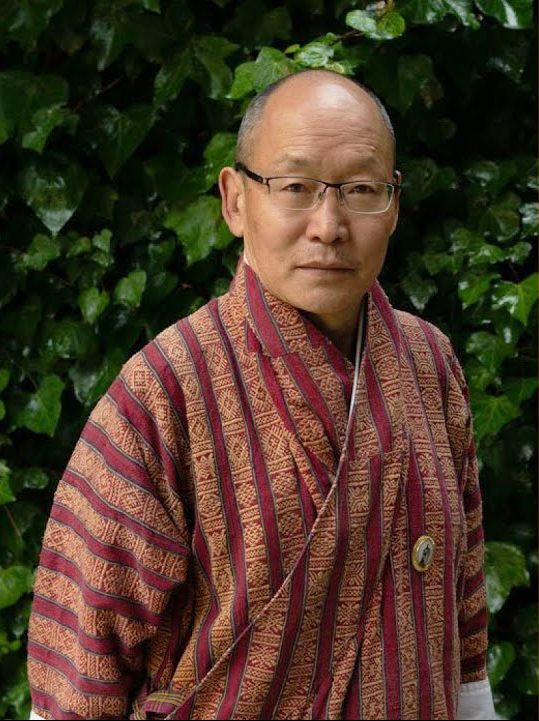
Dasho Karma Ura is a Bhutanese polymath — scholar, economist, novelist, painter, poet, and choreographer — who serves as President of the Centre for Bhutan Studies and Gross National Happiness Research. Born in the village of Ura in Bumthang, central Bhutan, he has been the principal architect of the GNH Index, the measurement framework that translates Bhutan's philosophy of holistic development into a rigorous, empirically grounded policy tool used by the Royal Government.[1]
Karma Ura holds a BA in Politics, Philosophy, and Economics from Magdalen College, University of Oxford, an MPhil in Economics from the University of Edinburgh, and a PhD from Nagoya University in Japan. His academic training in both Western and Asian intellectual traditions has made him uniquely positioned to articulate Bhutan's development philosophy in terms that resonate with international audiences while remaining rooted in Buddhist principles.[2]
In 2006, His Majesty the Fourth King, Jigme Singye Wangchuck, awarded Karma Ura the red scarf and the ancient title of distinction, Dasho, in recognition of his dedicated service to the nation. He was also a member of the Drafting Committee of Bhutan's first Constitution, enacted in July 2008.[1]
Early Life and Education
Karma Ura was born in the village of Ura in the Bumthang district of central Bhutan. Ura is one of the most historically and culturally significant valleys in the country, and Karma Ura's deep connection to his birthplace is reflected in much of his scholarly and creative work. He received his higher education abroad, studying at some of the most prestigious institutions in Europe and Asia: Magdalen College, Oxford (BA in PPE), the University of Edinburgh (MPhil in Economics), and Nagoya University (PhD).[3]
The GNH Index
Karma Ura's most consequential contribution to Bhutan and to global development discourse is his role as the principal architect of the Gross National Happiness Index. While the concept of GNH was first articulated by the Fourth King in the 1970s, it was Karma Ura who, in collaboration with the Oxford Poverty and Human Development Initiative (OPHI) and scholars such as Sabina Alkire, developed the rigorous measurement framework that transformed GNH from a philosophical aspiration into a practical policy instrument.[4]
The GNH Index is built around nine domains: psychological wellbeing, health, education, time use, cultural diversity and resilience, good governance, community vitality, ecological diversity and resilience, and living standards. Each domain is measured through a detailed survey administered across the country, and the results are used to guide government policy and budget allocation. The Index has attracted international attention as an alternative to GDP-centric measures of progress.[5]
Centre for Bhutan Studies
Karma Ura has served as President of the Centre for Bhutan Studies and Gross National Happiness Research since 2008. Under his leadership, the Centre has become the primary research institution for GNH-related scholarship and policy analysis. Prior to joining the Centre, he worked in the Planning Commission of Bhutan from 1989 to 1998, where he gained firsthand experience in the complexities of development planning in a small Himalayan kingdom.[1]
Literary Work
Karma Ura is the author of The Hero with a Thousand Eyes (1995), a historical novel set during the reign of the second King, Jigme Wangchuck. The novel provides a vivid portrait of the Bhutanese court in the early twentieth century, depicting its protocols, power dynamics, and the interplay between tradition and change. It remains one of the most significant works of Bhutanese fiction in English and offers readers a literary window into a period of Bhutanese history that is otherwise poorly documented.[6]
He has also authored several non-fiction works, including Bhutan: The Unremembered Nation and Leadership of the Wise: Kings of Bhutan, both of which explore Bhutanese history and governance through a scholarly lens.
Visual Art
In addition to his scholarly and literary pursuits, Karma Ura is an accomplished painter. His paintings, which draw on Bhutanese religious and cultural motifs, have been displayed in the Dochula temple, a national monument, and a piece of his work is held in the collection of the British Museum. His art reflects the same deep engagement with Bhutanese culture and Buddhist philosophy that characterizes his writing and scholarship.[1]
Constitutional Drafting
Karma Ura served as a member of the Drafting Committee for Bhutan's first written Constitution, which was enacted on 18 July 2008. The Constitution codified Bhutan's transition from an absolute monarchy to a constitutional monarchy with a parliamentary democracy. As a member of the drafting committee, Karma Ura helped shape the foundational legal document that would govern the country's political future, including provisions that enshrine GNH as a guiding principle of governance.
Recognition
Karma Ura's contributions to Bhutan have been recognized through several honors:
- Dasho (Red Scarf) — awarded by the Fourth King in 2006 for distinguished service to the nation
- Member of the Constitutional Drafting Committee (2001-2008)
- International recognition through lectures and collaborations with institutions including Oxford, Cambridge, and THE NEW INSTITUTE in Hamburg
References
Related articles
Know something about this topic? Edit this article or . Anonymous contributions welcome — no account required.