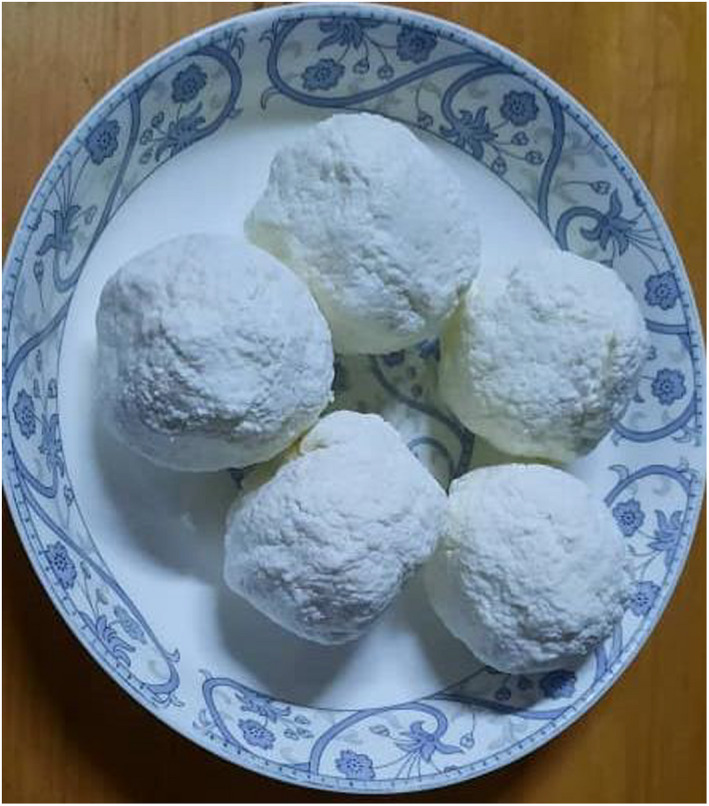

Datshi (Dzongkha: དར་ཚི) is a traditional Bhutanese cottage cheese produced from cow's or yak's milk through a natural fermentation and heat-coagulation process. Soft, white, crumbly, and mildly tangy, datshi is the single most important dairy product in Bhutanese cuisine and the defining ingredient of ema datshi, the country's national dish. The word datshi translates simply as "cheese," and in Bhutanese culinary usage it refers specifically to this fresh, unaged variety — distinct from the hard, smoke-dried chugo produced from yak milk in the highlands. Datshi is widely produced and consumed on a daily basis throughout Bhutan, with the country producing 3,953 metric tonnes in 2018 alone.[1]
The cheese is central not only to ema datshi but to an entire family of datshi-style dishes — kewa datshi (potato and cheese), shamu datshi (mushroom and cheese), goep datshi (turnip greens and cheese) — that collectively define the Bhutanese culinary repertoire. In a country where chilies are treated as a vegetable rather than a condiment, datshi provides the rich, creamy counterpoint that tempers the heat and binds the dish together. For most Bhutanese, a meal without datshi in some form is scarcely considered a proper meal at all.[2]
Production
The traditional production of datshi follows a multi-step process rooted in back-slopping fermentation — a method in which a small quantity of previously fermented product is used to inoculate a new batch. This technique, practiced for centuries across the Himalayan region, maintains a stable culture of lactic acid bacteria that drives the initial fermentation and contributes to datshi's characteristic tang.[3]
Fresh raw milk — most commonly from cows, though yak milk is used at higher altitudes — is first set aside in a warm place and inoculated with a small amount of dahi (curd) from a previous batch. Over the course of a day or more, lactic acid bacteria proliferate, acidifying the milk and producing a thick, tangy curd. This dahi is then transferred to a theki, a traditional wooden churning vessel, and vigorously churned to separate the butterfat. The butter (mar) is collected — itself a valued product — and the remaining liquid, known as mohi (buttermilk), is the raw material for datshi.[1]
The mohi is gently heated over a fire, causing the casein proteins to coagulate and form soft, white clumps. These curds are gathered in a cloth, squeezed to remove excess whey, and shaped by hand into balls or blocks of appropriate size. The result is a soft, moist cheese with a high water content that melts readily when heated — the very property that makes it ideal for the thick, coating sauce that defines ema datshi and its variants.[3]
Characteristics
Fresh datshi is white to pale cream in colour, with a crumbly texture similar to Indian paneer or a soft, young feta, though its flavour profile is distinct — mildly sour and tangy from the lactic acid fermentation, with a clean, dairy freshness. Unlike aged cheeses, datshi has a high moisture content and no rind, and it does not keep for extended periods without refrigeration. In traditional Bhutanese households, it is made in small batches and used within a few days.[2]
A 2022 study published in Food Science & Nutrition analysed the chemical composition and microbial quality of datshi from various Bhutanese producers, finding it to be a nutritious food rich in protein and calcium, with a moisture content considerably higher than that of most Western cheeses. The study also identified diverse lactic acid bacteria in traditionally produced datshi, confirming the role of the back-slopping inoculation in maintaining a complex and beneficial microbial community.[3]
Culinary Use
Datshi's primary culinary role is as the sauce-forming agent in Bhutan's datshi family of dishes. When heated with a small amount of water and oil, the cheese melts into a thick, glossy, coating sauce that clings to vegetables and chilies. In ema datshi, chunks of datshi are added to simmering chili peppers and stirred until the cheese forms a rich, creamy sauce — a process that takes only fifteen to twenty minutes and requires no specialised equipment. The same technique is applied to potatoes, mushrooms, ferns, beans, and virtually any vegetable the cook has to hand, making datshi the most versatile ingredient in the Bhutanese kitchen.[4]
The quality of datshi varies by region and altitude. Yak-milk datshi from the higher valleys is prized for its richness and slightly deeper flavour, while cow-milk datshi from the temperate central valleys is milder and more widely available. In urban areas, commercially produced processed cheese has increasingly been used as a substitute, a trend that purists lament as a diminution of the dish's authentic character.[2]
Economic Importance
Datshi is the most produced dairy product in Bhutan, accounting for a substantial share of the country's total milk utilisation. In 2018, 74 per cent of produced milk in Bhutan was directed toward dairy products, with datshi leading production figures, followed by mar (butter) and chugo (hard cheese). Despite this output, domestic demand consistently outstrips supply, and datshi is not currently exported. The Bhutanese government and international development organisations have supported programmes to improve dairy production and cheese-making skills, particularly among smallholder farmers in rural districts.[1]
Cultural Significance
The centrality of datshi to Bhutanese identity extends well beyond the kitchen. The phrase "ema datshi" has become almost synonymous with Bhutanese food itself, and the cheese is a source of quiet national pride. The traditional production process — back-slopping fermentation, hand-churning in a wooden theki, gentle heat coagulation — connects contemporary Bhutanese cooks to practices that have sustained mountain communities for centuries. As Bhutan navigates modernisation and globalisation, datshi remains an anchor of culinary continuity and a tangible link to the country's pastoral heritage.[1]
References
Related articles
Know something about this topic? Edit this article or . Anonymous contributions welcome — no account required.