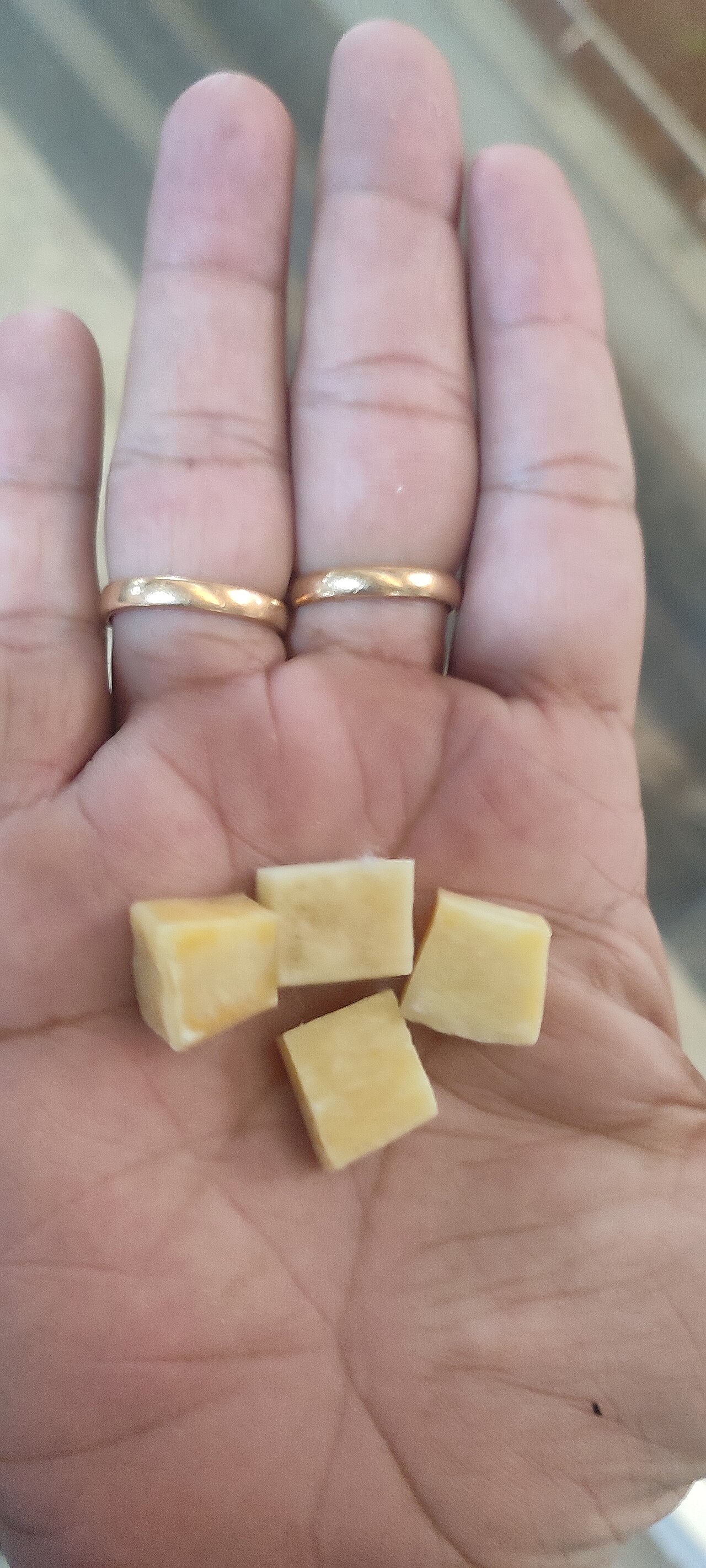

Chugo (Dzongkha: ཆུ་གོ; also known as chhurpi or durkha) is a traditional hard cheese produced in Bhutan from yak milk. Widely regarded as one of the hardest cheeses in the world, chugo is so dense and firm that it takes approximately thirty minutes of sustained chewing to work through a single piece, leading to its frequent comparison with chewing gum. The cheese is smoked over wood fires, sliced into thick blocks, and strung together on threads of yak hair for storage and sale. It is a staple food of Bhutan's highland yak-herding communities and a distinctive element of the country's culinary heritage.[1]
The cheese is particularly associated with the Haa district in western Bhutan, where yak herders living near the Bhutan–China border produce it in large quantities during the summer grazing season before migrating to lower valleys in winter. In Haa, chugo is popularly known as Haabey ruto — literally "the hard thing from Haa" — a testament to both its place of origin and its formidable texture. The product is also consumed in Nepal, Tibet, and parts of north-eastern India, where it appears under the name chhurpi, though the Bhutanese preparation has its own distinctive character shaped by local yak breeds, pasture conditions, and smoking techniques.[2]
Production
The production of chugo is an onerous, multi-stage process carried out by yak-herding families at high-altitude pastures. Fresh yak milk is first left to ferment in a warm area over several days, with new milk added to the fermenting batch progressively — a form of back-slopping that maintains the culture. When the milk has fully coagulated, it is churned vigorously in a traditional cowhide container to separate the butter from the liquid. The cream and butter are completely removed, yielding a bland, low-fat residue that becomes the basis of the cheese.[1]
The defatted liquid is then poured into a bronze pot and brought to a boil over a wood-fed stove, with occasional stirring. As the liquid heats, the casein proteins coagulate and form solid clumps — this stirring step is critical, as it determines the yield and texture of the final cheese. The curds are collected, wrapped tightly in coarse yak-hair cloth, and placed between two flat stones, which press out residual whey. After pressing, the cheese is sliced into thick, square blocks and strung together on threads of yak hair. The strung blocks are then hung above the wood-fed oven to smoke-dry, a process that further hardens the cheese and imparts a faintly smoky aroma.[3]
Characteristics
Finished chugo is shaped like thick square coasters with a dark brown exterior and a lighter, yellowish-white interior. It has a faintly yeasty smell reminiscent of yak and a bland, slightly sour taste — a consequence of the thorough removal of butterfat during churning. The texture is extraordinarily hard and dense; it cannot be bitten through and must instead be placed in the mouth and allowed to soften gradually with saliva before chewing becomes possible. In this manner, a single block of chugo can last anywhere from thirty minutes to five hours, making it a uniquely long-lasting source of nutrition for herders, travellers, and manual labourers.[1]
Yak milk is notably rich in protein, calcium, and fat-soluble vitamins, and although much of the fat is removed during chugo production, the cheese retains a high protein content. Its extreme dryness and hardness allow it to be stored without refrigeration for months or even years, an essential property in the remote, high-altitude regions where it is produced. This durability made chugo a vital trade good in Bhutan's traditional barter economy, exchanged by highland herders for rice, oil, and other lowland staples.[4]
Economic Role
Yak herders with large herds bring in at least five hundred kilogrammes of chugo to market annually, where it is sold or bartered for essential provisions. In Haa, shopkeepers report that hundreds of kilogrammes of the dusty, hardened cheese — strung together on threads of yak hair and hung from shop ceilings — are sold each year, with buyers including not only Bhutanese consumers but also Indian businessmen. The International Trade Centre has supported efforts to improve yak cheese production in Bhutan, recognising the product's potential as a niche export commodity.[5]
In recent years, chugo and similar hard yak cheeses have attracted international attention both as artisanal food products and as natural dog chews, with commercial enterprises in Nepal and Bhutan processing the cheese for export to pet markets in North America and Europe. While this has created new revenue streams for highland communities, purists note that the traditional product — chewed slowly by humans as a sustaining snack — remains the culturally authentic use of chugo.[3]
Cultural Significance
Chugo embodies the resourcefulness and self-reliance of Bhutan's semi-nomadic yak-herding communities, who have developed sophisticated techniques for preserving dairy products in environments where refrigeration is impossible. The cheese is closely associated with the yak, an animal of immense cultural and economic importance in highland Bhutan, providing milk, meat, wool, and draught power. The tradition of chugo production is increasingly recognised as an intangible cultural heritage deserving of documentation and preservation, particularly as younger generations in Bhutan migrate to urban centres and the number of active yak herders declines.[6]
See also
References
- "Bhutanese enjoy the hardest cheese in the world like chewing gums." Daily Bhutan.
- "Haap chugo — highland special." Anthropology of Bhutan.
- "Chhurpi." Wikipedia.
- "The Last Cheesemakers of the Eastern Himalayas." Gastro Obscura.
- "Improving Yak Cheese Production in Bhutan." International Trade Centre.
- "Empowering Dagala's Yak Herders." Bhutan Foundation.
- "Bhutanese Delight: Chugo — A Traditional Bhutanese Cheese Recipe." Culinary Creations.
Related articles
Know something about this topic? Edit this article or . Anonymous contributions welcome — no account required.