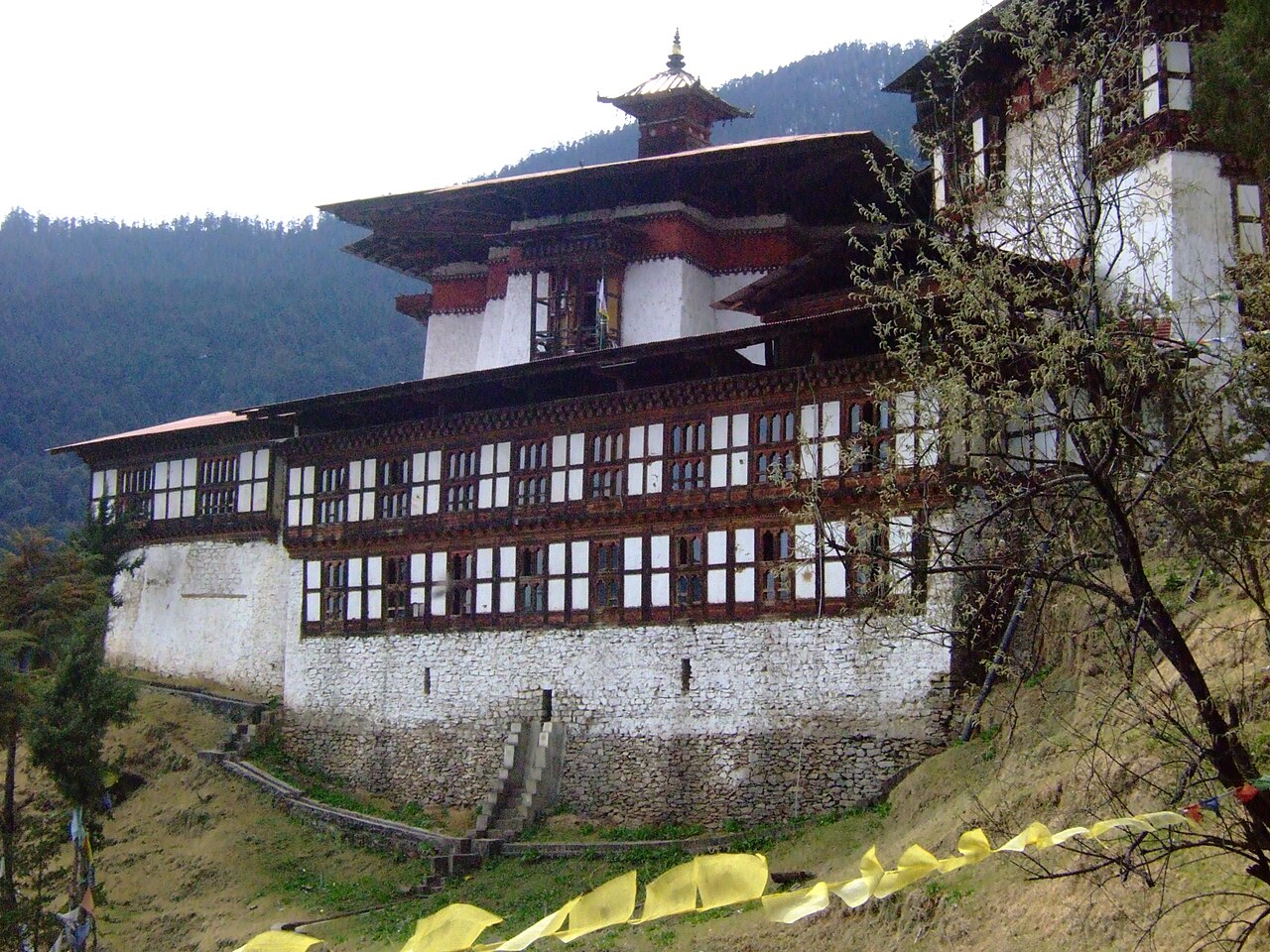

Cheri Monastery, formally known as Chagri Dorjeden (meaning "the supreme abode of the vajra"), is the first monastery established in Bhutan and one of the most historically significant religious sites in the country. Founded in 1620 by Zhabdrung Ngawang Namgyal, the unifier of Bhutan, it stands on a steep, densely forested hillside in the upper Thimphu valley, approximately fifteen kilometres north of the capital city of Thimphu. The monastery is accessible only by a roughly forty-five-minute uphill hike from the road at Dodena, crossing the Thimphu Chhu river on a traditional cantilever bridge.[1]
Cheri holds a unique place in Bhutanese religious and political history as the site where the Zhabdrung established the first monastic body (sangha) in Bhutan, ordaining thirty monks and thereby laying the institutional foundation for the dual system of religious and secular governance that continues to define Bhutanese statehood. The monastery also served as the Zhabdrung's primary meditation retreat and remained his spiritual headquarters even as he went on to construct the great dzongs that would consolidate his temporal power across the country.[2]
History
When Zhabdrung Ngawang Namgyal arrived in Bhutan from Tibet in 1616, he initially stayed at various religious sites in the western valleys before selecting the hillside above the Thimphu valley as the location for his first monastic foundation. Construction of Cheri Monastery began in 1619 and was completed in 1620. The Zhabdrung consecrated the site with a sacred hair relic of Tsangpa Gyare (1161–1211), the founder of the Drukpa Kagyu lineage, which he had brought with him from Ralung Monastery in Tibet. This relic, housed in a silver stupa, remains one of the monastery's most venerated objects.[3]
In 1620, the Zhabdrung ordained thirty monks at Cheri, creating the first formally constituted monastic community in Bhutan. This group became the nucleus of the Central Monastic Body (Dratshang Lhentshog), the institution that continues to oversee monastic affairs throughout the country under the authority of the Je Khenpo. The founding of the monastic body at Cheri was a deliberate act of state-building: by establishing an organised clergy loyal to the Drukpa Kagyu school, the Zhabdrung created an institutional counterweight to the rival religious and political factions that had hitherto prevented Bhutan's unification.[4]
In 1625, the Zhabdrung's father, Tempa Nima, who had followed his son to Bhutan, passed away at Cheri. A memorial stupa was erected in his honour. Shortly thereafter, the Zhabdrung began construction of Simtokha Dzong (1629), the first of the great dzong-fortresses, shifting the centre of his temporal administration while retaining Cheri as his primary retreat centre.[5]
Architecture and Setting
Cheri Monastery is built in the traditional Bhutanese architectural style, with whitewashed walls, timber framing, and an ornate golden roof. The main temple houses images of Guru Rinpoche (Padmasambhava), Shabdrung Ngawang Namgyal, and the Buddha. The complex includes monks' quarters, a prayer hall, and several smaller retreat houses scattered on the hillside above. The monastery is surrounded by old-growth blue pine and cypress forests, and the area is rich in bird and plant life, contributing to its atmosphere of profound seclusion.[6]
Below the monastery, a traditional cantilever bridge spans the Thimphu Chhu river. The bridge, rebuilt several times over the centuries, is adorned with prayer flags and marks the beginning of the uphill trail to the monastery. The surrounding forest is considered sacred and has been protected from logging for centuries, making the Cheri valley one of the most well-preserved natural environments near Thimphu.
Contemporary Role
Today, Cheri Monastery continues to function as one of Bhutan's most important meditation and retreat centres. It houses a three-year, three-month meditation retreat programme in the Drukpa Kagyu tradition, and monks in retreat observe strict seclusion. The monastery is also an important destination for Bhutanese pilgrims, particularly during auspicious days on the Buddhist calendar. While foreign tourists may visit the exterior grounds, access to the interior is generally restricted to protect the contemplative environment.[7]
Cheri suffered significant damage in the 2011 earthquake that affected the Thimphu valley, and restoration work was subsequently carried out with support from the government and international conservation organisations. The monastery's status as the birthplace of Bhutan's monastic tradition ensures that it remains a site of deep reverence in Bhutanese national consciousness.
References
Related articles
Know something about this topic? Edit this article or . Anonymous contributions welcome — no account required.