.jpg)
The Bhutanese calendar, known as the Bhutanese Lunar Calendar or Lo Tho, is a lunisolar calendrical system that governs the religious, agricultural, and ceremonial life of Bhutan. Derived from the broader Tibetan calendrical tradition, which itself synthesizes elements of Chinese astronomy, Indian astronomical texts (siddhanta), and the Kalachakra Tantra, the Bhutanese calendar determines the dates of major Buddhist festivals, the timing of agricultural activities, and the identification of auspicious and inauspicious days for important life events.
While the Gregorian calendar is used for government administration, international commerce, and modern education, the Bhutanese lunar calendar remains the authoritative system for religious observance and traditional cultural practice. The Royal Government of Bhutan publishes an annual calendar (lo tho) that provides both Gregorian and lunar dates, along with detailed astrological notations for each day.
Structure of the Calendar
Months and Days
The Bhutanese calendar consists of 12 lunar months, each beginning on the new moon and consisting of approximately 29 or 30 days. The months are numbered rather than named in everyday usage, though traditional names exist. Because the lunar year of approximately 354 days is shorter than the solar year, an intercalary (extra) month is added approximately every three years to keep the calendar aligned with the seasons. This adjustment ensures that agricultural festivals and planting cycles maintain their correct seasonal relationship.
An unusual feature of the Bhutanese calendar, shared with the Tibetan system, is that certain days may be duplicated or omitted based on astrological calculations. A "doubled" day occurs when two consecutive days share the same lunar date, while a "skipped" day occurs when a lunar date is passed over entirely. These adjustments maintain the alignment between the lunar count and actual astronomical observations.
The 60-Year Cycle
The Bhutanese calendar uses a 60-year cycle (Rabjung) formed by combining 12 animals with 5 elements. The 12 animals are: Mouse, Ox, Tiger, Rabbit, Dragon, Snake, Horse, Sheep, Monkey, Bird, Dog, and Pig. The 5 elements are: Wood, Fire, Earth, Iron, and Water. Each element governs two consecutive years, one male and one female, producing the full 60-year cycle. For example, the year 2024 in the Gregorian calendar corresponds to the Male Wood Dragon year.
The current Rabjung cycle (the 17th) began in 1987. The system is used for calculating astrological charts, determining compatibility in marriage, and identifying the general character of a year. For more on the astrological applications of this system, see Bhutanese Astrology.
Auspicious and Inauspicious Days
The Bhutanese calendar designates each day with a complex set of astrological attributes that determine whether the day is auspicious (tashi) or inauspicious for particular activities. The annual lo tho published by the government provides daily notations indicating whether the day is favorable for activities such as:
- Starting a new business or project
- Performing religious ceremonies and offerings
- Getting married
- Performing cremation and death rituals
- Constructing a new house
- Beginning agricultural activities (plowing, sowing, harvesting)
- Traveling long distances
- Medical treatments
Certain days in each lunar month are considered universally auspicious. The 8th, 10th, 15th (full moon), 25th, and 30th (new moon) of each lunar month are particularly important for Buddhist practice. The 10th day of each month is associated with Guru Rinpoche (Padmasambhava), the saint who brought Buddhism to Bhutan, and is marked by special prayers and rituals at temples and monasteries throughout the country.
Eclipses, both solar and lunar, are considered highly powerful days when the effects of both virtuous and harmful actions are magnified. Bhutanese Buddhists traditionally observe eclipses with intensive prayer and meditation.
Agricultural Calendar
For Bhutan's predominantly agricultural population, the lunar calendar is inseparable from the cycle of planting and harvest. The agricultural calendar varies by altitude and region, but key activities are timed to both lunar dates and seasonal indicators.
Rice planting in the subtropical southern lowlands begins in the 4th and 5th lunar months (approximately June-July), while in the temperate central valleys, planting begins slightly later. The harvest typically occurs in the 8th and 9th lunar months (approximately October-November). Wheat and barley cultivation in the higher valleys follows a different cycle, with planting in the 2nd or 3rd lunar months and harvest in the 6th or 7th.
Farmers consult the lo tho to determine the most auspicious day to begin plowing, sowing, and harvesting. The first plowing of the season is often accompanied by ritual offerings to local deities and earth spirits, reflecting the pre-Buddhist animistic traditions that remain integrated into Bhutanese agricultural practice.
Major Festivals and Observances
The Bhutanese calendar determines the dates of the kingdom's major religious and cultural festivals:
Losar (New Year): The Bhutanese New Year falls on the first day of the first lunar month, typically in February or March. Celebrations include prayers, family gatherings, the wearing of new clothes, the exchange of gifts, and the preparation of special foods. Losar is a public holiday and is celebrated with particular enthusiasm in western Bhutan.
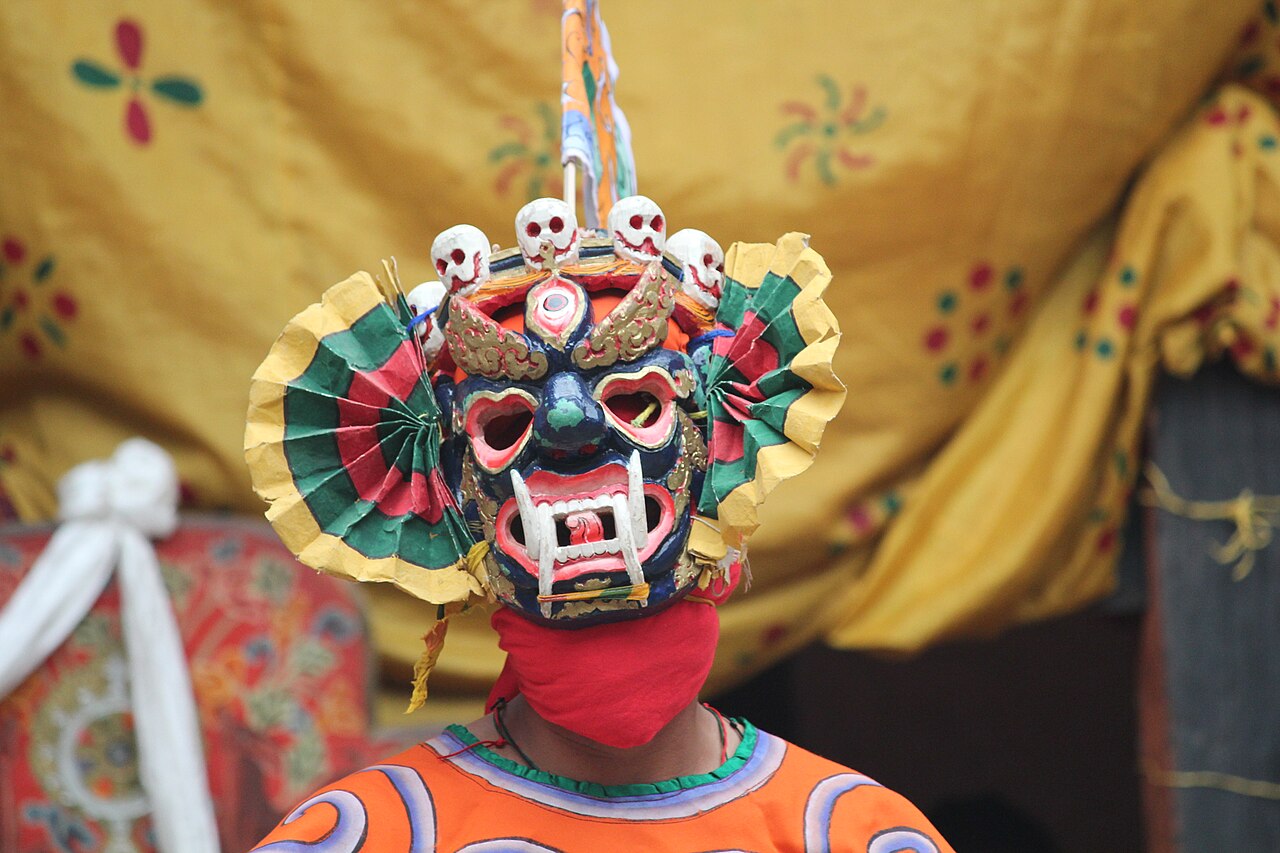
Tshechu: The tshechu festivals, held at dzongs and monasteries across Bhutan, are the most important public religious events in the Bhutanese calendar. Each district holds its tshechu on specific dates in the lunar calendar, typically honoring Guru Rinpoche. The festivals feature sacred mask dances (cham), religious teachings, and the display of sacred thangkha paintings. The Paro Tshechu, held in the 2nd lunar month, and the Thimphu Tshechu, held in the 8th lunar month, are among the most prominent.
Blessed Rainy Day (Thrue Bab): This observance, falling on the 22nd day of the 7th lunar month (typically September), marks the end of the monsoon season. Bhutanese traditionally bathe in rivers and streams on this day, believing that the water carries special purifying properties. It is a public holiday and an occasion for outdoor gatherings.
Dashain: The Lhotshampa community celebrates Dashain (Vijaya Dashami), the major Hindu festival, according to the lunar calendar. Falling in the 8th or 9th lunar month (September-October), Dashain is a 15-day celebration honoring the goddess Durga and is marked by family reunions, feasting, animal sacrifice (in some communities), and the receiving of blessings from elders.
Calendar Production
The official Bhutanese calendar is compiled annually by astrologers at the Central Monastic Body (Zhung Dratshang) in collaboration with the Royal Court. The calculations are complex, requiring expertise in both astronomical observation and the interpretive traditions of Buddhist astrology. The calendar is distributed throughout the country and is an essential reference for monks, farmers, and households alike.
References
- Pommaret, Françoise. Bhutan: Himalayan Mountain Kingdom. Odyssey Publications, 2006.
- Henning, Edward. Kalacakra and the Tibetan Calendar. Columbia University Press, 2007.
- Ura, Karma. The Ballad of Pemi Tshewang Tashi. Karma Ura, 1996.
- Schicklgruber, Christian, and Françoise Pommaret, eds. Bhutan: Mountain Fortress of the Gods. Serindia Publications, 1998.
- Phuntsho, Karma. The History of Bhutan. Random House India, 2013.
Related articles
Know something about this topic? Edit this article or . Anonymous contributions welcome — no account required.