Architectural Painting in Bhutan
From BhutanWiki, the people's encyclopedia of Bhutan · culture · Verified
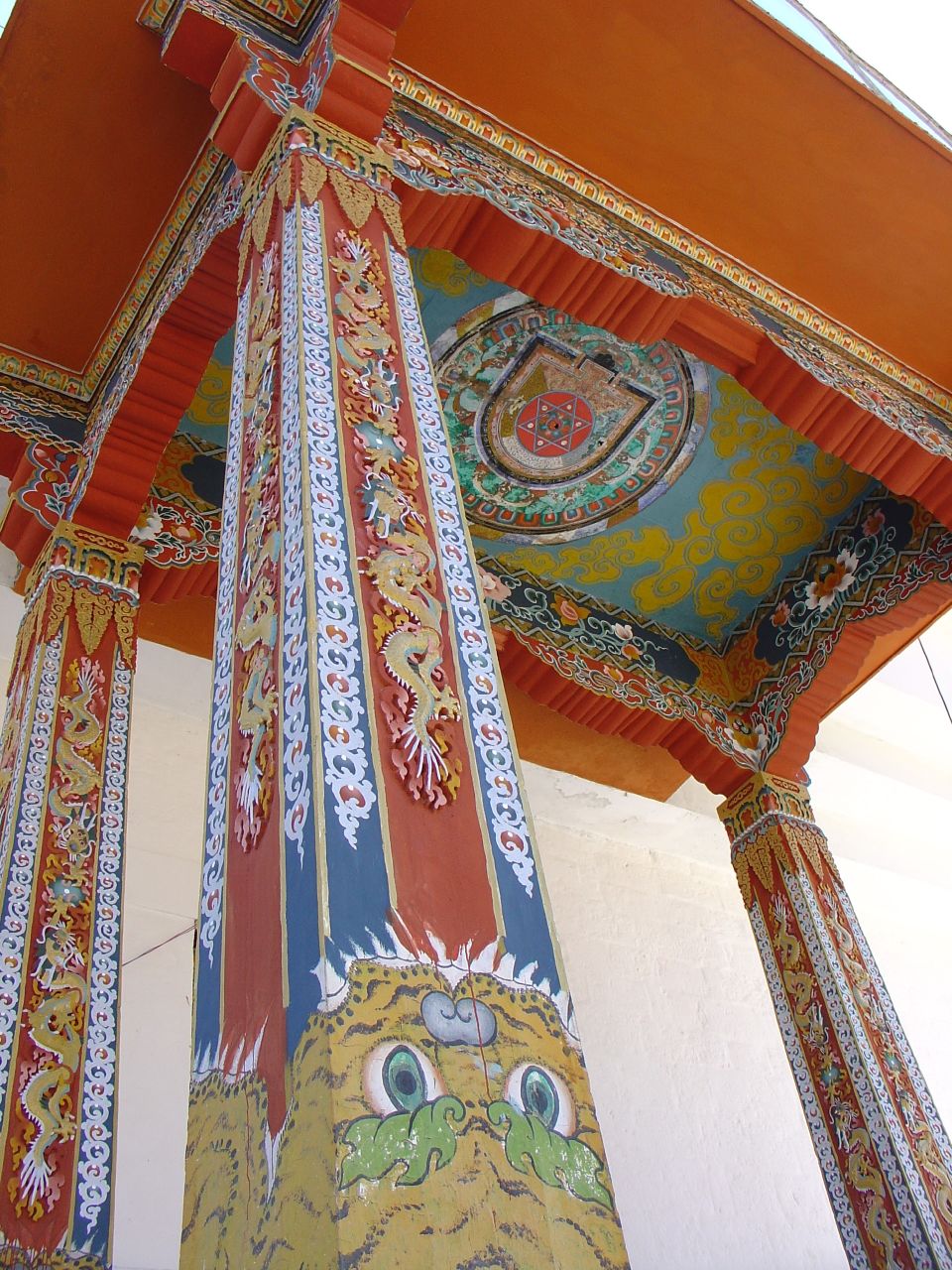
.jpg)
Architectural painting in Bhutan (Dzongkha: ལྷ་བྲིས་, lha-dri, literally "divine painting") is a vibrant tradition of exterior and interior wall painting, decorative woodwork polychromy, and symbolic mural art that transforms Bhutanese buildings — from modest farmhouses to grand dzongs — into surfaces of religious expression and cultural communication. The tradition encompasses Buddhist iconographic murals inside temples and monasteries, painted decorative bands on building exteriors, and the distinctive folk motifs, including phallus paintings, that make Bhutanese buildings visually unique in the Himalayan world.[1]
Painting (lhazo) is one of the thirteen traditional arts of Bhutan (zorig chusum), a classification system that encompasses all forms of craft and artistic production in Bhutanese culture. Painters (lhadripa) undergo years of training, traditionally through apprenticeship and increasingly through the Institute for Zorig Chusum in Thimphu, learning to master the complex iconometric proportions, colour symbolism, and religious protocols that govern the creation of sacred images.
Exterior Wall Paintings
The most immediately visible form of architectural painting in Bhutan is the painted decoration of building exteriors. This includes both representational images (figures, symbols, and scenes) painted directly on whitewashed walls and the polychrome painted bands that embellish timber elements such as cornices, window frames, and door surrounds.
Phallus Paintings
The most distinctive and internationally remarked-upon feature of Bhutanese architectural painting is the phallus (lingam) motif painted on the exterior walls of houses, shops, and even some public buildings. These paintings depict the erect phallus, often ejaculating, and frequently adorned with ribbons, eyes, or flames. To outsiders, these images can appear startling, but in Bhutanese culture they serve a deeply traditional protective function.[2]
The tradition is associated with the 15th-century Buddhist saint Drukpa Kunley (1455–1529), known as the "Divine Madman" (Drukpa Kunley), who used outrageous and sexually provocative behaviour as a means of teaching Buddhist wisdom and challenging social conventions. Drukpa Kunley's phallus was said to possess the power to subdue demons and evil spirits, and the painting of phalluses on buildings is understood as an invocation of this protective power. The paintings ward off evil spirits, deflect the evil eye, and protect against malicious gossip — a particularly feared social harm in Bhutanese communities.[3]
Phallus paintings are most prevalent in and around the Punakha valley (where Drukpa Kunley's principal temple, Chimi Lhakhang, is located) and in parts of central Bhutan, though they can be found throughout the country. The paintings are executed in a range of styles, from crude folk renderings to carefully composed compositions featuring the phallus entwined with dragons, flames, or auspicious symbols. In recent years, some urbanization-driven modesty has reduced the prevalence of phallus paintings in Thimphu and other towns, though the tradition remains robust in rural areas.
Protective and Auspicious Symbols
Beyond phallus paintings, Bhutanese house walls frequently display other painted protective and auspicious motifs:
- The Four Harmonious Friends (Thuenpa Puen Zhi): An elephant, monkey, rabbit, and bird stacked in a tower — Bhutan's most beloved folk image, representing cooperation and harmony. It is painted on house walls as a wish for family unity and social peace.[4]
- The Eight Auspicious Symbols (Tashi Tagye): The parasol, golden fish, treasure vase, lotus, conch shell, endless knot, victory banner, and dharma wheel, painted individually or as a set on walls near entrances
- The Wind Horse (Lungta): A horse bearing the wish-fulfilling jewel, symbolizing prosperity and good fortune, commonly painted near doorways
- Tigers, snow lions, garudas, and dragons: The four supernatural creatures of Buddhist cosmology, painted at the corners of buildings or flanking entrances as guardians
- Swastika (yungdrung): The Buddhist swastika (turning clockwise), an ancient symbol of eternity and good fortune, painted near doorways and windows
Painted Timber Decoration
The timber elements of Bhutanese buildings — cornices, rabsel frames, door surrounds, brackets, and column capitals — are painted in a vivid polychrome palette. The standard decorative vocabulary includes trefoil arches, lotus-petal borders, cloud scrolls, flame motifs, and floral patterns executed in red, blue, green, gold, and white against a dark red-brown ground.[1]
The painted cornice (kachep) below the roofline is a particularly important decorative element. It consists of a series of projecting timber layers, each painted with a different motif: the lowest layer might carry a row of trefoil arches, the next a band of lotus petals, and the uppermost a frieze of cloud scrolls or jewel motifs. The cumulative effect is of a richly layered visual border that crowns the building and marks the transition from the worldly realm of the walls to the celestial realm of the sky.
Interior Murals in Temples and Dzongs
The most elaborate and religiously significant architectural painting in Bhutan is found inside lhakhangs (temples) and dzongs, where interior walls are covered with large-scale murals depicting Buddhist deities, mandalas, historical scenes, and narrative cycles. These murals are not decorative additions but integral components of the religious architecture: they transform the interior space into a sacred environment that supports meditation, ritual, and teaching.[1]
Temple murals follow strict iconometric conventions (thig-tse) that prescribe the proportions, colours, attributes, and spatial positions of each figure. The positioning of deities on the walls follows a cosmological logic: wrathful protector deities guard the entrance, peaceful buddhas and bodhisattvas occupy the main walls, and the most sacred figure (often Guru Rinpoche or Shakyamuni Buddha) occupies the wall behind the altar. The palette traditionally relied on mineral pigments — azurite for blue, malachite for green, cinnabar for red, and gold leaf for highlights — though modern acrylic paints have increasingly supplemented these materials.
The Role of the Painter
In Bhutanese culture, the painter (lhadripa) of religious images is regarded not merely as a craftsman but as a spiritual practitioner. Before beginning work on a major mural or thangka (scroll painting), the painter undertakes rituals of purification, receives blessings from a lama, and may observe dietary restrictions and meditation practices for the duration of the project. The act of painting a sacred image is itself considered a form of merit-making — a devotional practice that benefits both the painter and the patron who commissions the work.
Training traditionally took place through a master-apprentice system, with young painters spending years grinding pigments, preparing surfaces, and copying line drawings before being permitted to paint independently. Since 1971, the Institute for Zorig Chusum (National Institute for the Thirteen Traditional Arts) in Thimphu has formalized this training, offering a six-year programme in painting alongside the other twelve traditional arts.[1]
Conservation Challenges
Bhutan's architectural paintings face several conservation challenges. Exterior wall paintings are exposed to monsoon rains, ultraviolet degradation, and the physical wear of annual whitewashing cycles. Interior murals in damp temple environments are vulnerable to mould, salt efflorescence, and insect damage. Fire — a persistent threat in Bhutan's timber-rich buildings — has destroyed irreplaceable murals at several historic sites.
International conservation organisations, including UNESCO and the Swiss-Bhutanese Helvetas programme, have collaborated with the Bhutanese government on mural conservation projects at several important sites. These efforts balance the imperative to preserve historic painting with the Bhutanese view that religious buildings are living institutions — meant to be used, maintained, and even renewed — rather than frozen museum exhibits.
References
Related articles
Know something about this topic? Edit this article or . Anonymous contributions welcome — no account required.