culture
Kunzang Choden: Bhutanese Author
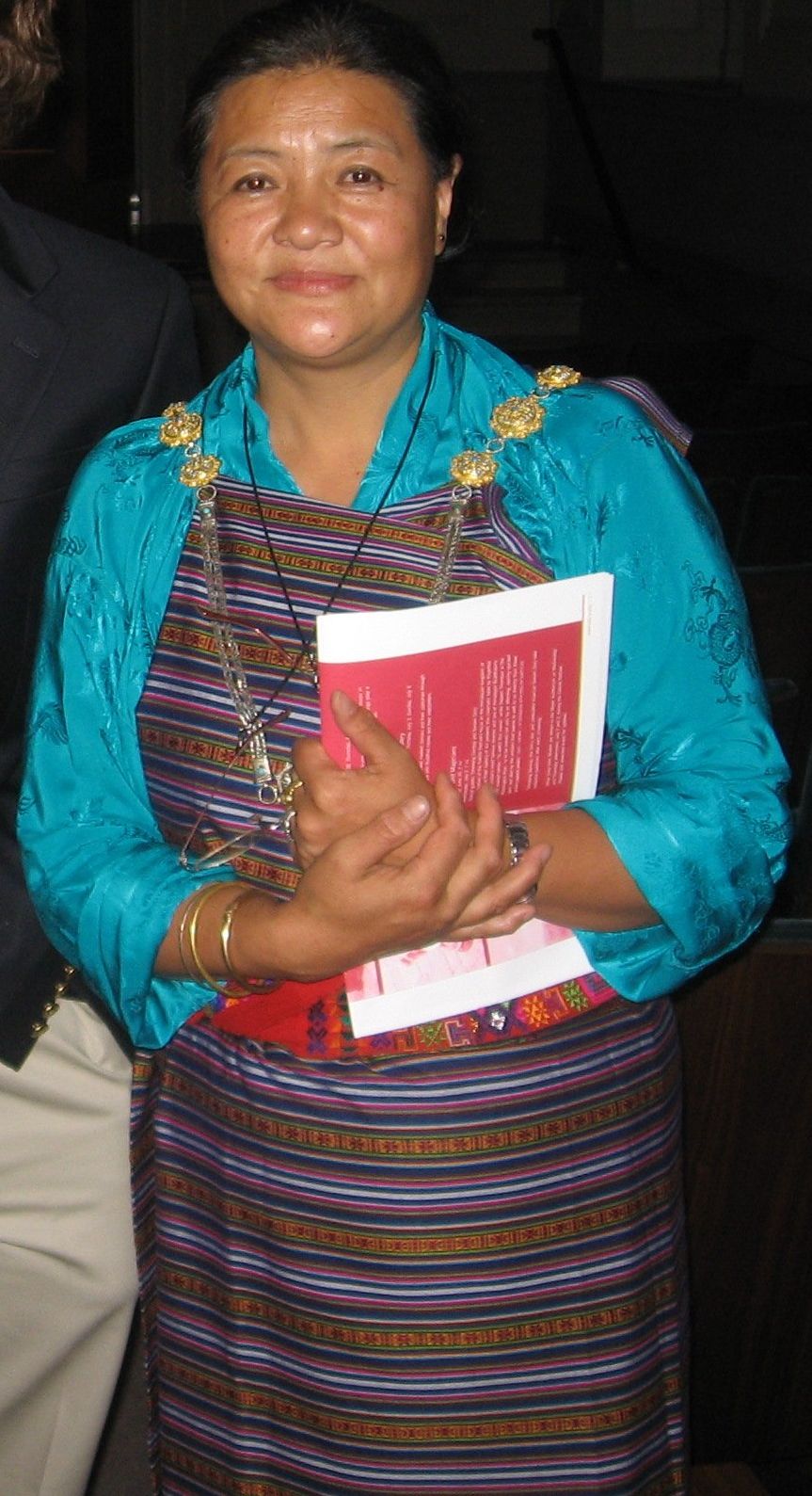
Kunzang Choden (born 1952) is a Bhutanese writer and folklorist widely regarded as Bhutan's first female novelist. Her works — including the landmark novel "The Circle of Karma" (2005) and the folklore collections "Bhutanese Tales of the Yeti" and "Folktales of Bhutan" — have played a pioneering role in documenting Bhutanese oral traditions and bringing Bhutanese women's experiences to international literary audiences.

Kunzang Choden (born 1952, Bumthang, Bhutan) is a Bhutanese author, folklorist, and cultural commentator who holds the distinction of being Bhutan's first female novelist. Her body of work — spanning fiction, folklore collection, and cultural writing — represents a singular contribution to Bhutanese literature and to the broader project of documenting and preserving Bhutan's intangible cultural heritage. Writing in English, Choden has introduced international audiences to the inner world of Bhutanese society, particularly the experiences of women in a traditional Buddhist kingdom undergoing rapid modernization.
Choden's most celebrated work, the novel The Circle of Karma (2005), follows the life of a Bhutanese woman named Tsomo across decades and across the Himalayan landscape, tracing her journey from a rural village through marriage, loss, pilgrimage, and ultimately a hard-won independence. The novel was the first full-length work of fiction published by a Bhutanese woman and has been widely read in Bhutan, South Asia, and beyond. Her folklore collections — Bhutanese Tales of the Yeti (1997) and Folktales of Bhutan (1994) — are foundational texts in the documentation of Bhutanese oral traditions.
In a country where literary culture has historically been dominated by religious texts in Dzongkha and Chhoekay (Classical Tibetan), Choden's emergence as a secular writer working in English represents a quiet revolution. Her work bridges the traditional and the modern, the oral and the written, the local and the global, making her one of the most important cultural figures in contemporary Bhutan.
Early Life and Education
Kunzang Choden was born in 1952 in Bumthang, one of the most culturally rich and historically significant districts of central Bhutan. She grew up in a traditional Bhutanese household surrounded by the oral storytelling culture that would later become central to her literary work. The stories she heard from her grandmother and other family elders — tales of yetis, demons, animal tricksters, divine interventions, and the moral complexities of human life — formed a repository of narrative material that she would draw upon throughout her career.
Choden received her early education in Bhutan and India, part of the first generation of Bhutanese women to access formal Western-style schooling. She subsequently studied in the United States and Canada, earning a degree in anthropology that equipped her with the scholarly frameworks and methodological tools for the cultural documentation work that would become her life's project. Her time abroad also gave her the outsider's perspective on her own culture — the ability to see what was distinctive, valuable, and at risk of being lost in the currents of modernization.
Returning to Bhutan, Choden combined family responsibilities with a growing commitment to documenting the oral traditions and cultural practices she saw changing around her. She undertook extensive fieldwork, travelling to remote villages to record stories, songs, and accounts of traditional practices from elderly informants. This work was driven by a sense of urgency: the rapid changes sweeping Bhutan — roads, television, formal education, urbanization — were transforming the conditions that had sustained oral culture for centuries.
Folklore Collections
Folktales of Bhutan (1994) was Choden's first major publication and one of the first systematic collections of Bhutanese oral literature in English. The book presents a curated selection of tales drawn from different regions of Bhutan, organized thematically and accompanied by contextual notes that situate each story within Bhutanese cultural and religious life. The tales range from origin myths and religious legends to animal fables, ghost stories, and humorous anecdotes about the trickster figure Apa Zhonnu.
Bhutanese Tales of the Yeti (1997) focuses on one of the most distinctive elements of Bhutanese folklore: the migoi, the Himalayan wild man known in Western popular culture as the yeti or abominable snowman. Choden's collection approaches the migoi not as a cryptozoological curiosity but as a figure of deep cultural significance in Bhutanese mountain communities. The stories she collected reveal the migoi as a complex symbolic figure — sometimes threatening, sometimes beneficent, always marking the boundary between the human and the wild, the civilized and the untamed. The book is both an important folkloric document and a thoughtful meditation on the relationship between Bhutanese communities and the wild landscapes that surround them.
Both collections are notable for their fidelity to the oral sources. Choden was scrupulous about recording stories in the words of her informants, preserving dialectal variations and narrative structures that a more interventionist editor might have smoothed away. This approach gives her collections an authenticity and ethnographic value that distinguishes them from more literary retellings of folk material.
The Circle of Karma
The Circle of Karma, published in 2005 by Zubaan Books (New Delhi), is Choden's most ambitious and widely discussed work. The novel tells the story of Tsomo, born into a rural Bhutanese family in the mid-20th century, whose life unfolds across a landscape of social constraint, personal loss, and eventual self-determination. The narrative follows Tsomo from her childhood in a patriarchal household through an arranged marriage, widowhood, migration, a second marriage, and a spiritual journey that takes her across Bhutan and into India.
The novel's title refers to the Buddhist concept of karma — the accumulated effects of one's actions across lifetimes — and the circular, repetitive quality of suffering in the absence of spiritual awakening. Tsomo's life illustrates the operation of karma not as an abstract philosophical principle but as a lived reality: the ways in which social structures, gender expectations, and personal choices create patterns of suffering and resilience that echo across generations.
The Circle of Karma is distinguished by its unflinching depiction of the challenges faced by women in traditional Bhutanese society: limited access to education, vulnerability within marriage, economic dependence, and the weight of patriarchal expectations. Choden does not idealize Bhutanese tradition or demonize it; she presents it with the complexity and ambivalence of lived experience. The novel's feminism is embedded rather than polemical, arising from the careful observation of women's lives rather than from ideological argument.
The book received significant critical attention in South Asia and among scholars of Himalayan literature. It has been adopted as a text in university courses on South Asian literature, gender studies, and Buddhist culture, and has been translated into several languages. For many international readers, it remains the primary point of access to the interior world of Bhutanese women's experience.
Themes and Contributions
Several themes recur across Choden's body of work. The first is the centrality of women's experience. In a literary landscape dominated by male voices — whether the religious scholars of the monastic tradition or the political and administrative figures of modern Bhutan — Choden consistently foregrounds women's perspectives, women's labour, women's knowledge, and women's spiritual lives. Her work makes visible a dimension of Bhutanese culture that has historically been underrepresented in published sources.
A second theme is the tension between tradition and modernity. Choden's writing registers the profound changes transforming Bhutanese society — the arrival of roads, electricity, television, formal education, and market economics — without either celebrating progress uncritically or romanticizing the traditional order. Her characters and stories inhabit the space between old and new, negotiating the demands of each with varying degrees of success and suffering.
A third theme is the spiritual dimension of everyday life. Choden's Bhutan is not a secularized space but one in which Buddhist beliefs and practices permeate daily existence — from the prayer flags on the hillside to the consultations with astrologers before major decisions to the understanding that one's current circumstances reflect the accumulated karma of past lives. Her writing conveys this spiritual saturation without exoticizing it, presenting it as the natural texture of the world her characters inhabit.
Legacy and Recognition
Kunzang Choden's significance extends beyond her individual publications. As a pioneer — the first Bhutanese woman to publish a novel, one of the first Bhutanese of either gender to produce secular literature in English — she opened a path for subsequent Bhutanese writers. The small but growing body of contemporary Bhutanese literature in English owes a foundational debt to Choden's demonstration that Bhutanese experience is valid literary material worthy of international attention.
Her folklore documentation work has had a direct impact on cultural preservation efforts. The stories she recorded from elderly informants in the 1980s and 1990s would in many cases have been lost to the natural attrition of oral culture as storytellers pass away and younger generations grow up in a media-saturated environment. Her collections serve as repositories of cultural memory, available to future generations of Bhutanese who may wish to reconnect with their oral heritage.
Choden has also contributed to cultural discourse in Bhutan through public speaking, participation in cultural policy discussions, and mentorship of younger writers and researchers. She has received recognition from the Bhutanese government and from international cultural organizations for her contributions to literature and cultural preservation.
Her work has particular resonance for the Bhutanese diaspora, including Lhotshampa communities resettled around the world, for whom questions of cultural preservation, identity, and the relationship between tradition and modernity are daily lived realities. While Choden writes from the perspective of Buddhist central Bhutan rather than the Lhotshampa south, the themes she explores — belonging, displacement, the search for identity in a changing world — speak to the universal dimensions of the Bhutanese experience.
Selected Works
- Folktales of Bhutan (1994)
- Bhutanese Tales of the Yeti (1997)
- The Circle of Karma (2005)
- Dawa: The Story of a Stray Dog in Bhutan (2013)
- Chilli and Cheese: Food and Society in Bhutan (2008)
See also
- Literary Works of Kunzang Choden
- Kunzang Choden
- Ashi Kesang Choden Wangchuck
- Ashi Sangay Choden Wangchuck
- Dorji Choden
References
- Choden, Kunzang. The Circle of Karma. Zubaan Books, 2005.
- Choden, Kunzang. Folktales of Bhutan. White Lotus Press, 1994.
- Choden, Kunzang. Bhutanese Tales of the Yeti. White Lotus Press, 1997.
- "Kunzang Choden." Wikipedia.
- Ura, Karma, and Sonam Kinga, eds. The Spider and the Piglet: Proceedings of the First International Seminar on Bhutan Studies. Centre for Bhutan Studies, 2004.
Contributed by Anonymous Contributor, Syracuse, New York
View online: https://bhutanwiki.org/articles/kunzang-choden-author · Content licensed CC BY-SA 4.0