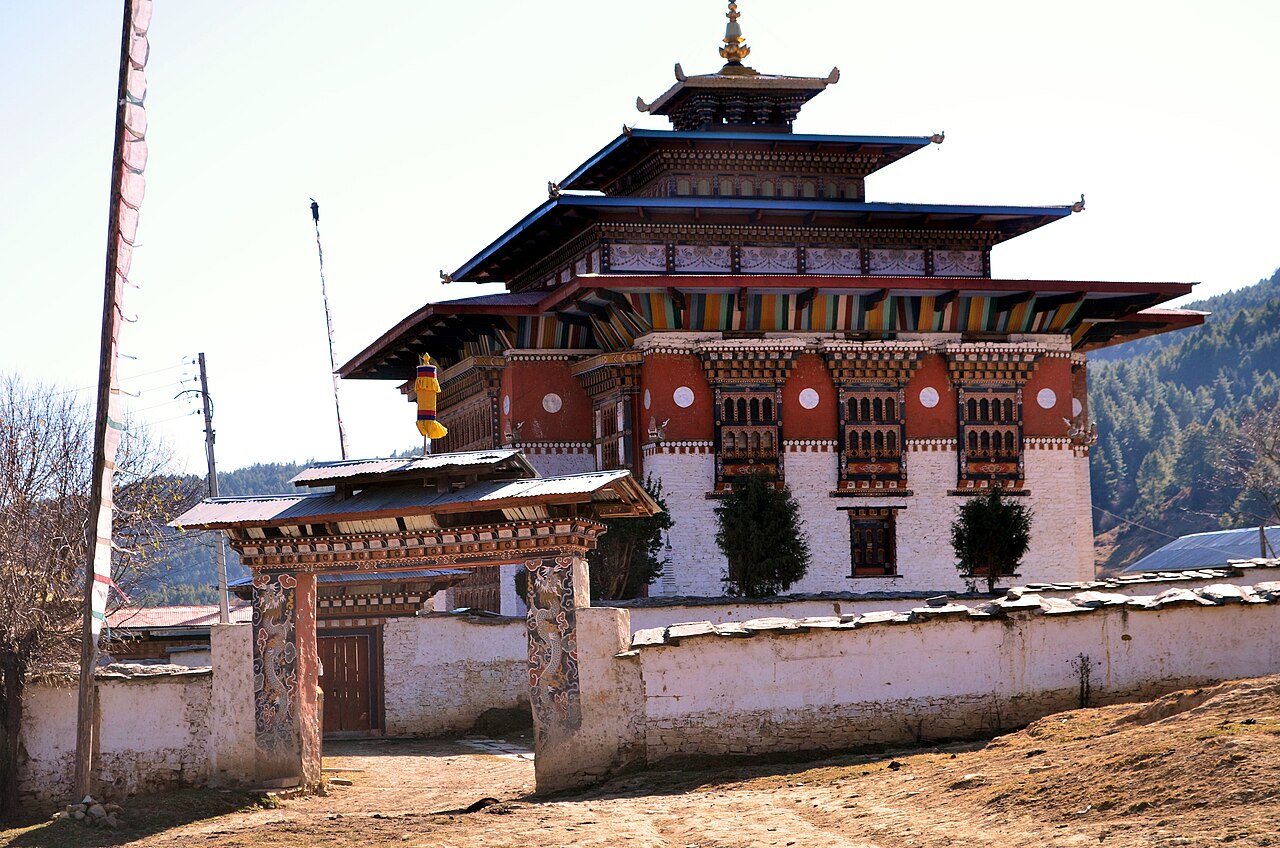

Ura Valley (Dzongkha: ཨུ་ར) is the easternmost and highest of the four valleys that make up Bumthang District in central Bhutan. Situated at an elevation of approximately 3,100 metres (10,170 feet) above sea level, Ura is the least visited of Bumthang's valleys, lying about 48 kilometres east of Jakar, the district capital. The valley is characterised by open, gently rolling terrain, broad pastures, and terraced fields of buckwheat and potatoes, giving it a markedly different appearance from the forested valleys to its west.[1]
The valley is home to a cluster of roughly 40 houses that form Ura village, one of the oldest settlements in Bumthang. The houses are built in the traditional Bhutanese style with rammed-earth walls, timber frames, and shingled roofs, and they are arranged in an unusually compact formation, giving Ura the appearance of a single, unified settlement rather than the dispersed hamlets typical of rural Bhutan. Above the village stands Ura Lhakhang, the valley's principal temple, which serves as the focal point of community religious life.[2]
Ura Valley is best known internationally for the Ura Yakchoe, an annual religious festival held in April or May that draws pilgrims and visitors from across Bhutan. The festival, which lasts five days, centres on the display of a sacred relic and features masked dances, communal feasting, and the strengthening of social bonds among the valley's inhabitants.
Geography and Climate
Ura Valley occupies a broad, relatively flat expanse at the eastern end of Bumthang District, bounded by mountain ridges that separate it from the Chumey and Tang valleys to the west. The valley floor sits between 3,000 and 3,200 metres in elevation, making it one of the highest permanently inhabited valleys in Bhutan. The surrounding mountains rise to over 4,000 metres, and the landscape transitions from temperate broadleaf forest at lower elevations to alpine meadows and rhododendron scrub at higher altitudes.[3]
The climate is cool and temperate, with cold winters that bring occasional snowfall and mild summers. Rainfall is moderate compared to Bhutan's southern lowlands, and the relatively dry conditions favour the cultivation of buckwheat, which has been the staple crop of Ura for centuries. The valley's pastures support yak herding, and semi-nomadic herders move their animals between seasonal grazing grounds in a pattern that has persisted for generations.
Ura Yakchoe Festival
The Ura Yakchoe is one of Bhutan's most important religious festivals and the defining cultural event of Ura Valley. Held annually in the fourth month of the Bhutanese lunar calendar (typically April or May), the festival commemorates the introduction of a sacred relic — believed to be a terma, or hidden treasure, revealed by the treasure-discoverer Longchenpa — to the valley. The festival lasts five days and centres on Ura Lhakhang, the village temple.[4]
During the Yakchoe, the entire community participates in a programme of masked dances (cham), religious ceremonies, and communal meals. Unlike larger tshechu festivals held at dzongs across Bhutan, the Ura Yakchoe retains a distinctly intimate, village-scale character. Families from throughout the valley gather at the temple, dressed in their finest traditional clothing, and the festival serves as much as a social occasion as a religious one. Women of the village traditionally prepare elaborate feasts of buckwheat noodles, dried yak meat, and local cheeses.[5]
The masked dances performed during the Yakchoe include both sacred dances depicting episodes from Buddhist mythology and folk dances unique to the Ura community. The festival concludes with the public display of a large thangka (religious scroll painting) and the bestowing of blessings upon the assembled pilgrims.
History and Religious Significance
Ura has been inhabited since at least the medieval period and has strong associations with the Buddhist saints who brought Vajrayana Buddhism to Bumthang. The valley's temples contain some of the oldest religious artefacts in the district, and local oral traditions trace the founding of Ura Lhakhang to the period following Guru Rinpoche's legendary visit to Bumthang in the eighth century.[6]
The valley was historically somewhat isolated from the rest of Bumthang due to the mountain passes that must be crossed to reach it. This isolation helped preserve Ura's distinctive cultural practices, dialect, and architectural traditions. The construction of the lateral road connecting Jakar to Mongar in the 1960s and 1970s brought Ura into closer contact with the rest of Bhutan, as the road passes through the valley on its way east.
Economy and Daily Life
Agriculture and animal husbandry remain the primary occupations of Ura's residents. Buckwheat, cultivated in terraced fields across the valley floor, is the principal crop and forms the basis of the local diet. Potatoes, introduced in the twentieth century, have become an important cash crop. Yak and cattle herding supplement agricultural income, and the production of butter, cheese, and dried meat remains integral to the local economy.[7]
In recent decades, Ura has begun to experience the effects of rural-to-urban migration, as younger residents seek employment and education in Thimphu and other towns. The Bhutanese government and cultural organisations have undertaken initiatives to preserve Ura's traditional architecture and cultural practices in the face of these demographic changes. Tourism, while still modest in scale, provides supplementary income to some households, particularly during the Yakchoe festival season.
Access and Tourism
Ura Valley is accessible by road from Jakar, a journey of approximately two hours along a winding mountain road that crosses the Ura La pass at 3,600 metres. The valley lies along the main east-west highway connecting Bumthang to Mongar and the eastern districts, making it a natural stopping point for travellers journeying across central and eastern Bhutan. Trekking routes connect Ura to neighbouring valleys and to alpine pastures above the treeline, offering opportunities for cultural and nature tourism in a relatively uncrowded setting.[8]
References
Related articles
Know something about this topic? Edit this article or . Anonymous contributions welcome — no account required.