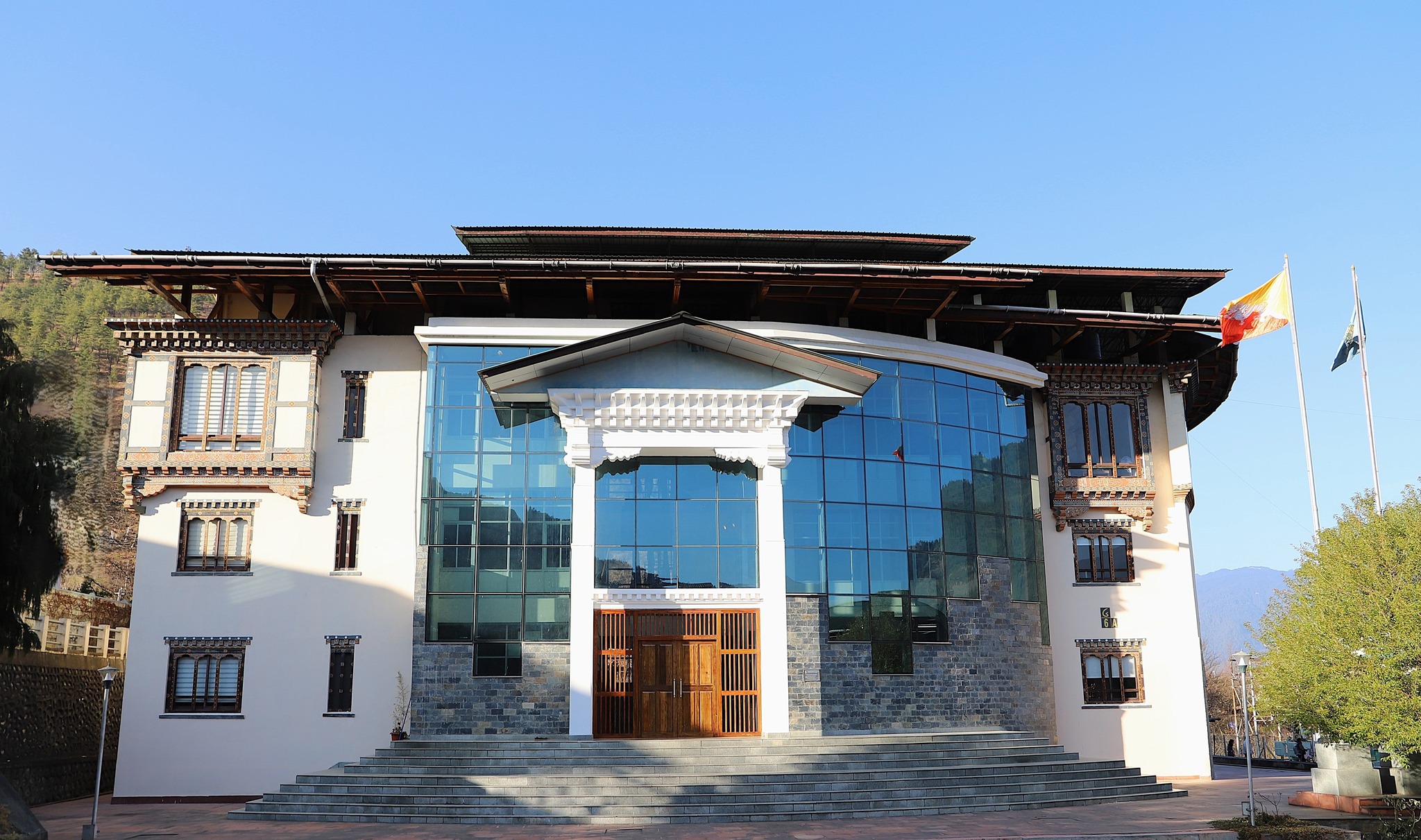
The Royal University of Bhutan (RUB; Dzongkha: འབྲུག་རྒྱལ་འཛིན་གཙུག་ལག་སློབ་སྡེ) is the national university of Bhutan and the country's primary institution of higher learning. Established by royal charter on 2 June 2003 under the vision of the Fourth King, Jigme Singye Wangchuck, RUB was created to consolidate Bhutan's existing tertiary institutions under a single university framework and to expand access to higher education domestically. The university is headquartered in Thimphu, while its constituent colleges are distributed across multiple districts, reflecting a deliberate policy to promote regional development and reduce the concentration of educational resources in the capital.[1]
Prior to the establishment of RUB, Bhutanese students seeking university degrees had to study abroad, primarily in India, where the Royal Government funded thousands of scholarships annually. While overseas education broadened the horizons of Bhutanese graduates, it also placed a heavy financial burden on the state and contributed to brain drain. The creation of a national university was intended to address these challenges, build domestic research capacity, and anchor higher education within Bhutan's cultural and developmental context, particularly the philosophy of Gross National Happiness.[2]
Organisational Structure
RUB operates as a federated university, meaning it does not have a single centralised campus but rather functions through a network of constituent colleges, each with its own campus, administration, and academic focus. The university is governed by a University Council chaired by a royal appointee, and academic affairs are coordinated through a central Office of the Vice Chancellor in Thimphu. Each constituent college maintains a degree of autonomy in its academic programmes while adhering to university-wide standards for curriculum, assessment, and quality assurance.[2]
The Vice Chancellor serves as the chief executive officer of the university. The position has been held by several distinguished Bhutanese academics and administrators since the university's inception. The Registrar's Office manages admissions, examinations, and student records across all constituent colleges.
Constituent Colleges
As of the mid-2020s, RUB comprises ten constituent colleges, most of which predate the university's establishment and were originally independent government-run institutes:
Paro College of Education (Paro) is one of the oldest tertiary institutions in Bhutan, originally established in 1968 as the National Institute of Education. It offers bachelor's and postgraduate degrees in education, training the majority of Bhutan's schoolteachers. Samtse College of Education (Samtse) serves a similar function and was established in 1983 to meet the growing demand for trained teachers.[1]
College of Science and Technology (Phuentsholing) is Bhutan's primary engineering and technology institution, offering degrees in civil, electrical, electronic, and information technology disciplines. It was established in 2001 with support from the Indian government. College of Natural Resources (Lobesa, Punakha) focuses on agriculture, animal science, and forestry, reflecting the importance of these sectors to Bhutan's predominantly rural economy.[2]
Gedu College of Business Studies (Gedu, Chukha) is the country's primary business school, offering programmes in commerce, finance, and management. Sherubtse College (Kanglung, Trashigang) is the oldest degree-granting institution in Bhutan, established in 1966 with Jesuit support and affiliated with the University of Delhi until RUB's formation. It offers degrees in arts, sciences, and commerce and is widely regarded as one of Bhutan's most prestigious academic institutions.[3]
Jigme Namgyel Engineering College (Dewathang, Samdrup Jongkhar) was established in 1974 as a polytechnic and now offers diploma and degree programmes in engineering. College of Language and Culture Studies (Taktse, Trongsa) is dedicated to the study and preservation of Dzongkha, Choekey (Classical Tibetan), Buddhist studies, and Bhutanese cultural heritage. It plays a critical role in training Dzongkha teachers and cultural professionals.[2]
Khesar Gyalpo University of Medical Sciences of Bhutan (KGUMSB), formerly the Faculty of Nursing and Public Health and the Faculty of Traditional Medicine, was elevated to an independent medical university in 2014 but maintains close ties with RUB. It trains nurses, public health professionals, and practitioners of Sowa Rigpa (traditional Bhutanese medicine). Gyalpozhing College of Information Technology (Mongar) is among the newer additions, established to expand IT education in eastern Bhutan.[1]
Academic Programmes and Research
RUB offers a range of undergraduate degrees, primarily Bachelor of Arts, Bachelor of Science, Bachelor of Engineering, Bachelor of Education, and Bachelor of Business Administration. Postgraduate programmes, including Master's degrees and postgraduate diplomas, have been progressively introduced, though the range remains limited compared to universities in neighbouring countries. Several colleges offer diploma and certificate programmes in technical and vocational fields.[2]
Research at RUB has grown steadily, with faculty and students publishing in areas such as renewable energy, biodiversity, traditional medicine, Bhutanese linguistics, and GNH-related social science. The university maintains research partnerships with institutions in India, Australia, Japan, Thailand, and Europe. However, research output remains constrained by limited funding, heavy teaching loads, and the small size of the academic community.
Challenges and Future Directions
RUB faces several significant challenges. Enrolment demand far exceeds available seats, and many qualified students are turned away each year. Faculty recruitment and retention are persistent difficulties, as Bhutan's small pool of PhD-holders and the relatively modest academic salaries make it hard to compete with opportunities abroad or in the private sector. Infrastructure at some colleges, particularly in remote eastern locations, requires substantial investment.[4]
Youth unemployment among university graduates has become a growing concern, prompting calls for curriculum reform to better align academic programmes with labour market demands. The university has responded by introducing more vocationally oriented programmes and strengthening partnerships with industry. Internationalisation is another priority, with RUB seeking to attract foreign students and expand exchange agreements with overseas universities.
Despite these challenges, the Royal University of Bhutan has fundamentally transformed higher education in the country. In two decades, it has grown from a loose collection of small institutes into a functioning national university that produces the majority of Bhutan's teachers, engineers, scientists, and business professionals, anchoring the nation's human resource development within its own borders.
2022–23 removal of Arts-stream courses
In 2022 and 2023 the Royal University of Bhutan removed or sharply reduced Arts and Humanities programmes from its government colleges, a policy change that closed the higher-education pathway for thousands of Class XII Arts-stream graduates. At Sherubtse College — the country’s oldest — affected programmes included the BA in Dzongkha, BA in English, BA in Media Studies and BA in History, alongside the BA in Population and Development Studies and several science degrees (BSc in Geography, Environmental Science, Computer Science and Statistics). Of the 13,373 candidates who sat the Bhutan Higher Secondary Education Certificate examination in 2022, some 6,543 were Arts-stream students, leaving more than 6,000 graduates in a single cohort searching for options. (Source: The Bhutanese.)
In June 2026 the government announced a Nu 237.5 million (~USD 2.8 million) remediation package — delivered through scholarships and education-loan schemes — for the two stranded cohorts. The episode drew criticism as a reversal that abolished established disciplines by administrative decision rather than letting student demand determine which courses survived. (Source: Kuensel; The Bhutanese, 1 June 2026.)
References
Related articles
Know something about this topic? Edit this article or . Anonymous contributions welcome — no account required.