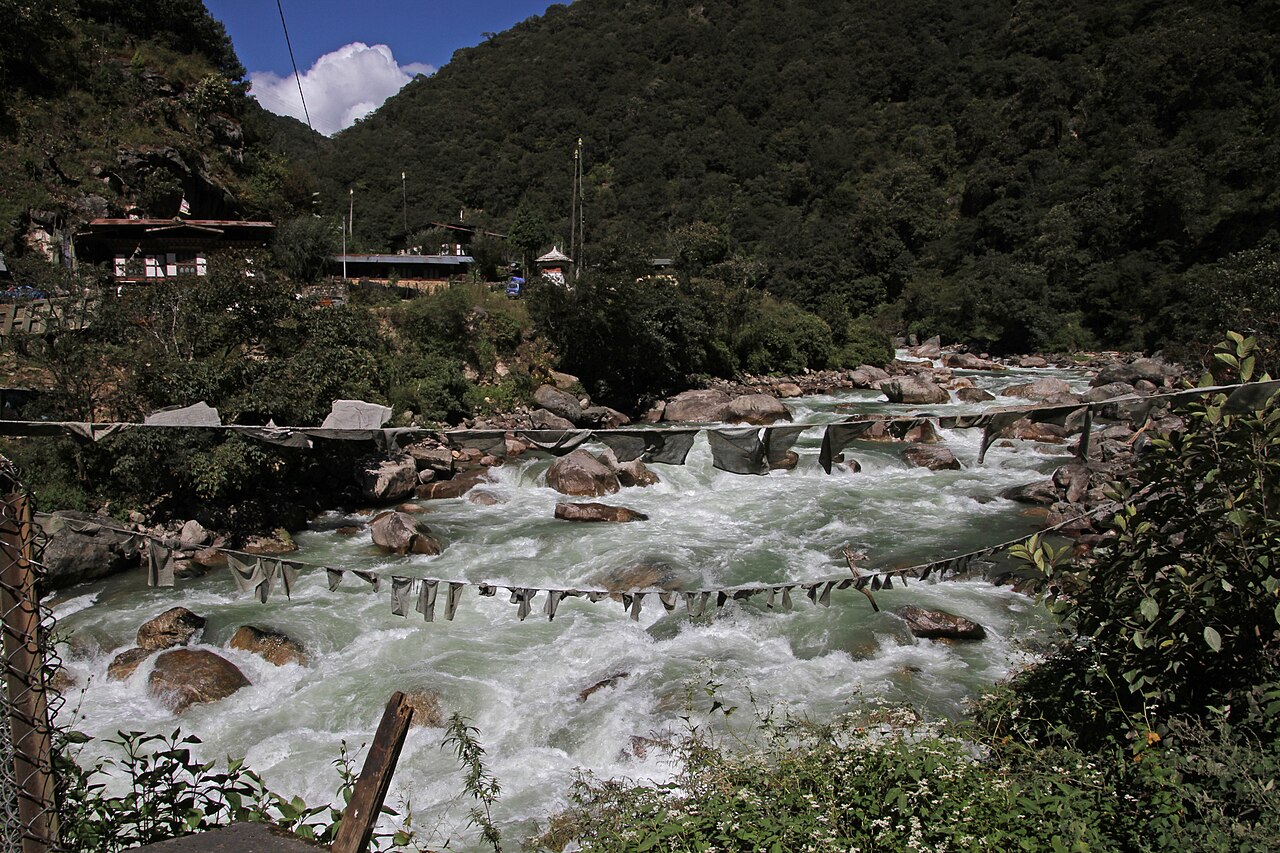

The Mangde Chhu (Dzongkha: མང་སྡེ་ཆུ) is one of the principal rivers of central Bhutan, flowing through the districts of Trongsa and Zhemgang before crossing into the Indian state of Assam, where it is known as the Manas River. With a total drainage area of approximately 2,700 square kilometres within Bhutan, the Mangde Chhu is a major component of the Manas River system, which ultimately feeds into the Brahmaputra. The river's deep gorge has historically served as a natural boundary between eastern and western Bhutan, making it one of the most geographically and politically significant waterways in the country.[1]
In the twenty-first century, the Mangde Chhu has gained international prominence as the site of the Mangdechhu Hydroelectric Project, a 720-megawatt run-of-the-river power station completed in 2019. This facility is one of the largest hydropower installations in Bhutan and exemplifies the country's strategy of leveraging its abundant water resources for economic development through electricity exports to India. The project has been a centrepiece of Indo-Bhutanese bilateral cooperation and a significant contributor to Bhutan's national revenue.[2]
The river flows through some of the most biodiverse terrain in Bhutan, descending from alpine meadows and coniferous forests at elevations above 4,000 metres to subtropical broadleaf forests below 1,000 metres. This dramatic altitudinal range makes the Mangde Chhu basin a hotspot for ecological diversity, supporting species ranging from the red panda and golden langur to a rich variety of orchids and rhododendrons.[3]
Geography and Course
The Mangde Chhu originates in the high-altitude regions of Wangchuck Centennial National Park in the northern reaches of Trongsa district. Its headwaters are fed by snowmelt and glacial runoff from peaks exceeding 5,000 metres. The river flows generally southward, carving a deep and narrow gorge through the central Bhutanese highlands. This gorge, which reaches depths of over 2,000 metres in some sections, creates one of the most dramatic landscapes in the eastern Himalayas.[4]
The river passes below Trongsa Dzong, the ancestral seat of the Wangchuck dynasty, which perches on a ridge high above the gorge. The dzong's commanding position above the Mangde Chhu allowed its rulers to control all east-west movement through Bhutan, as the only viable route between the two halves of the country crossed the river at this point. This geographic chokepoint was instrumental in the political consolidation of Bhutan under the Trongsa penlops (governors) who eventually became the country's monarchs.[5]
Below Trongsa, the Mangde Chhu continues southward through Zhemgang district, passing through increasingly subtropical terrain. The river eventually enters the southern foothills, where it joins other tributaries before crossing into India. On the Indian side, the combined waterway is known as the Manas River, a name derived from the Hindu goddess Manasa. The Manas flows through the Royal Manas National Park, a transboundary protected area shared between Bhutan and India.[6]
Mangdechhu Hydroelectric Project
The Mangdechhu Hydroelectric Project (MHEP) is a 720 MW run-of-the-river hydropower station located on the Mangde Chhu in Trongsa district. The project was developed as a bilateral initiative between the governments of Bhutan and India, with India's NHPC Limited serving as the lead construction partner. Construction began in 2012, and the plant was commissioned in stages between 2019 and 2020. The total project cost was approximately INR 43.54 billion (roughly USD 530 million), financed through a combination of Indian government grants (70 per cent) and loans (30 per cent).[7]
The facility consists of a 50-metre-high concrete gravity dam, a 12.7-kilometre headrace tunnel, an underground powerhouse containing four 180 MW Francis turbines, and a 2.5-kilometre tailrace tunnel. As a run-of-the-river project, it does not create a large storage reservoir, instead diverting water through the turbines and returning it to the river downstream. This design reduces the environmental impact compared to large-dam projects, though it also means that power generation is subject to seasonal variations in river flow.[8]
The MHEP is one of several major hydropower projects that form the backbone of Bhutan's economy. Electricity from the plant is primarily exported to India under a bilateral power purchase agreement, generating significant revenue for the Bhutanese government. The project was honoured with the Brunel Medal from the Institution of Civil Engineers in 2020 for excellence in civil engineering.[9]
Historical Significance
The Mangde Chhu gorge has shaped Bhutanese history by functioning as a natural barrier between the country's eastern and western regions. Before the construction of modern roads in the twentieth century, crossing the gorge required arduous descents and ascents along steep footpaths. The Trongsa penlops, who controlled the only practicable crossing point, leveraged this geographic advantage to become the most powerful regional rulers in Bhutan. Jigme Namgyal, the father of Bhutan's first king Ugyen Wangchuck, consolidated his authority from Trongsa in the mid-nineteenth century, and the Trongsa penlop's seat remains a title held by the Crown Prince of Bhutan to this day.[10]
Ecology and Conservation
The Mangde Chhu basin encompasses a remarkable range of ecosystems due to its extreme altitudinal gradient. The upper catchment lies within Wangchuck Centennial National Park, while the lower reaches flow through Jigme Singye Wangchuck National Park and towards the Royal Manas National Park at the Indian border. These protected areas form part of Bhutan's extensive network of biological corridors, ensuring habitat connectivity for wide-ranging species such as the tiger, clouded leopard, and Asian elephant.[11]
The river itself supports populations of golden mahseer and other freshwater fish species. Conservation organisations have identified the Mangde Chhu as a priority basin for freshwater biodiversity protection, particularly in the context of hydropower development. Environmental impact assessments for the MHEP included provisions for maintaining minimum environmental flows and constructing fish passage facilities, though the effectiveness of these measures remains a subject of ongoing study.
References
- "Mangde Chhu." Wikipedia.
- "Mangdechhu Hydroelectric Project." Wikipedia.
- "Mangde Chhu Basin." WWF Bhutan.
- "Trongsa District." Wikipedia.
- "Trongsa Dzong." Wikipedia.
- "Manas River." Wikipedia.
- "Mangdechhu Hydroelectric Project." Wikipedia.
- "Mangdechhu Hydroelectric Project." Wikipedia.
- "Mangdechhu Hydroelectric Project wins Brunel Medal." Institution of Civil Engineers, 2020.
- "Trongsa Dzong." Wikipedia.
- "Mangde Chhu Basin." WWF Bhutan.
- Mangde Chhu — Wikipedia
- Bhutan — River Systems — US Library of Congress Country Studies
- Mangdechhu Hydroelectric Project — Power Technology
- Mangdechhu — Druk Green Power Corporation
- Mangdechhu Hydroelectric Project Authority — official site
- Bhutan DGPC handed keys to 720 MW Mangdechhu hydro project — Business Standard
- DGPC takes over 720 MW Mangdechhu hydropower plant — Renewable Energy World
Related articles
Know something about this topic? Edit this article or . Anonymous contributions welcome — no account required.