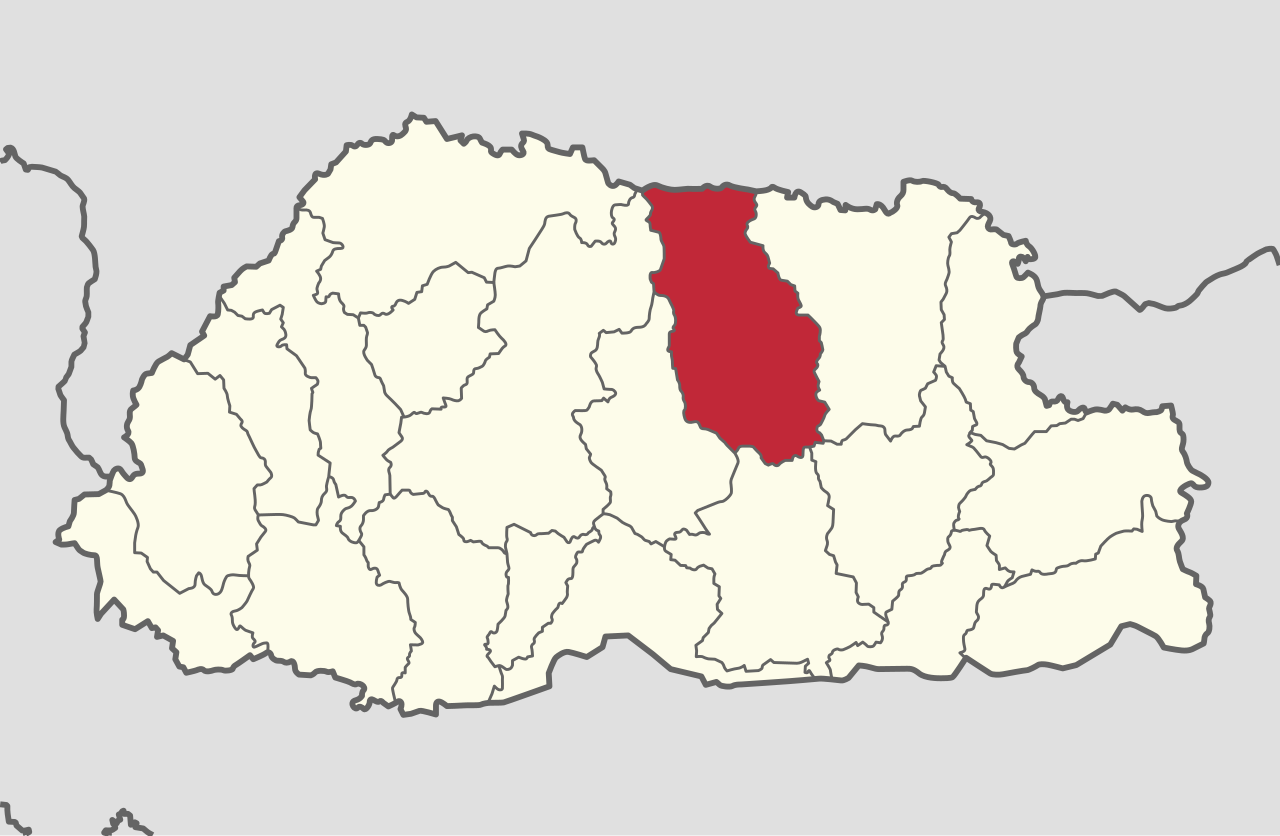

The Kingdom of Bumthang was an early independent polity in central Bhutan, centered in what is today the Bumthang Dzongkhag. It is considered one of the oldest and most historically significant of the small kingdoms and chiefdoms that existed in the region prior to the unification of Bhutan under Zhabdrung Ngawang Namgyal in the 17th century. The valley of Bumthang, known as the "Spiritual Heartland of Bhutan," served as the setting for some of the most important events in Bhutanese Buddhist history.[1]
The kingdom is most closely associated with Sindhu Raja, an 8th-century king who is credited with inviting Padmasambhava (Guru Rinpoche) to Bumthang — an event that tradition holds as the beginning of Buddhism's firm establishment in Bhutan. The rulers of Bumthang claimed divine origins, and the kingdom served as a major center of religious and political power for centuries before its incorporation into the unified Bhutanese state.
Geography and Significance
Bumthang is located in the central highlands of Bhutan, comprising four main valleys: Chokhor, Tang, Ura, and Chhume. The region sits at an elevation of approximately 2,600 meters and is characterized by broad, fertile valleys surrounded by forested mountains. Its strategic location at the crossroads of trade routes connecting eastern and western Bhutan made it a natural center of political and economic activity in pre-modern times.[2]
The name "Bumthang" is traditionally interpreted as meaning either "beautiful field" (bum meaning "beautiful" or "girl," thang meaning "field" or "plain") or as a reference to the sacred bumpa (ritual vase) shape of the valley. The region remains one of the most culturally rich areas of Bhutan, home to numerous ancient temples and monasteries.
Early History and the Pre-Buddhist Period
Archaeological evidence and oral traditions suggest that the Bumthang valley has been inhabited since ancient times. Before the arrival of Buddhism, the region was home to practitioners of the indigenous Bon religion, which venerated nature spirits and local deities. Small, independent chiefdoms emerged in the valley by at least the early centuries of the Common Era, governed by petty kings or chiefs (deb) who exercised authority over limited territories.
The first significant Buddhist contact with Bumthang is traditionally dated to the 7th century, when the Tibetan emperor Songtsen Gampo (c. 604-650 CE) is said to have ordered the construction of Buddhist temples across the Himalayan region as part of a vast geomantic project. Two of these temples were reportedly built in Bhutan: Kyichu Lhakhang in the Paro Valley and Jampa Lhakhang in the Bumthang Valley. While the historical veracity of this attribution is debated by scholars, Jampa Lhakhang remains one of the oldest and most sacred temples in Bhutan.[3]
Sindhu Raja and the Arrival of Padmasambhava
The most pivotal episode in the history of the Kingdom of Bumthang centers on Sindhu Raja (also called Sendha Gyab or Künjom), an Indian king who, according to tradition, had been exiled from his homeland and established a court at Chakhar Gutho Palace in the Chokhor Valley. Sindhu Raja is dated to approximately the mid-8th century CE.[4]
According to Bhutanese tradition, Sindhu Raja became embroiled in a conflict with Nawuchhe (or Naochhe), another Indian king ruling to the south. During this conflict, Sindhu Raja fell gravely ill, his life force (la) having been stolen by a powerful local deity named Shelging Karpo, who had been offended by the king's actions. Unable to find a cure through ordinary means, Sindhu Raja was advised to invite the great tantric master Padmasambhava from Tibet.
Padmasambhava traveled to Bumthang and, through elaborate tantric rituals, subdued the malevolent deity, recovered the king's life force, and restored his health. The king converted to Buddhism, and Padmasambhava established several sacred sites in the Bumthang region, including the famous Kurjey Lhakhang, where the imprint of his body is said to be preserved in a rock face. This event is traditionally regarded as the moment when Buddhism was firmly established in Bumthang and, by extension, in Bhutan as a whole.[5]
Post-Sindhu Raja Period
After Sindhu Raja's conversion, the Kingdom of Bumthang continued to function as an independent polity for several centuries. The region produced or attracted numerous important religious figures, including Pema Lingpa (1450-1521), the great treasure revealer who was born in the Tang Valley and whose descendants would eventually establish the Wangchuck dynasty.
By the early 9th century, several small independent kingdoms had developed across what is now Bhutan, each ruled by petty kings who often claimed divine or semi-divine origins. The Kingdom of Bumthang was the most prominent among these, but it coexisted with other small polities in the Paro, Haa, and eastern valleys. This fragmented political landscape persisted for centuries, with periodic conflicts and shifting alliances among the various chiefdoms.
Incorporation into Unified Bhutan
The independence of the Kingdom of Bumthang ended with the arrival of Zhabdrung Ngawang Namgyal, a Tibetan lama of the Drukpa Kagyu school who fled Tibet in 1616 and began the process of unifying the disparate valleys of Bhutan under a single theocratic state. The Zhabdrung established a system of fortified administrative centers (dzongs) across the country and appointed governors to administer the regions on his behalf.
Bumthang was brought under the Zhabdrung's control through a combination of military force and religious diplomacy, with his lieutenant Chogyal Minjur Tenpa playing a key role in establishing authority over central and eastern Bhutan. The Jakar Dzong, built in the Bumthang Valley, became the administrative seat of the new government's authority in the region. While the old ruling families lost their political independence, Bumthang retained its status as a spiritual heartland of the nation.[6]
References
- Wikipedia. "Kingdom of Bumthang." en.wikipedia.org.
- Bumthang Dzongkhag Administration. "History." bumthang.gov.bt.
- Wikipedia. "History of Bhutan." en.wikipedia.org.
- Wikipedia. "Kingdom of Bumthang." en.wikipedia.org.
- Wikipedia. "Kingdom of Bumthang." en.wikipedia.org.
- Wikipedia. "History of Bhutan." en.wikipedia.org.
Related articles
Know something about this topic? Edit this article or . Anonymous contributions welcome — no account required.