Ging Tsholing Cham (Dance of the Terrifying Deities)
From BhutanWiki, the people's encyclopedia of Bhutan · culture · Verified
.jpg)
Ging Tsholing Cham (Dzongkha: གིང་ཚོགས་གླིང་འཆམ་), commonly translated as the Dance of the Terrifying Deities, is a major cham dance performed at tshechu festivals throughout Bhutan. The dance is a spectacular enactment of the celestial realm of Guru Rinpoche (Padmasambhava) on the Zangdopelri — the Copper-Coloured Mountain — which is the paradisiacal pure land where the great master is believed to reside. The performance features two distinct groups of dancers, the Ging and the Tsholing, who together depict the retinue of enlightened beings that populate Guru Rinpoche's realm and carry out his enlightened activity in the world.[1]
The dance is closely associated with the Nyingma school of Tibetan Buddhism, the oldest lineage and the dominant tradition in Bhutan, which venerates Guru Rinpoche as its founding master. Ging Tsholing Cham serves both as an act of devotion to Guru Rinpoche and as a ritual invocation of his protective power, which is believed to shield practitioners and lay communities from physical and spiritual harm.[2]
The Ging and the Tsholing
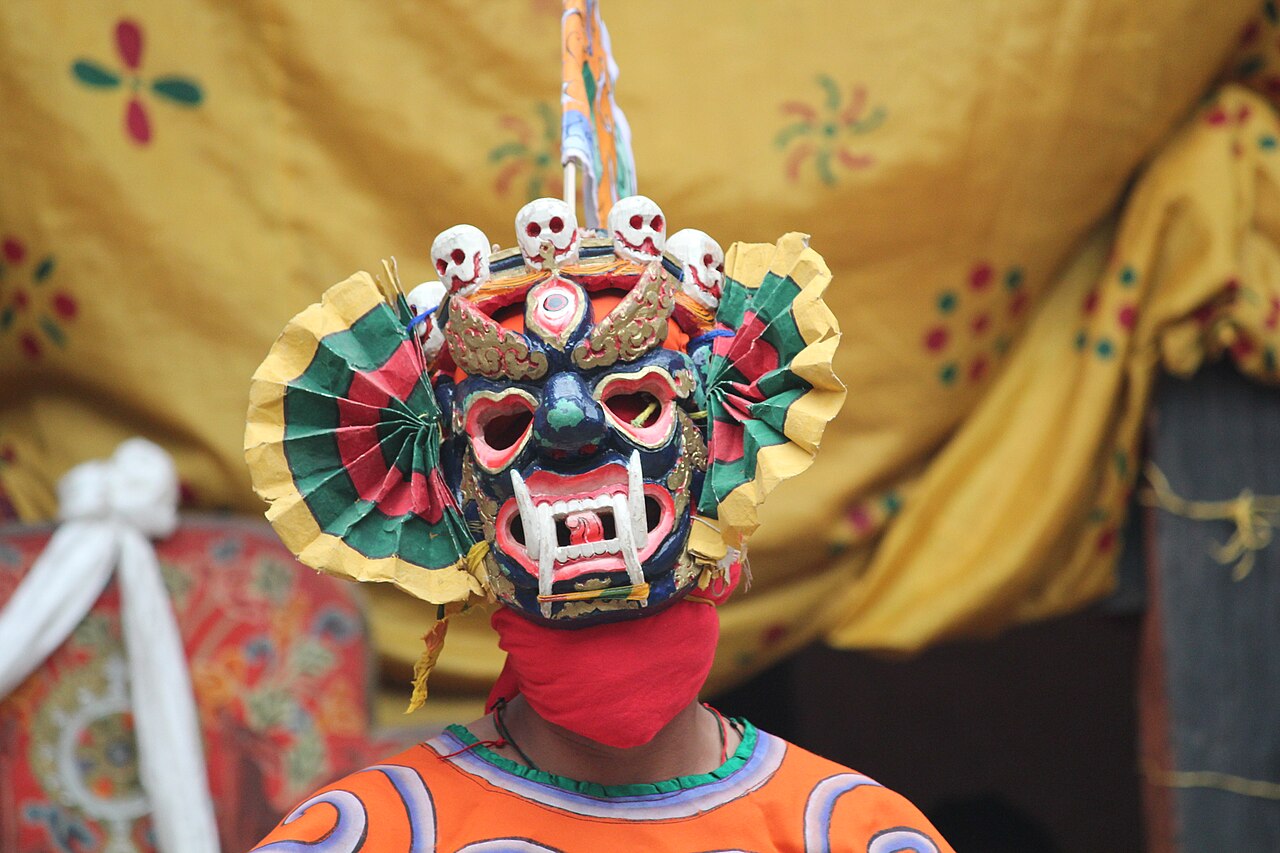
The two groups of performers that give the dance its name represent distinct categories of celestial beings. The Ging are terrifying, wrathful figures — divine warriors and protectors who serve Guru Rinpoche as his retinue. They wear fearsome masks with bulging eyes, flaming eyebrows, and snarling mouths, and their costumes feature bold colours and martial accessories. The Ging carry drums and drumsticks, which they beat with tremendous energy as they dance, and their movements are characterised by powerful, athletic leaps and aggressive gestures that symbolise the wrathful compassion of enlightened beings who destroy obstacles to the dharma.
The Tsholing, by contrast, represent a diverse assembly of beings from various realms of existence who have gathered in Guru Rinpoche's paradise. They wear animal masks — deer, bulls, elephants, garuda birds, snow lions, and mythical creatures — as well as masks of various spirits and supernatural beings. Their movements tend to be more varied and playful than those of the Ging, reflecting the diversity of forms through which enlightened activity manifests. Together, the Ging and Tsholing create a panoramic tableau of the entire cosmos of Guru Rinpoche's pure land.[3]
Guru Rinpoche's Eight Manifestations
A central theme of the Ging Tsholing Cham is the depiction of Guru Rinpoche's eight manifestations (Guru Tsen Gye), through which he appeared in different forms to accomplish different aspects of his enlightened activity. These eight forms range from peaceful scholars to wrathful subjugators of demons, and they represent the full spectrum of methods that a Buddha may employ to benefit sentient beings. The eight manifestations are:
- Guru Tsokye Dorje — born from a lotus in Lake Dhanakosha
- Guru Shakya Senge — the monastic scholar who studied all Buddhist teachings
- Guru Pema Gyalpo — the king who taught dharma through royal authority
- Guru Pema Jungne — the tamer of spirits and converter of the Himalayan lands
- Guru Loden Chokse — the master of all knowledge and tantric arts
- Guru Nyima Ozer — the radiant yogi who dispelled darkness of ignorance
- Guru Senge Dradog — the lion-voiced wrathful emanation who defeated heretics
- Guru Dorje Drolo — the most wrathful form, who subdued the most powerful demons
In the Ging Tsholing Cham, these manifestations may be represented by specific dancers or invoked through the choreographic narrative, with different sections of the dance corresponding to different aspects of Guru Rinpoche's activity.[4]
Performance and Choreography
The Ging Tsholing Cham is one of the most physically demanding dances in the cham repertoire. The Ging dancers must maintain vigorous drumming while executing leaps, spins, and aggressive stamping movements, requiring considerable athletic ability and endurance. The dance is typically performed in a large open space — a dzong courtyard or monastery ground — to accommodate the large number of performers and their expansive movements.
The choreography follows a structure of advance and retreat, with the Ging and Tsholing moving in coordinated patterns that represent the dynamics of spiritual warfare — the confrontation between enlightened forces and the obstacles to dharma. At climactic moments, the two groups converge in a thunderous display of drumming and movement that symbolises the total victory of wisdom over ignorance. The visual and auditory impact of dozens of masked dancers moving in unison to the roar of drums and horns is overwhelming and is considered one of the high points of any tshechu.[5]
Spiritual Significance
The Ging Tsholing Cham serves multiple spiritual functions. As a depiction of Guru Rinpoche's pure land, the dance transforms the performance space into a temporary manifestation of Zangdopelri, allowing spectators to experience — even briefly — the atmosphere of an enlightened realm. This is considered a profound blessing, as Bhutanese Buddhists believe that even a momentary connection with a pure land can plant seeds of liberation in the mindstream.
The wrathful aspects of the dance — the fierce Ging warriors, the aggressive drumming, the combative choreography — embody the principle of wrathful compassion: the understanding that spiritual progress sometimes requires forceful intervention to overcome deeply entrenched obstacles. The Ging represent the enlightened anger that arises not from hatred but from an urgent compassion that will not tolerate the suffering caused by ignorance and negative forces.
The dance also invokes Guru Rinpoche's protective power on behalf of the community. Bhutanese Buddhists believe that the annual performance of Ging Tsholing Cham at their local tshechu renews the protective blessings that Guru Rinpoche established when he first brought Buddhism to the Himalayan region in the eighth century, shielding the community from natural disasters, epidemics, and hostile spiritual influences for another year.[6]
Costumes and Visual Elements
The visual richness of the Ging Tsholing Cham is extraordinary even by the high standards of Bhutanese cham. The Ging masks are carved to depict wrathful protector deities with exaggerated features — protruding eyes, flaming crowns of skulls, and mouths bared in fierce grimaces. The Tsholing masks offer a kaleidoscopic variety of animal and spirit forms, each painted in vivid colours and adorned with horsehair, feathers, or silk attachments. The costumes feature layered skirts, brocade aprons, and flowing scarves that create dynamic visual effects as the dancers spin and leap.
Cultural Preservation
The Ging Tsholing Cham, like other major cham traditions, is maintained through a combination of monastic training and state support. The Central Monastic Body oversees the correct performance of the dance at major tshechus, while the Royal Academy of Performing Arts documents and teaches the tradition to lay performers. As Bhutan navigates the pressures of modernisation, the Ging Tsholing Cham remains a vital expression of the country's spiritual heritage, connecting contemporary communities to the founding narrative of Guru Rinpoche's civilising mission in the Himalayan world.[7]
References
Related articles
Know something about this topic? Edit this article or . Anonymous contributions welcome — no account required.